
For most of its existence, Project Blue Book had a useful ally: an astronomer who could be counted on to provide respectable, scientific-sounding explanations for what people were reporting in the sky. Dr. J. Allen Hynek had been consulting for the Air Force’s UFO programs since the late 1940s, first for Project Sign, then Grudge, then Blue Book. He was the program’s credentialed shield – proof that a real scientist had reviewed the evidence and found nothing extraordinary.
Then, in the mid-1960s, Hynek started saying out loud what he’d been thinking quietly for years: Blue Book was broken, and the Air Force was more interested in closing files than finding answers.
His defection set off a chain reaction – congressional hearings, a compromised university study, a devastating memo leaked to the press, and the eventual shutdown of the program. The unraveling of Project Blue Book is a story about what happens when institutional credibility runs out.
The Swamp Gas Incident
The breaking point had a name that became a national punchline.
On March 20, 1966, dozens of witnesses in Dexter and Hillsdale, Michigan, reported luminous objects hovering over swampy terrain. The witnesses included police officers, civil defense personnel, and students at Hillsdale College who watched the lights from a dormitory window. The sightings made national news.
The Air Force sent Hynek to investigate. Under pressure from Blue Book leadership to provide a quick explanation, Hynek held a press conference and suggested the lights might have been caused by “swamp gas” – methane from decaying vegetation that occasionally ignites.
The reaction was immediate and brutal. The press mocked it. Witnesses were furious. Michigan Congressman Gerald Ford – future president – called for congressional hearings, saying:
“The American public deserves a better explanation than that given by the Air Force.”
Hynek later said the swamp gas explanation was offered as one possible factor for some of the sightings, not as a blanket answer. But the damage was done. The phrase became shorthand for everything people distrusted about Blue Book: pat answers, institutional arrogance, and a government that seemed to think its citizens couldn’t tell the difference between a glowing object and a decomposing marsh.
For Hynek, it was a turning point. He’d spent nearly two decades giving the Air Force the benefit of the doubt. After Michigan, he began publicly questioning whether Blue Book was capable of – or even interested in – genuine scientific inquiry.
Congress Asks Questions
On April 5, 1966, the House Armed Services Committee held hearings on UFOs. The Air Force sent Secretary Harold Brown, Blue Book director Major Hector Quintanilla, and Hynek to testify.
Brown’s testimony was blunt:
“I know of no one of any scientific competence… who believes that they come from extraterrestrial sources.”
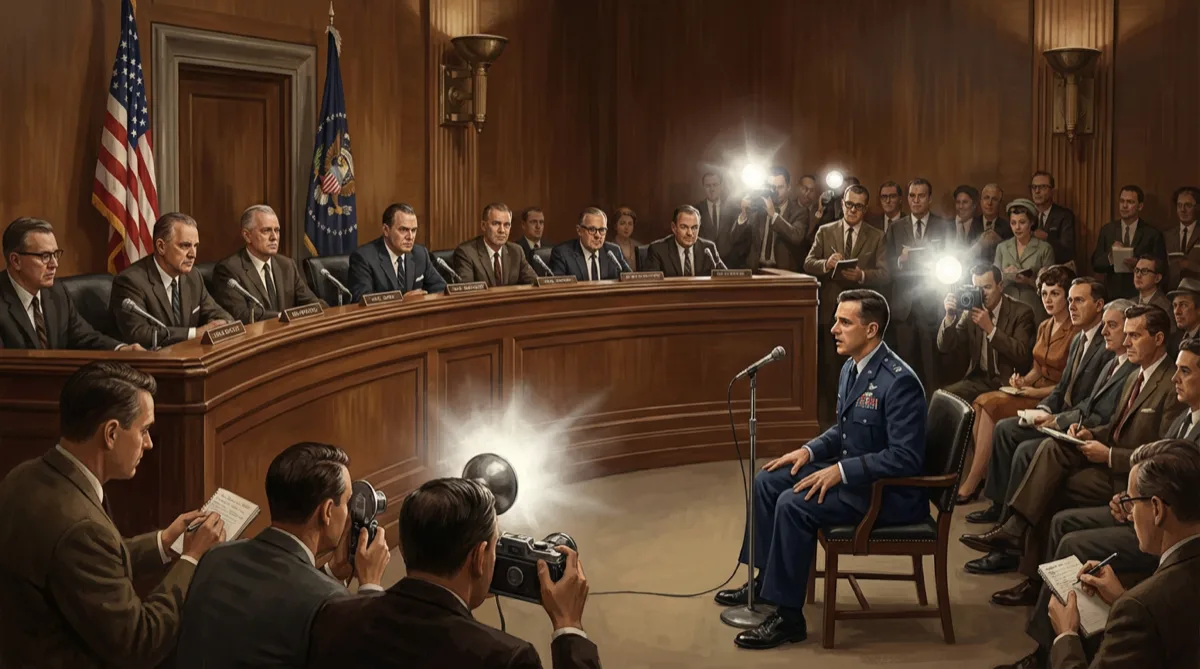
Quintanilla defended the program’s methods. But the hearing’s real significance was what it produced: a recommendation that the Air Force commission an independent scientific study of UFOs at a university. The idea was to get the UFO question out of the military’s hands and into academia’s – hopefully settling it once and for all.
The Air Force agreed and, in October 1966, funded a study at the University of Colorado under the direction of physicist Dr. Edward U. Condon.
It was supposed to be the definitive examination. Instead, it became one of the most controversial scientific studies of the twentieth century.
The Condon Committee
The University of Colorado UFO project – commonly called the Condon Committee – was funded by the Air Force to provide an objective, scientific evaluation of UFO reports. The team included physicists, psychologists, and other researchers who reviewed Blue Book files and investigated selected new cases over roughly two years.
Condon himself made no secret of his skepticism. He joked publicly about the project and made dismissive comments that critics would later cite as evidence of bias. But the real damage came from a document that was never meant to be public.
The Low Memo
On August 9, 1966 – before the study had even formally begun – Robert Low, the project coordinator, wrote an internal memo outlining how the university should approach the contract. The memo included a remarkably candid passage:
“Our study would be conducted almost entirely by non-believers who, although they couldn’t possibly prove a negative result, could and probably would add an impressive body of evidence that there is no reality to the observations. The trick would be, I think, to describe the project so that, to the public, it would appear a totally objective study.”
The Low memo was leaked in 1968 and published. It detonated. Critics argued it was proof that the study’s outcome was predetermined – that the Condon Committee had been structured from the beginning to reach a negative conclusion while maintaining the appearance of objectivity.
Defenders of the study countered that the Low memo represented one administrator’s initial strategizing, not the research team’s actual methodology. But the perception stuck: the fix was in.
The Report
The Condon Report – formally, the Scientific Study of Unidentified Flying Objects – was completed in late 1968 and published in 1969. At over 1,400 pages, it contained detailed case analyses, atmospheric studies, and psychological assessments.
Condon’s summary concluded:
“Further extensive study of UFOs probably cannot be justified in the expectation that science will be advanced thereby.”
The summary was sweeping and dismissive. But researchers who read the full report noticed something the summary didn’t advertise: roughly 30% of the cases the committee examined remained unexplained in the body of the report itself. The case analyses and the executive summary told different stories.
The American Institute of Aeronautics and Astronautics (AIAA) formed a subcommittee to review the report and concluded that the dismissive summary was not supported by the case analyses within it. The AIAA recommended continued scientific attention to a subset of cases involving “reliable witnesses and inexplicable observations.”
None of that mattered to the Air Force. The Condon Report was exactly what they needed.
The National Academy Endorsement
In January 1969, a National Academy of Sciences panel reviewed the Condon Report and endorsed its overall conclusions:
“Nothing has come from the study of UFOs in the past 21 years that has added to scientific knowledge.”
The NAS review provided the institutional cover the Air Force had been waiting for. Armed with a university study and an Academy endorsement, the Air Force could now do what many of its officials had wanted to do since the Grudge era: get out of the UFO business entirely.
December 17, 1969: Blue Book Dies
On December 17, 1969, Secretary of the Air Force Robert C. Seamans Jr. announced the termination of Project Blue Book, effective immediately. The Air Force stated three conclusions:
- No UFO investigated by the Air Force had ever been a threat to national security.
- There was no evidence that any “unidentified” case represented technology beyond known science.
- There was no evidence that any UFO was an “extraterrestrial vehicle.”
“Further funding cannot be justified either on the grounds of national security or in the interest of science.”
The program’s 12,618 case files were packed into boxes and retired to the National Archives in College Park, Maryland, where they were cataloged as microfilm publication T1206 – 94 rolls of film containing everything from witness questionnaires to Ruppelt’s internal memos to Hynek’s handwritten notes.
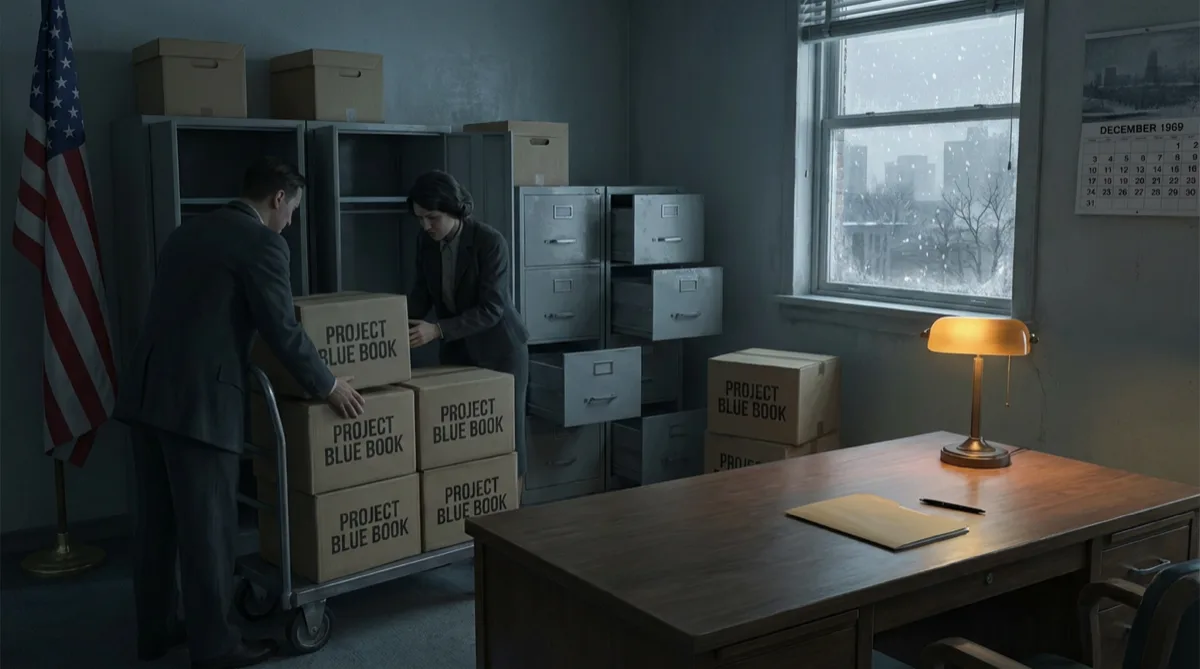
For the first time since 1947, the United States government had no official program for investigating UFO reports. The silence would last for nearly fifty years.
Hynek’s Second Act
Hynek didn’t stop when Blue Book did. If anything, the program’s closure freed him to say what he’d been building toward for years.
He published The UFO Experience in 1972, systematizing the categories of sightings – nocturnal lights, daylight discs, radar-visual, and the famous “close encounters” of the first, second, and third kind. The classification system became standard vocabulary.
He founded the Center for UFO Studies (CUFOS) in 1973, an organization dedicated to the kind of rigorous, civilian-led scientific investigation that Blue Book had never been. He continued speaking, writing, and advocating for serious research until his death in 1986.
Hynek’s evolution – from cooperative skeptic to institutional critic – is one of the most telling threads in the entire Blue Book story. He had more direct exposure to the evidence than almost anyone else in the program’s history. And the more he saw, the less satisfied he became with the answers being given.
The Ghost in the Machine
Blue Book’s closure didn’t end the sightings. It didn’t end military encounters. And it didn’t end the questions.
In 2017, the New York Times revealed the existence of the Advanced Aerospace Threat Identification Program (AATIP), a Pentagon effort that had been quietly investigating UAP encounters since 2007. In 2022, it was succeeded by the All-domain Anomaly Resolution Office (AARO), which now processes hundreds of new cases annually.
The parallels to Blue Book are striking – and deliberate. AARO’s stated mandate echoes Blue Book’s almost word for word: assess national-security risk and evaluate reports for potential science and technology implications. The modern programs even cite Blue Book’s files as part of the historical baseline.
But the differences matter too. When David Grusch testified before Congress in 2023 that the U.S. government possesses retrieved non-human craft and biological material, he was making claims that would have been unthinkable in the Blue Book era – not because the evidence didn’t exist, but because the institutional framework was designed to prevent exactly that kind of conclusion from being reached.
The FY2026 NDAA includes provisions for UAP transparency that directly address the kind of institutional resistance Blue Book exemplified. The NASA UAP study panel recommended a permanent scientific framework – the kind of structure Hynek spent his post-Blue Book years arguing for.
Blue Book’s 701 unidentified cases sit in the National Archives, publicly accessible, waiting. The program that produced them has been dead for over fifty years. But the questions it couldn’t answer – and the institutional habits it perfected for avoiding them – are more alive than ever.
| Date | Event |
|---|---|
| 1966-03 | Michigan “swamp gas” controversy |
| 1966-04 | House Armed Services Committee UFO hearings |
| 1966-08 | Low memo written (leaked 1968) |
| 1966-10 | Condon Committee funded at University of Colorado |
| 1968-10 | Condon Report completed |
| 1969-01 | NAS review endorses Condon conclusions |
| 1969-12-17 | Blue Book terminated |
| 1973 | Files transferred to National Archives; Hynek founds CUFOS |
| 2017 | AATIP revealed by New York Times |
| 2022 | AARO established as Blue Book’s modern successor |
| 2023 | Grusch testifies; Congress demands UAP transparency |
This is Part 3 of a three-part series on Project Blue Book. Part 1: The Air Force’s Secret UFO Office covers the program’s Cold War origins. Part 2: 12,618 Reports examines the cases that defied explanation and what the statistics actually show.
Read the full series on the Project Blue Book landing page.
Sources: USAF Fact Sheet – Project Blue Book · Condon Report (complete) · NAS Review (DoD FOIA) · CRS Report 76-52SP: UFOs · The Condon Report: CU Boulder’s Historic UFO Study · The Condon UFO Study: A Trick or a Conspiracy? (CFI) · Quintanilla – The Investigation of UFOs (CIA) · NARA – Project Blue Book · NARA – Do Records Show Proof of UFOs?