Project Blue Book
12,618 Reports. 701 Unanswered. One Program Designed to Make Them Disappear.
For seventeen years, the United States Air Force ran the longest official UFO investigation in history out of a basement office at Wright-Patterson Air Force Base. The staff: one officer, two sergeants, and a secretary. The mandate: explain everything. The result: 701 cases they couldn't.
Project Blue Book began in Cold War panic and ended in institutional exhaustion. In between, it processed more UFO reports than any government program before or since — and quietly built the template for how governments manage questions they'd rather not answer. This series traces the full arc: the origins, the cases, and the collapse.
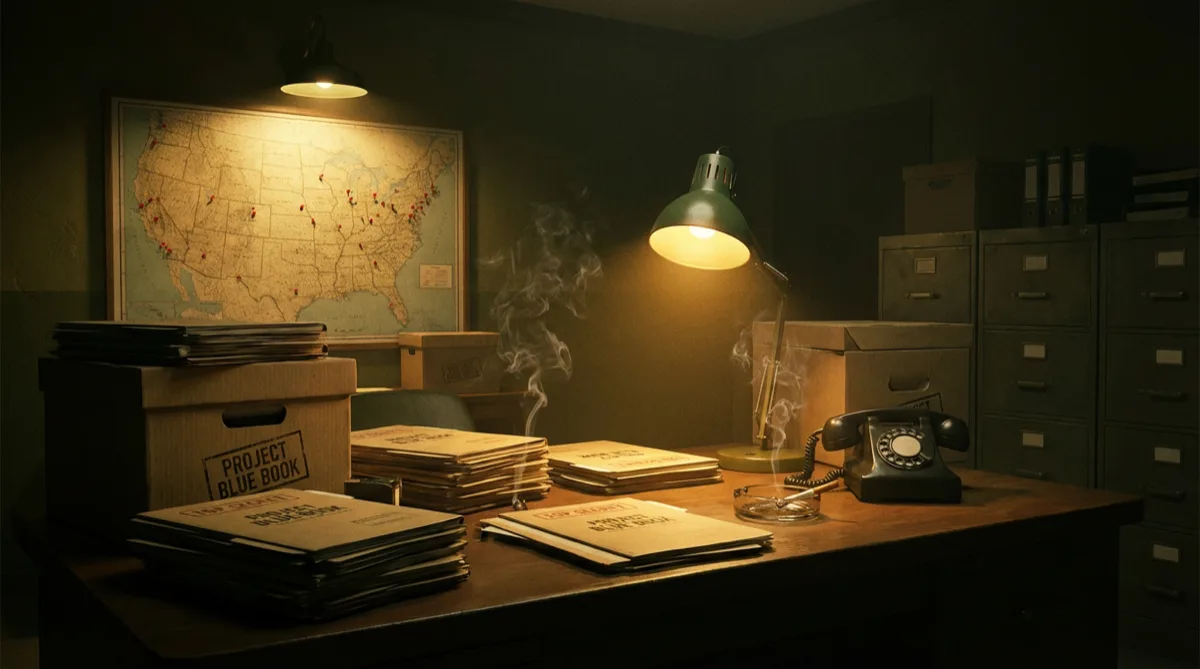
The Air Force's Secret UFO Office Was Run by Four People and a Filing Cabinet
A rejected top-secret report, a revolving door of cover names, and one captain who tried to turn a PR operation into real science. The origins of Blue Book — from Project Sign's destroyed estimate to the Robertson Panel's debunking mandate.
Read Part 1 →
12,618 Reports, 701 That Nobody Could Explain
Police officers chasing objects across state lines. A reconnaissance crew tracked on three sensors at once. A New Mexico cop who found burn marks where a craft had landed. The cases Blue Book couldn't close — and the statistics the Air Force didn't publicize.
Read Part 2 →
The Astronomer Who Turned, the Study That Was Rigged, and the Program That Died
Hynek's break with the Air Force. The Condon Committee's damning leaked memo. A 1,400-page report whose summary contradicted its own findings. And the December day in 1969 when the boxes were packed and the questions were left behind.
Read Part 3 →"Of a total of 12,618 sightings reported to Project Blue Book, 701 remained 'unidentified.'"
— U.S. Air Force Official Fact Sheet
The Files Are Public
Every case file from Project Blue Book — 94 rolls of microfilm — is available at the National Archives in College Park, Maryland. Many have been digitized.