
In the summer of 1947, a private pilot named Kenneth Arnold saw nine objects streaking past Mount Rainier at speeds he estimated at over 1,200 miles per hour. A newspaper reporter coined the phrase “flying saucer.” Within weeks, the Air Force had a problem it didn’t know how to solve – and wouldn’t for the next 22 years.
What followed was not one program, but three: a succession of code names, contradictory conclusions, and bureaucratic knife fights that would define how the U.S. government handled UFO reports for a generation. The final version – Project Blue Book – ran from 1952 to 1969 and processed 12,618 reports. It was headquartered in a small office at Wright-Patterson Air Force Base in Dayton, Ohio. At its peak, it was staffed by one officer, two sergeants, and a secretary.
This is the story of how it got there.
Project Sign: The Report That Was Burned
The Air Force’s first formal UFO investigation began in late 1947, just months after Arnold’s sighting and the Roswell incident. It was called Project Sign, and it operated out of the Air Technical Intelligence Center (ATIC) at Wright-Patterson.
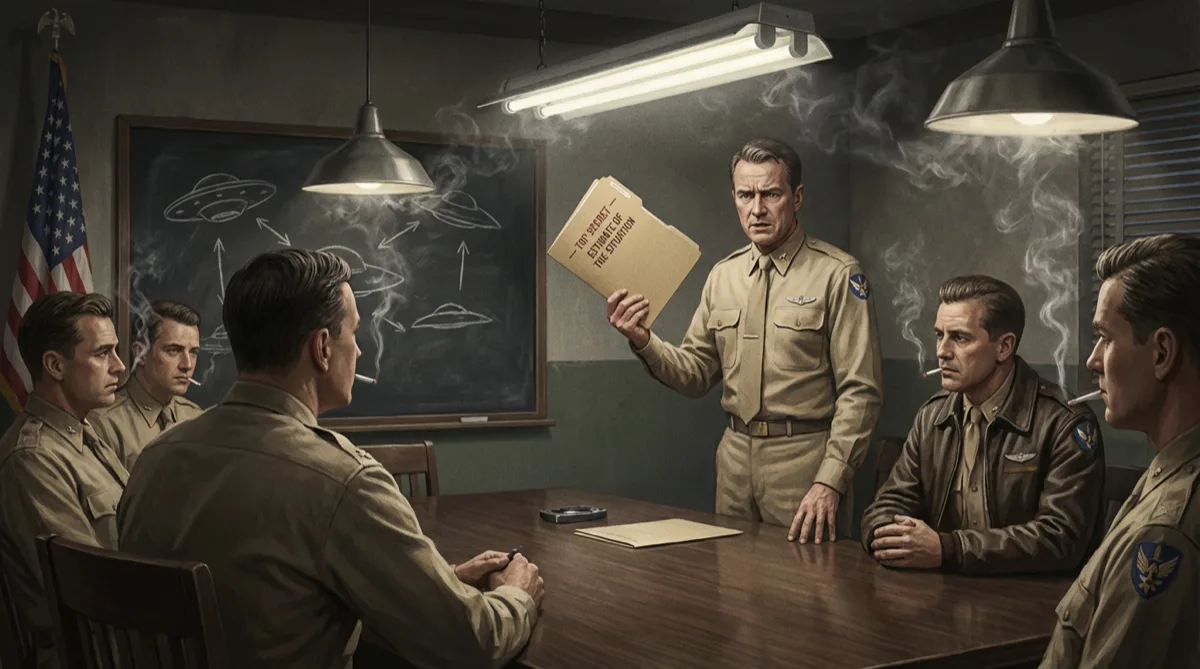
Sign’s analysts took the reports seriously. They interviewed pilots. They examined radar data. And in the fall of 1948, they produced a document that would become one of the most controversial artifacts in UFO history: the “Estimate of the Situation.”
The Estimate reportedly concluded that the most likely explanation for the best UFO cases was extraterrestrial origin.
It went up the chain of command to General Hoyt Vandenberg, the Air Force Chief of Staff. Vandenberg rejected it – not because the evidence was wrong, he reportedly said, but because the evidence wasn’t strong enough to support so extraordinary a conclusion. The document was ordered destroyed. Copies were burned.
The rejection wasn’t just about one report. It set the template for everything that followed: the Air Force would collect UFO data, but its conclusions were expected to land in a comfortable range. “Unexplained” was acceptable. “Extraterrestrial” was not.
Sign was renamed Project Grudge in February 1949. The message was clear.
Project Grudge: The Debunking Years
If Sign had been cautiously open-minded, Grudge was the opposite. The program’s mandate shifted toward public reassurance and conventional explanations. Cases were explained away as misidentified aircraft, weather balloons, stars, or psychological phenomena. The approach was less investigation than damage control.
A later Congressional Research Service review described the Grudge era as one “increasingly shaped by public relations and ‘educating the public’ rather than deep scientific investigation.”
Grudge produced a final report in late 1949 that concluded UFOs were not a threat and recommended scaling down the effort. The program limped along with minimal staffing and attention until 1951, when the UFO problem refused to go away. Sighting reports were increasing – and they were getting harder to dismiss.
In December 1951, the Air Force engaged the Battelle Memorial Institute, a respected research organization, to help standardize and statistically analyze the growing case files. The work would eventually produce Special Report No. 14, the most rigorous statistical analysis of Blue Book data ever conducted.
But the real catalyst was already building. In the summer of 1952, something happened over the nation’s capital that made Grudge’s approach untenable.
1952: The Year Everything Changed
Between June and August of 1952, the Air Force was deluged with UFO reports – 1,501 that year alone, the highest single-year total in the entire Blue Book archive. The wave peaked in July, when radar operators and airline pilots tracked unidentified objects over Washington, D.C. on two consecutive weekends, triggering the largest Pentagon press conference since World War II.
The public wanted answers. The press wanted answers. Congress wanted answers. The Air Force needed someone who could get the program under control.
That someone was Captain Edward J. Ruppelt.

Ruppelt Takes Over
Ruppelt was assigned to lead Project Blue Book in mid-1952 – right as the Washington flap was turning UFOs into a national crisis. He was 29 years old, a World War II veteran, and an engineer by training. He was also, by all accounts, the only Blue Book director who tried to run it like an actual investigation.
He standardized reporting procedures. He created questionnaires (AF Form 117) so witnesses would provide consistent, structured data instead of rambling letters. He pushed for follow-up investigations and outside consultation. He coined the term “UFO” – unidentified flying object – to replace the loaded phrase “flying saucer.”
“A sighting is unidentified when a report apparently contains all pertinent data necessary to suggest a valid hypothesis concerning the cause or explanation of the report, but the description of the object or its motion cannot be correlated with any known object or phenomena.”
– Project Blue Book classification definition
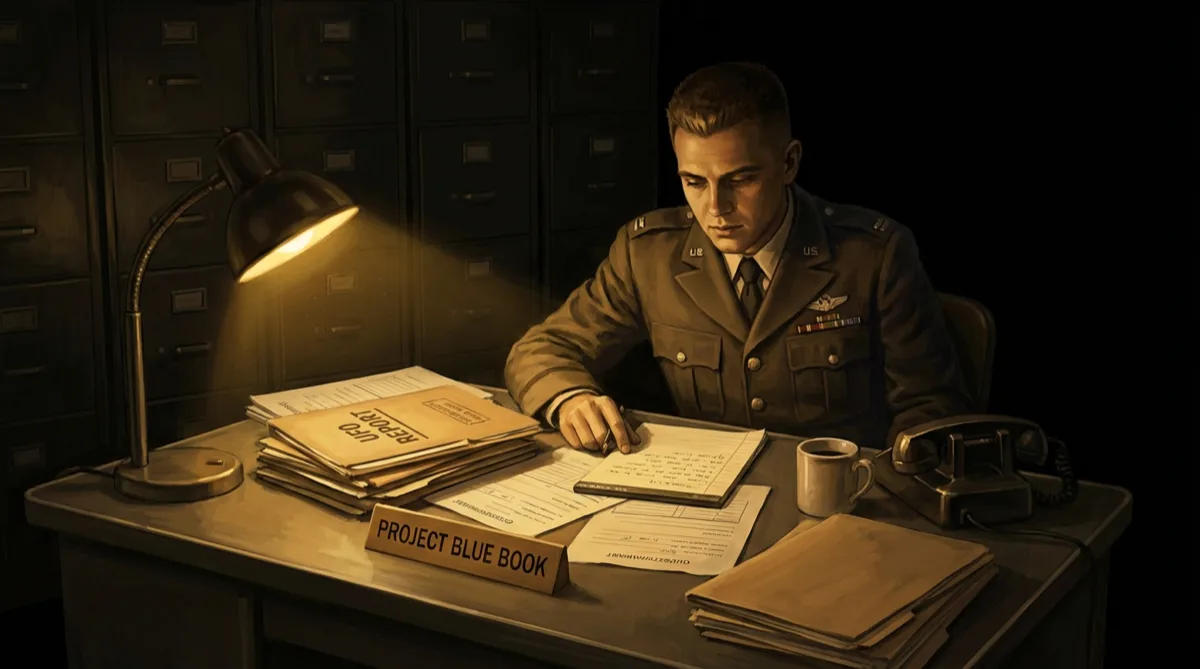
Ruppelt brought in Dr. J. Allen Hynek, an astronomer at Ohio State University, as the program’s scientific consultant. Hynek’s job was to filter out cases that had obvious astronomical explanations – meteors, planets, stars. He would later become Blue Book’s most famous critic, but in these early years he was a cooperative skeptic, happy to explain away what he could.
Under Ruppelt, Blue Book was as close to a genuine scientific effort as the Air Force ever managed. But the infrastructure around him was working against it.
The Robertson Panel: The CIA Steps In
The Washington sightings didn’t just embarrass the Air Force – they alarmed the CIA. In September 1952, the CIA’s Office of Scientific Intelligence issued a memo warning that the flood of UFO reports could overwhelm air-defense communications during a real Soviet attack. The concern wasn’t that UFOs were real. It was that public interest in them was a national security vulnerability.
In January 1953, the CIA convened a secret panel of scientists – the Robertson Panel, chaired by physicist Howard P. Robertson – to review the best UFO evidence and make recommendations. After four days, the panel concluded:
“Strip the unidentified flying objects of the special status they have unfortunately acquired.”
The panel recommended a public education campaign to debunk UFO reports and reduce the volume of sightings clogging military channels. It also recommended that civilian UFO research groups be monitored for potential subversive activity.
The full story of the CIA’s role in shaping UFO perception goes much deeper – but for Blue Book, the Robertson Panel was a turning point. The program’s mission quietly shifted from investigating UFO reports to explaining them.
Ruppelt left Blue Book in 1953. His successors inherited a program that was increasingly expected to produce reassuring answers, not honest ones.
The Machine: How Blue Book Actually Worked
The mechanics of Blue Book were straightforward – and revealing.
UFO reports entered the system through Air Force channels, governed by regulations AFR 200-2 (later AFR 80-17). When a military or civilian witness reported a sighting, the nearest Air Force base was supposed to conduct an initial investigation and forward the report to Wright-Patterson. There, Blue Book staff reviewed the file, requested follow-up if needed, and assigned a classification.
The categories were simple:
- Identified – correlated with a known object (aircraft, balloon, satellite, astronomical body, etc.)
- Insufficient Data – not enough information to evaluate
- Unidentified – all pertinent data present, but the object could not be correlated with anything known
The problem was scale. By the mid-1960s, the program’s day-to-day operation consisted of one officer, two sergeants, and one civilian stenographer. They were processing dozens of cases per month with no budget for field investigations, no lab facilities, and no full-time scientific staff beyond Hynek’s part-time consulting arrangement.
Internal and external critics described the staffing as “grossly inadequate.” A program that was supposed to be investigating one of the most persistent mysteries of the twentieth century was being run like a mailroom.
| Period | Director | Approach |
|---|---|---|
| 1952–1953 | Capt. Edward Ruppelt | Standardized procedures, pushed for rigor |
| Mid-1950s | Capt. Charles Hardin | Short tenure, PR-focused era |
| Late 1950s | Maj. Robert Friend | Limited resources, heavy caseloads |
| 1963–1969 | Maj. Hector Quintanilla | Dismissive posture, led through closure |
Each change in leadership moved Blue Book further from investigation and closer to public relations. By the time Quintanilla took over in 1963, the program’s primary function was explaining things away quickly enough to keep the press quiet.
The cases, though – the cases kept coming. And some of them were very hard to explain.
This is Part 1 of a three-part series on Project Blue Book. Part 2: The Cases They Couldn’t Explain examines the investigations that defied Blue Book’s explanations – and the 701 cases the Air Force officially left “unidentified.” Part 3: The Unraveling traces how the program collapsed under its own contradictions.
Read the full series on the Project Blue Book landing page.
Sources: USAF Fact Sheet – Project Blue Book · Project Blue Book Pamphlet (DoD FOIA) · Robertson Panel Report (declassified) · CRS Report 76-52SP: UFOs · NARA – Project Blue Book Research Guide · Saucers Over Washington (NARA Prologue Blog)