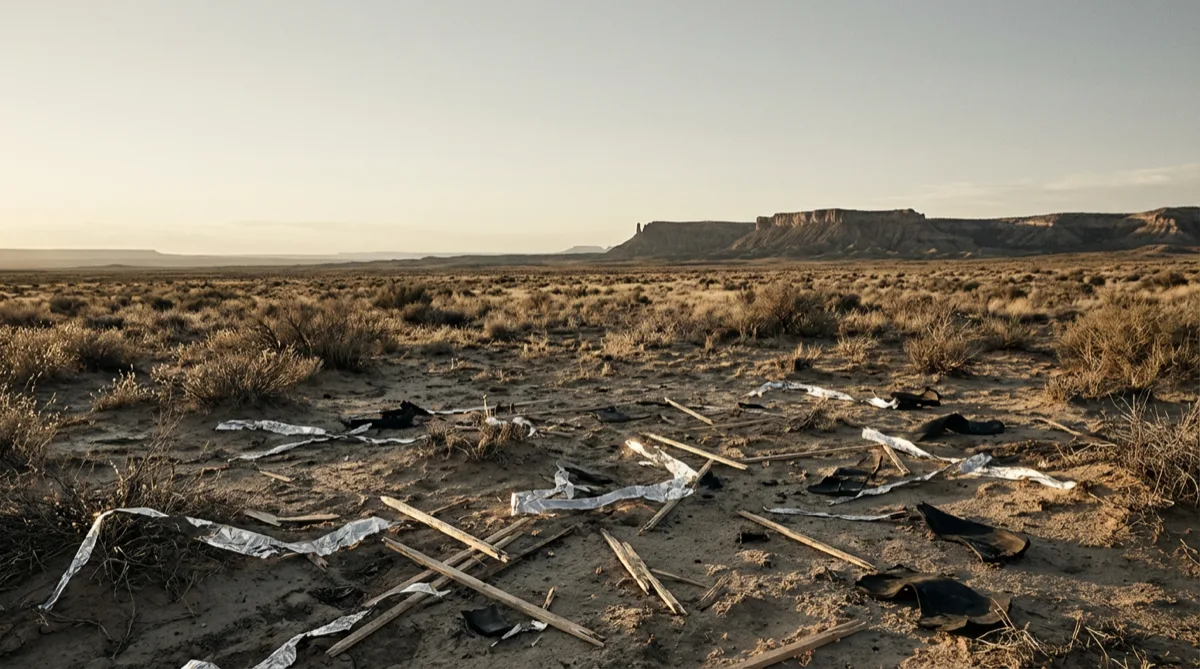
On the morning of July 8, 1947, the public information office at Roswell Army Air Field issued a press release that would echo for decades. The 509th Bomb Group – the only nuclear-armed unit in the world at the time – announced that it had “come into the possession of a flying disc.”
Within hours, the story was dead. Brig. Gen. Roger Ramey, commanding the Eighth Air Force in Fort Worth, told reporters the object was nothing more than a weather balloon with a radar reflector. Cameras captured the wreckage on his office floor. The public moved on.
It took 30 years for anyone to ask what had really happened – and once they did, the answers kept changing.
The Debris Field
The story begins with a ranch foreman named W.W. “Mac” Brazel. Sometime in mid-June 1947, Brazel noticed unusual material scattered across a stretch of the Foster Ranch, roughly 75 miles northwest of Roswell near Corona, New Mexico. He described what he found plainly:
“a large area of bright wreckage made up of rubber strips, tinfoil, and rather tough paper, and sticks.”
On July 7, Brazel brought some of the debris to Sheriff George Wilcox in Roswell. Wilcox contacted the air field. That afternoon, Maj. Jesse A. Marcel, the 509th’s intelligence officer, and Capt. Sheridan Cavitt of the Counter Intelligence Corps drove out to the ranch to collect what remained.
The next morning, Lt. Walter Haut – the base’s public information officer – issued the press release on orders from base commander Col. William H. Blanchard. The wire services picked it up instantly.
“The many rumors regarding the flying disks became a reality yesterday…”
The announcement lasted less than a day.
The Retraction
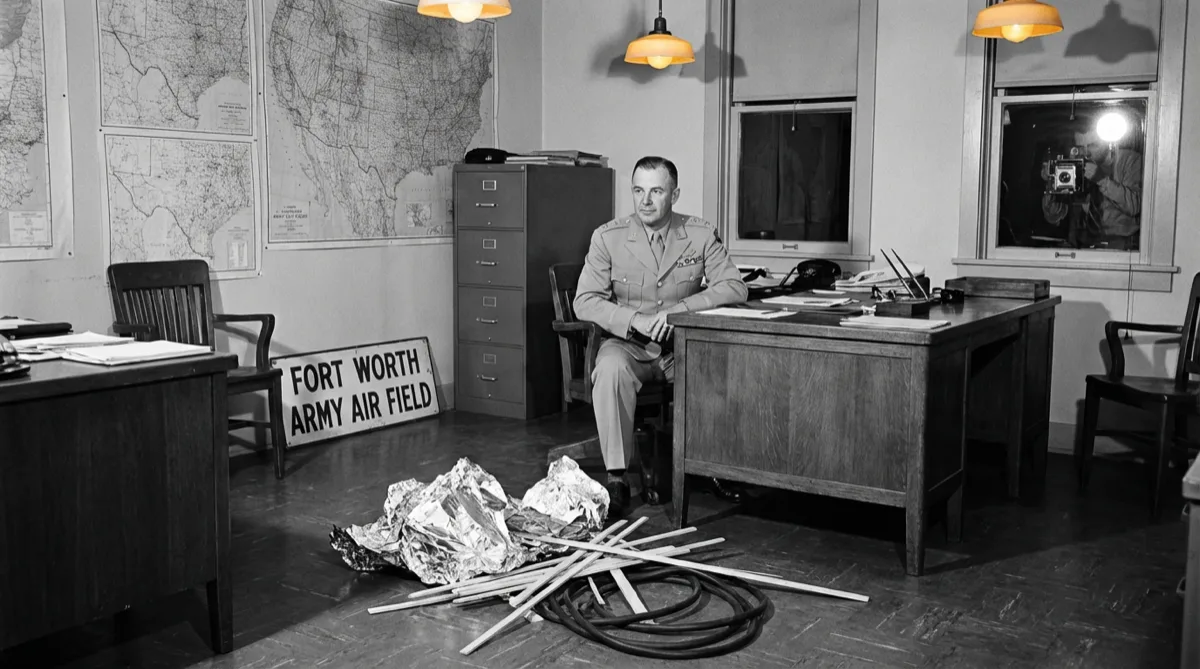
That same afternoon, the debris was flown to Fort Worth Army Air Field. Gen. Ramey took control of the narrative. He called in Warrant Officer Irving Newton, a weather forecaster, who examined the material laid out on Ramey’s office floor.
“I told them that this was a balloon and a RAWIN target…”
Press photographers snapped pictures of Ramey, Marcel, and the wreckage. The images showed crumpled foil, broken sticks, and rubber – consistent with a standard weather balloon carrying a radar reflector. Newspapers ran corrections the next day. By July 9, the story was over.
An FBI teletype from that day, now declassified, summarized the Eighth Air Force’s position:
“The disc is hexagonal in shape and was suspended from a balloon by cable…”
Thirty Years of Silence
Roswell disappeared from the UFO conversation almost entirely. The Air Force’s own later review made this point explicitly:
“Research revealed that the ‘Roswell Incident’ was not even considered a UFO event until the 1978–1980 time frame.”
That changed in 1978, when UFO researcher Stanton Friedman tracked down Jesse Marcel – now retired – and interviewed him. Marcel said the material displayed in Fort Worth was not what he had collected from the ranch. He claimed a substitution had taken place: the real debris was unusual, and the weather balloon was staged for the cameras.
In 1980, Charles Berlitz and William Moore published The Roswell Incident, which brought Marcel’s account to a national audience. Over the next decade, the story grew. New witnesses came forward claiming alien bodies had been recovered. A second crash site was alleged. A mortician named Glenn Dennis said base personnel had asked him about child-sized caskets. The narrative expanded from scattered ranch debris into a full crash-retrieval scenario.
Not all of these accounts held up. Frank Kaufmann, a prominent Roswell witness who described recovery operations and produced supporting documents, was later exposed when investigators found his papers had been altered or fabricated. Even some pro-UFO researchers, including Kevin Randle, publicly withdrew confidence in Kaufmann’s claims. The 1995 “Alien Autopsy” film, marketed as Roswell footage, was eventually acknowledged as a hoax by its creators.
Project Mogul: The Air Force’s Answer
Under pressure from Rep. Steven Schiff of New Mexico, the U.S. General Accounting Office launched a records audit in 1994. The Air Force conducted its own parallel investigation.
The result was a 1994 report concluding that the Roswell debris was most likely connected to Project Mogul – a classified Cold War program that used high-altitude balloon “trains” equipped with acoustic sensors to detect Soviet nuclear tests. The balloons were launched from Alamogordo Army Air Field by teams from New York University and other research groups.
The report pointed to a specific launch – often discussed as “Flight 4,” sent up on June 4, 1947 – as the probable source of the Foster Ranch debris. Mogul balloon trains carried RAWIN radar targets: diamond-shaped reflectors made of lightweight foil and balsa-wood sticks. Early production runs of these targets used tape printed with geometric symbols, manufactured by a toy and novelty company. This detail aligned with witness descriptions of sticks bearing purple or pink “hieroglyphics.”
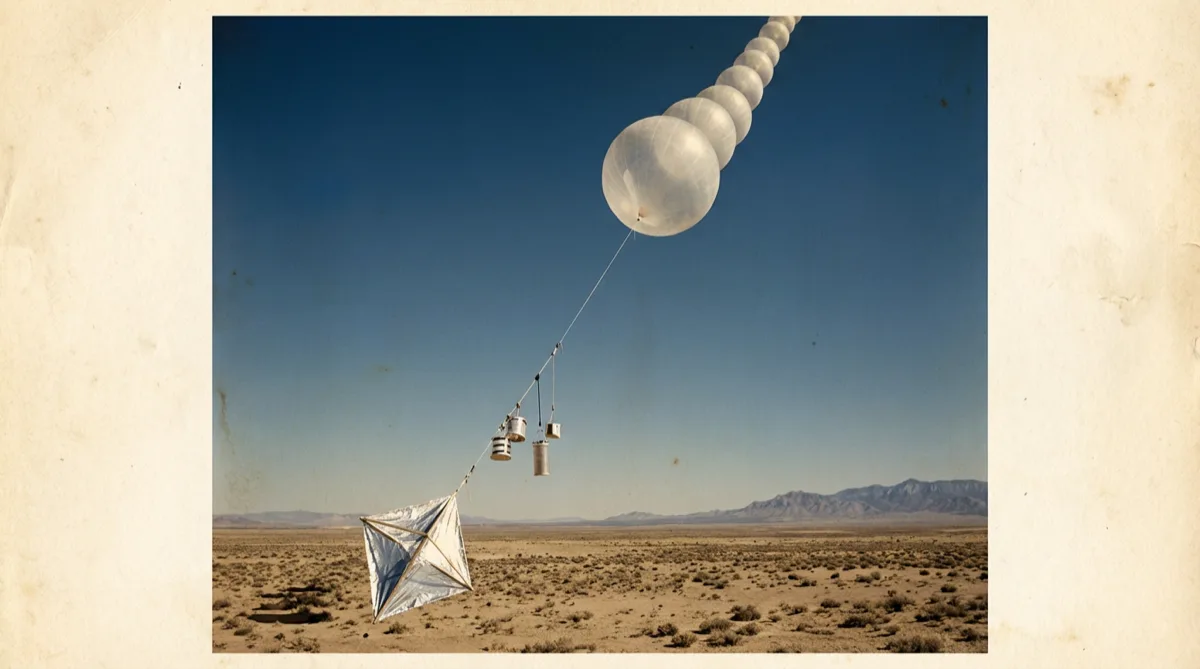
The program itself was classified, but the individual components – weather balloons, radar targets – were not. This meant the people who found the debris would not have recognized what they were looking at, while the military had reason to avoid explaining its true purpose.
In 1997, the Air Force published a follow-up report, The Roswell Report: Case Closed, addressing the “alien bodies” claims directly. Its conclusion:
‘“Aliens” observed in the New Mexico desert were probably anthropomorphic test dummies’
The report argued that witnesses had conflated memories of later Air Force activities – including dummy drops from high-altitude balloons in the 1950s – with the 1947 debris recovery, compressing unrelated events into a single narrative.
What Remains Unresolved
The Air Force reports answered some questions and raised others.
The Mogul explanation accounts for the physical debris descriptions reasonably well, but critics note that Marcel – the intelligence officer who handled it – insisted until his death that the material was extraordinary. Marcel’s son, Jesse Marcel Jr., said his father brought debris home and showed it to the family, including a beam with markings he couldn’t identify.
The so-called “Ramey memo” – a document visible in Gen. Ramey’s hand in one of the 1947 Fort Worth photographs – has been the subject of decades of enhancement attempts. Researchers disagree on what the text says, and no definitive reading has been established.
The GAO’s 1995 records search found that key administrative records from the 509th Bomb Group covering the relevant period had been destroyed, though it could not determine when or why. This fueled suspicions of a cover-up, though the GAO itself drew no such conclusion.
And the most basic question has never been fully answered: why did the Roswell public information office issue a “flying disc” press release in the first place? Whether it was a mistake, a miscommunication, or a deliberate deflection from a classified program, the original announcement remains the seed of everything that followed.
The Cultural Afterlife
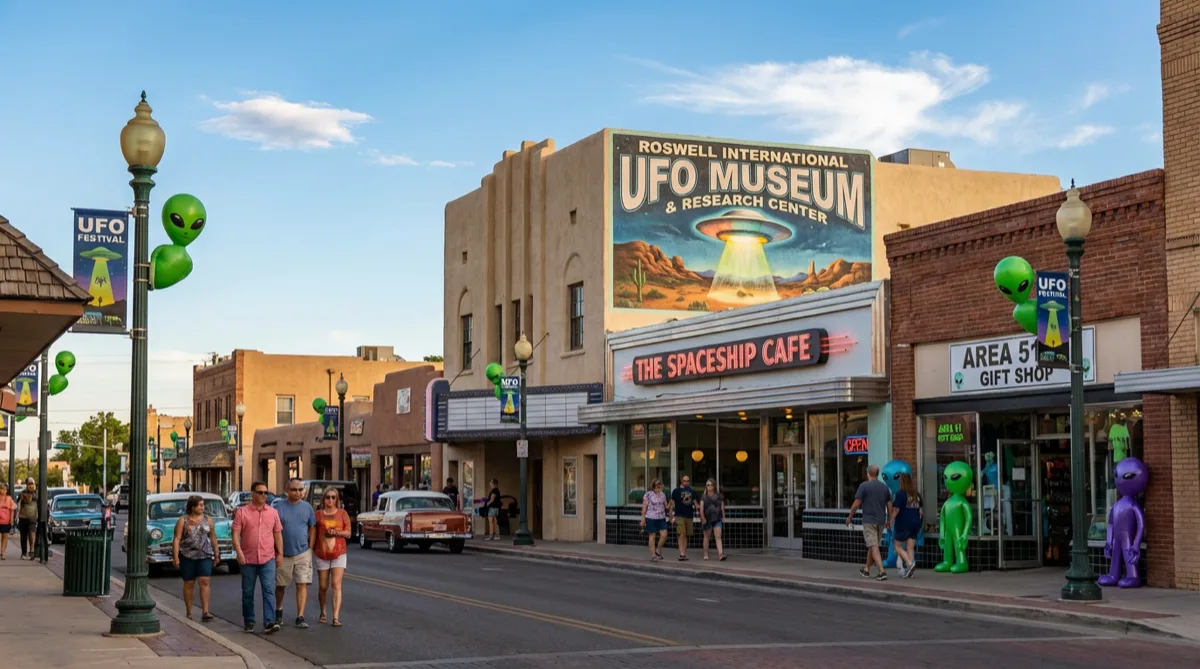
Whatever crashed on the Foster Ranch, Roswell’s place in American culture was secured long ago. The town embraced its identity – UFO museums, alien-themed streetscapes, and an annual festival draw visitors from around the world. Roswell became the default reference point for government UFO secrecy, crash-retrieval claims, and the tension between official explanations and witness testimony.
The incident also set a template that continues to shape modern UAP debates. When former intelligence official David Grusch testified before Congress in 2023 about alleged crash-retrieval programs, the echoes of Roswell were explicit. The language of “legacy programs,” non-human materials, and institutional secrecy all trace back to a ranch in New Mexico and a press release that lasted less than a day.
Roswell happened just two weeks after Kenneth Arnold’s sighting near Mount Rainier launched the modern UFO era. Together, the two events defined the summer of 1947 – and the decades of questions that followed.
| Date | Event |
|---|---|
| June 14, 1947 | Mac Brazel first notices unusual debris on the Foster Ranch |
| July 7, 1947 | Brazel reports debris to Sheriff Wilcox; military personnel respond |
| July 8, 1947 | RAAF announces recovery of a “flying disc” |
| July 8, 1947 | Gen. Ramey retracts: identifies debris as weather balloon |
| 1978 | Stanton Friedman interviews Jesse Marcel; modern Roswell revival begins |
| 1980 | The Roswell Incident (Berlitz & Moore) published |
| July 1994 | USAF report: debris consistent with Project Mogul |
| 1997 | USAF Case Closed: “alien body” claims attributed to test dummy recoveries |
Sources: USAF 1994 Roswell Report · USAF 1997 Case Closed · FBI Vault: Roswell teletype · GAO letter to Rep. Schiff (1995) · Smithsonian Magazine · Britannica · NARA blog · TIME · CUFOS: Kaufmann Exposed · CFI/SUN #75