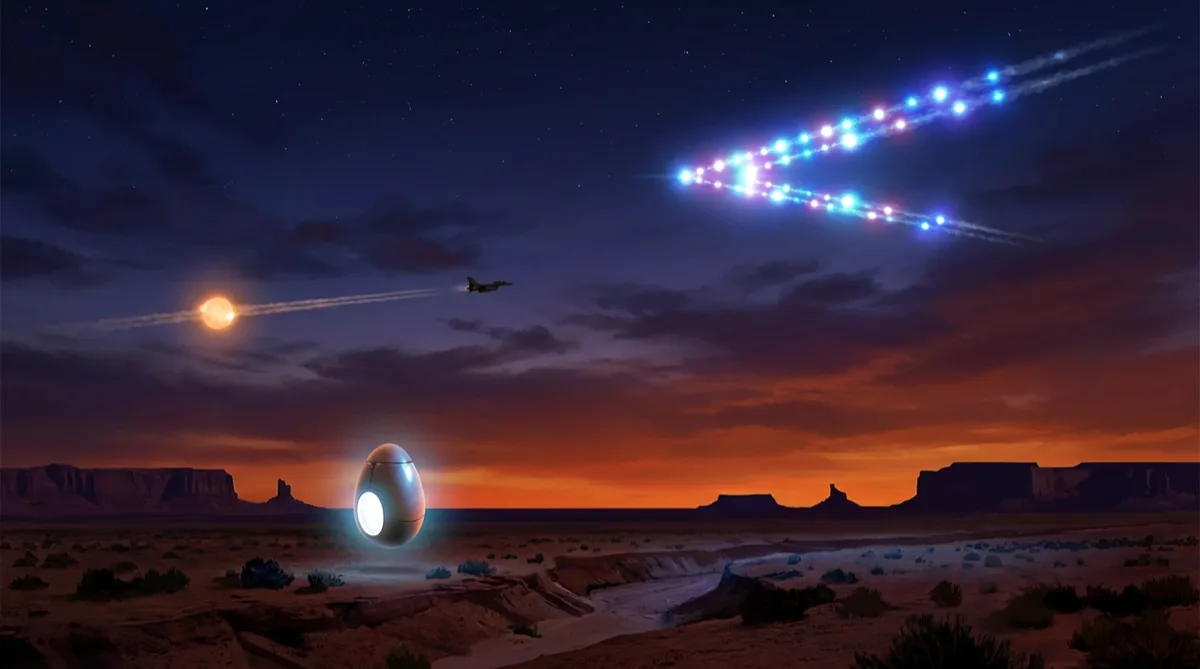
Between 1952 and 1969, the U.S. Air Force logged 12,618 UFO reports through Project Blue Book. The vast majority were resolved: misidentified aircraft, weather balloons, satellites, planets, meteors. The Air Force had an explanation for most of what people saw.
But not all of it. When the program shut down, 701 cases – about 5.56% of the total – remained officially classified as “unidentified.” Not “unexplained pending further data.” Not “inconclusive.” Unidentified: meaning the report contained all pertinent information, and the object still could not be matched to anything known.
Seven hundred and one times, the system worked exactly as designed – collected the data, consulted the experts, ran the analysis – and came up empty.
These are some of those cases. And the numbers that surround them.
The Numbers Game
Blue Book’s statistical record is one of the most detailed UFO datasets any government has ever produced. The Battelle Memorial Institute, commissioned in 1951, conducted the most rigorous analysis in Special Report No. 14, examining thousands of cases through the mid-1950s.
The breakdown of cases from 1953 to 1964 – the core operational years – tells a clear story about what Blue Book was mostly dealing with:
| Category | Cases | Percentage |
|---|---|---|
| Astronomical (stars, planets, meteors) | 2,167 | 31.8% |
| Insufficient data | 1,248 | 18.3% |
| Aircraft | 1,167 | 17.1% |
| Other / miscellaneous | 916 | 13.4% |
| Balloons | 665 | 9.8% |
| Satellites | 417 | 6.1% |
| Unidentified | 237 | 3.5% |
| Total | 6,817 |
Nearly a third of all reports turned out to be people looking at Venus, Jupiter, or bright stars under unusual atmospheric conditions. Another third were aircraft, balloons, or satellites. The “insufficient data” category – cases where witnesses didn’t provide enough detail to evaluate – ran nearly as high as the aircraft category.
But that bottom line persisted. Even after filtering out everything explainable, a residual signal remained.
The peak year was 1952, with 1,501 reports – driven largely by the Washington, D.C. radar incidents and the broader summer wave. The second-highest was 1957 (1,006 reports), a year that produced some of Blue Book’s most compelling individual cases.
Levelland, Texas: Cars Stop, Lights Die
On the night of November 2, 1957, the Levelland, Texas, sheriff’s office started getting calls. One after another, motorists on the flat West Texas highways were reporting the same thing: a luminous object near the road, and then – their engines died. Headlights went dark. Radios cut out. When the object moved away, everything came back on.
At least fifteen witnesses across multiple locations reported the same pattern over a span of about three hours. Some described the object as egg-shaped, others as a glowing oval. The size estimates ranged from 100 to 200 feet.
Blue Book sent a single investigator, who spent one day in Levelland. The official explanation: ball lightning and electrical storms in the area.
The problem: several witnesses reported clear skies at the time of their encounters. And ball lightning had never been documented causing simultaneous engine, headlight, and radio failure in motor vehicles.
The Levelland case became a textbook example of Blue Book’s methodology under strain – a multi-witness, multi-location event compressed into a single conventional explanation that didn’t fully account for the reported effects.
The RB-47: A UFO on Radar, Eyes, and Electronic Intercept
July 17, 1957. An Air Force RB-47 reconnaissance aircraft – a converted bomber packed with electronic intelligence equipment – was flying from Mississippi across Louisiana, Texas, and into Oklahoma. The crew consisted of six experienced officers.
What happened over the next several hours was one of the most instrumented UFO encounters in military history.
The RB-47’s electronic warfare officer first detected an unusual signal on his monitoring equipment – a strong microwave pulse that didn’t match any known ground-based emitter. Then the crew spotted a bright light that appeared to be pacing their aircraft. Air-traffic radar at Duncanville, Texas confirmed an unknown target in the same position.
The object was tracked simultaneously by three independent detection methods: the crew’s visual observation, ground radar, and the aircraft’s own electronic intercept equipment. At one point the pilot attempted to close on the object. It accelerated away. When the RB-47 turned, the signal and the radar return moved with it.
The encounter lasted over an hour, covering hundreds of miles across multiple states.
Blue Book attempted various explanations – including an airliner on a nearby route – but the Condon Committee later examined the case in detail and acknowledged it remained unexplained. The triple-sensor correlation made conventional explanations extraordinarily difficult to sustain.
Socorro, New Mexico: The Cop and the Craft
On the afternoon of April 24, 1964, Patrolman Lonnie Zamora of the Socorro, New Mexico, police department was chasing a speeding car south of town when he heard a roar and saw a flame descending in the distance. Thinking a dynamite shack might have exploded, he broke off the pursuit and drove toward it.
What he found, in a shallow gully about 800 feet away, was a smooth, white, egg-shaped object resting on the desert floor on small landing legs. He could see what appeared to be two figures in white coveralls near it – small, “like children.” As he approached on foot, the object emitted a loud roar, produced a blue flame, and lifted off, climbing silently into the sky until it disappeared.
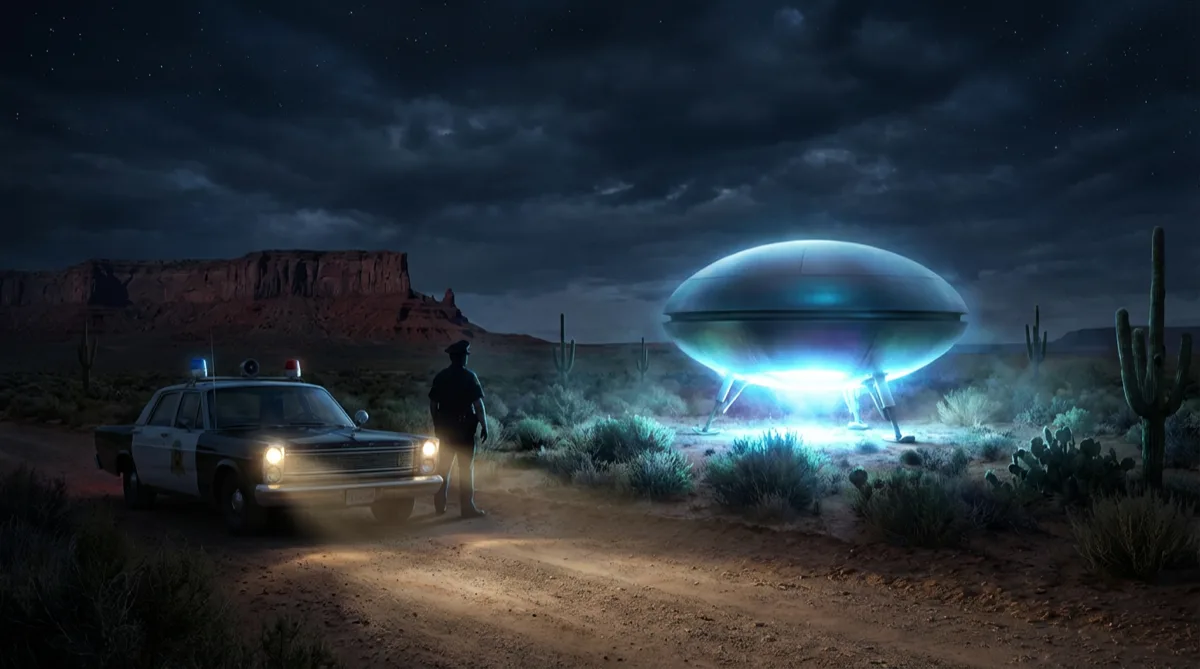
Zamora called it in immediately. Sergeant Sam Chavez arrived within minutes and found the physical evidence Zamora described: burned brush, indentations in the soil where the landing legs had been, and fused sand in the spot beneath where the craft had sat.
The case drew Hynek personally to the site. The FBI investigated independently. Blue Book never provided a satisfactory explanation and the case is widely listed among the program’s unresolved files.
What made Socorro unusual wasn’t just the sighting – it was the convergence of a credible, trained witness; immediate corroborating evidence; physical traces examined by multiple agencies; and a complete absence of any hoax evidence despite extensive investigation.
Exeter, New Hampshire: The Night Patrol
Just after midnight on September 3, 1965, a teenager named Norman Muscarello stumbled into the Exeter, New Hampshire, police station, visibly shaken. He said he’d been hitchhiking on Route 150 when an enormous object – dark, with pulsating red lights – had come directly at him over an open field, forcing him to dive into a ditch.
Officer Eugene Bertrand drove Muscarello back to the location. In the field, they both watched the object rise silently from behind a line of trees – a large, dark mass with five brilliant red lights that pulsed in sequence. Bertrand radioed for backup. Officer David Hunt arrived and saw it too, watching as the object drifted slowly east, still pulsing, before disappearing toward the ocean.
The Air Force eventually attributed the sighting to a military refueling exercise, then retracted that explanation when records showed no operations in the area that night. Blue Book ultimately offered no definitive explanation.
The Exeter incident, with two police officers as primary witnesses and a civilian corroborating account, became a focal point for critics who argued Blue Book was more interested in closing files than investigating them.
Portage County, Ohio: The Deputies’ Chase
At 5:07 a.m. on April 17, 1966, Deputy Sheriff Dale Spaur and his partner Wilbur Neff were investigating an abandoned car on a rural road near Ravenna, Ohio, when a bright object rose from the tree line and hovered over them. It was large, luminous, and humming.
When they got in their cruiser and radioed dispatch, they were told to follow it. What followed was a 70-mile pursuit across county lines into Pennsylvania, reaching speeds over 100 mph, with the object staying ahead of them the entire time. Officer Wayne Huston in East Palestine picked up the chase as Spaur and Neff passed through his jurisdiction. Officer Frank Panzanella in Conway, Pennsylvania, was already watching the object when the cruisers arrived.
Four law enforcement officers across two states, with continuous radio communication, tracked the same object for over 30 minutes.
Blue Book’s explanation: they were chasing Venus.
Spaur, a decorated officer, was incredulous. The explanation – that four trained observers in moving vehicles at varying angles all mistook a stationary planet for a bright, low-altitude, moving object – became one of the most widely mocked Blue Book conclusions of the 1960s. Hynek later called it “a travesty.”
The 701: What “Unidentified” Actually Meant
The number 701 has taken on an almost mythic quality in UAP discourse. But it’s worth being precise about what Blue Book meant when it applied that label.
“A sighting is unidentified when a report apparently contains all pertinent data necessary to suggest a valid hypothesis concerning the cause or explanation of the report, but the description of the object or its motion cannot be correlated with any known object or phenomena.”
– Project Blue Book classification pamphlet
“Unidentified” was not a euphemism for “alien.” It was a bureaucratic classification applied when the system had enough data to work with and still couldn’t match the observation to anything in its catalog. It was the smallest category in every statistical summary Blue Book ever produced.
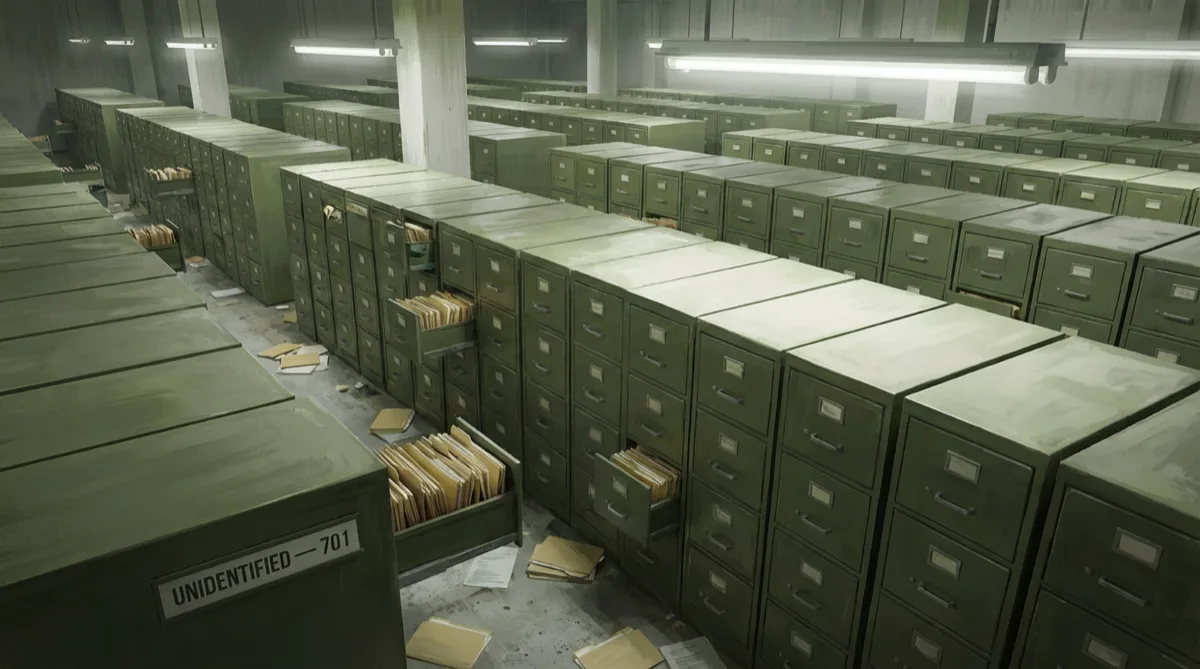
But the composition of that 701 is what makes it significant. These weren’t the vague, low-information reports that filled the “insufficient data” bin. By definition, they were the best-documented cases – the ones with the most complete witness information, the most corroborating data, the most thorough investigation – that still defied explanation.
The Battelle analysis in Special Report No. 14 found something additional that the Air Force never publicized: cases rated as having “excellent” data quality were more likely to remain unidentified than cases with poor data. The better the evidence, the harder it was to explain away.
That statistical finding quietly undermined the Air Force’s public position that the unidentified cases were simply under-investigated. The data suggested the opposite.
What the Numbers Don’t Show
Blue Book’s statistics have limitations that matter. The program only recorded cases that entered the Air Force reporting system – meaning civilian sightings that weren’t reported to a base, and any military encounters that were classified above Blue Book’s access level, don’t appear in the count.
The “insufficient data” category – 18.3% of all cases – is itself a grey zone. Some of those cases might have been resolved with better investigation. Others might have joined the unidentified list if anyone had followed up. With a staff of four, many reports received only cursory review.
And then there’s the question of cases that were explained but shouldn’t have been. Critics like Hynek, who reviewed hundreds of cases personally, argued that many identifications were forced – convenient labels applied under pressure to keep the unidentified percentage low.
The 701 is a floor, not a ceiling. The real number of genuinely anomalous cases in the Blue Book files may be significantly higher.
Today, those files sit on 94 rolls of microfilm at the National Archives in College Park, Maryland (publication T1206). They’ve been digitized by Fold3 and are available through NARA’s bulk-download system. Anyone can look.
This is Part 2 of a three-part series on Project Blue Book. Part 1: The Air Force’s Secret UFO Office covers how the program was born out of Cold War panic and bureaucratic infighting. Part 3: The Unraveling traces how Blue Book collapsed – and why its ghosts still haunt modern UAP efforts.
Read the full series on the Project Blue Book landing page.
Sources: USAF Fact Sheet – Project Blue Book · Project Blue Book Pamphlet (DoD FOIA) · Blue Book Special Report No. 14 – Battelle · Condon Report (complete) · CRS Report 76-52SP: UFOs · Levelland Case File (Internet Archive) · NARA – Project Blue Book · NARA UAP Bulk Downloads · NARA – Do Records Show Proof of UFOs?