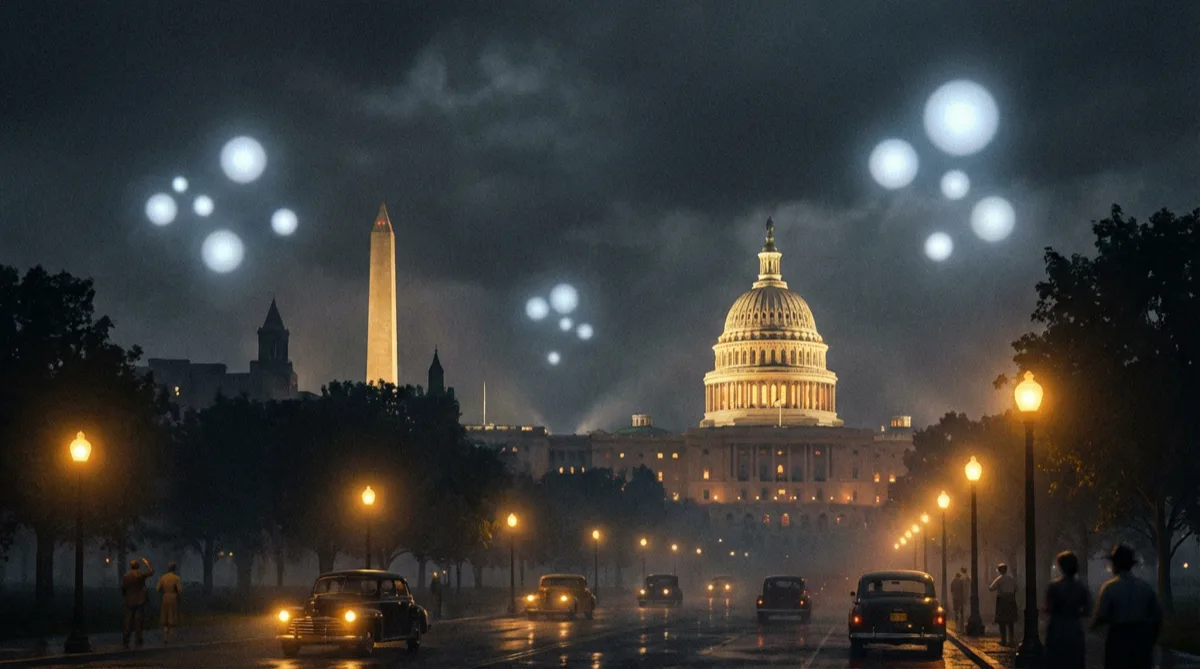
Late on the night of July 19, 1952, air traffic controller Edward Nugent glanced at his radar scope inside Washington National Airport and spotted something that shouldn’t have been there. Seven unidentified targets, roughly 15 miles southeast of the nation’s capital, moving slowly – then suddenly accelerating.
It was a clear, hot, humid Saturday night. The skies over Washington were quiet. But the radar screens were not.
Within hours, fighter jets were scrambled, airline pilots were reporting unexplained lights, and controllers at three separate facilities were tracking objects they couldn’t identify. By dawn, the targets were gone. By Monday, the story was on the front page of every major newspaper in the country. And one week later, it happened again.
The First Weekend: July 19–20
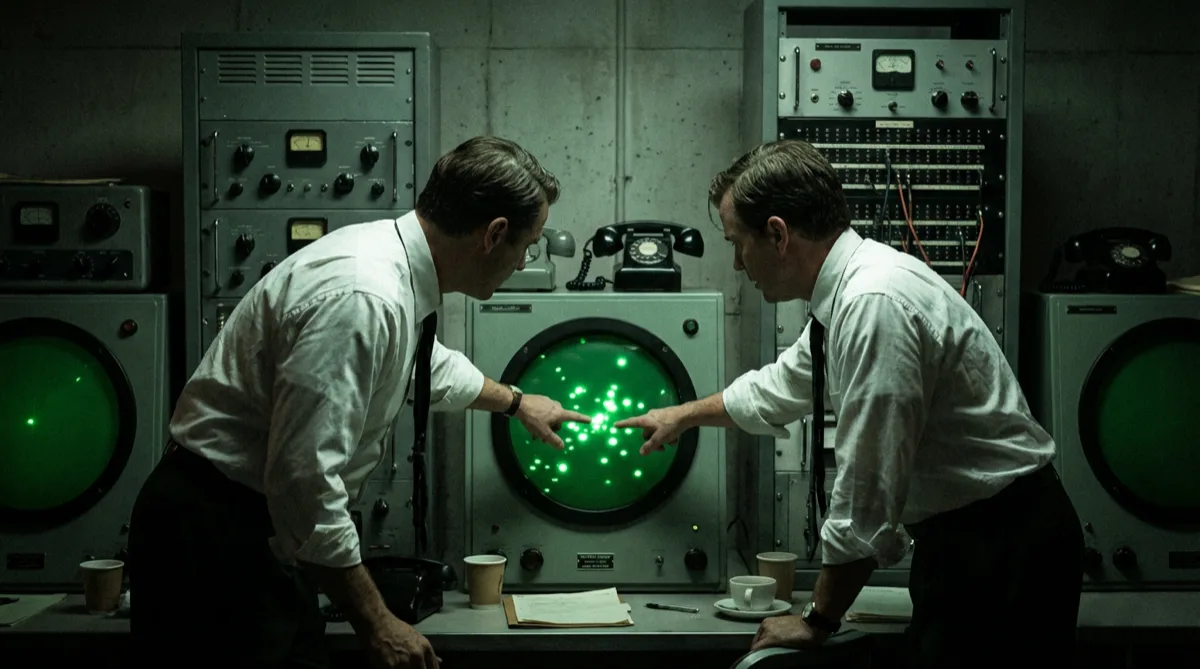
Senior controller Harry G. Barnes confirmed the targets weren’t caused by equipment malfunction by cross-checking with radar at Andrews Air Force Base and Bolling Air Force Base. All three facilities were tracking returns in the same areas.
Controller Joe Zacko stepped outside and saw a hovering bright light that then “zoomed away” at high speed – consistent with what the scopes were showing. Howard Cocklin, another controller, described a “whitish blue light” from what appeared to be a solid, round, saucer-like object with no wings, nose, or tail.
In the air, Capital Airlines pilot Capt. S.C. “Casey” Pierman, flying Flight 807, radioed in after spotting multiple bright lights moving rapidly. When asked if he could see anything unusual, his response was brief:
“There’s one – and there it goes.”
Pierman reported the lights over a 14-minute interval while in direct radio contact with the radar room.
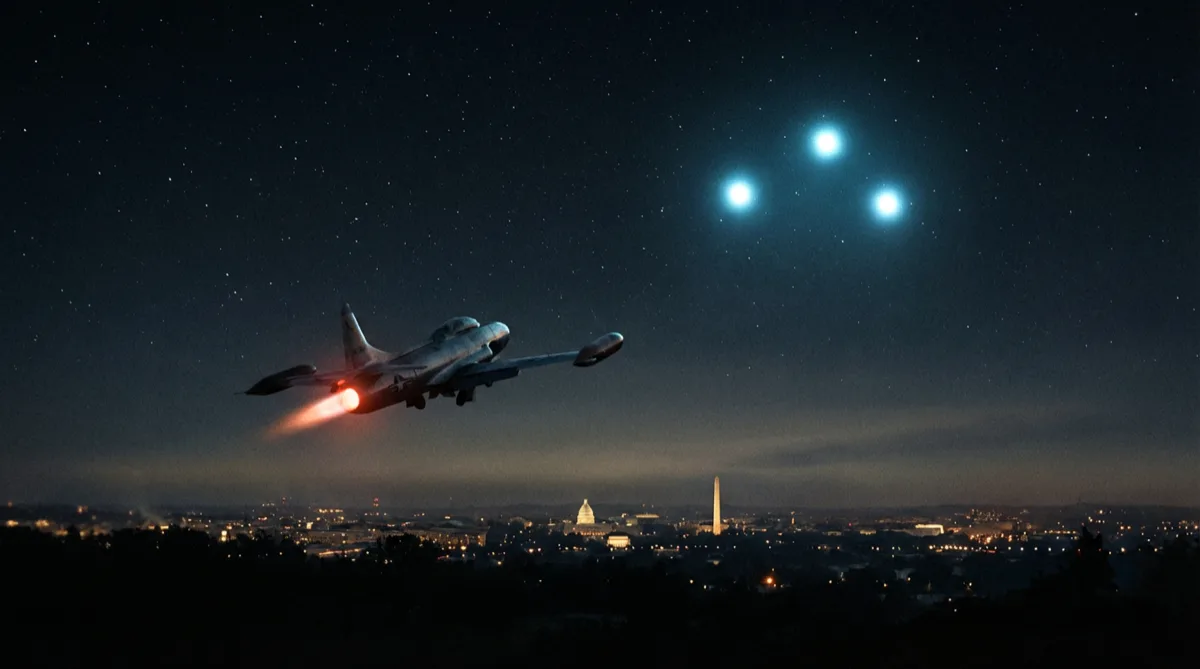
Two F-94 Starfire interceptors were scrambled from New Castle County Air Force Base in Delaware – the nearest available alert aircraft, since Andrews’ runways were reportedly closed for repairs. When the jets arrived over Washington, the radar targets vanished. When the jets departed, the targets came back. The pattern repeated until near dawn, when the returns disappeared for good.
The Second Weekend: July 26–27
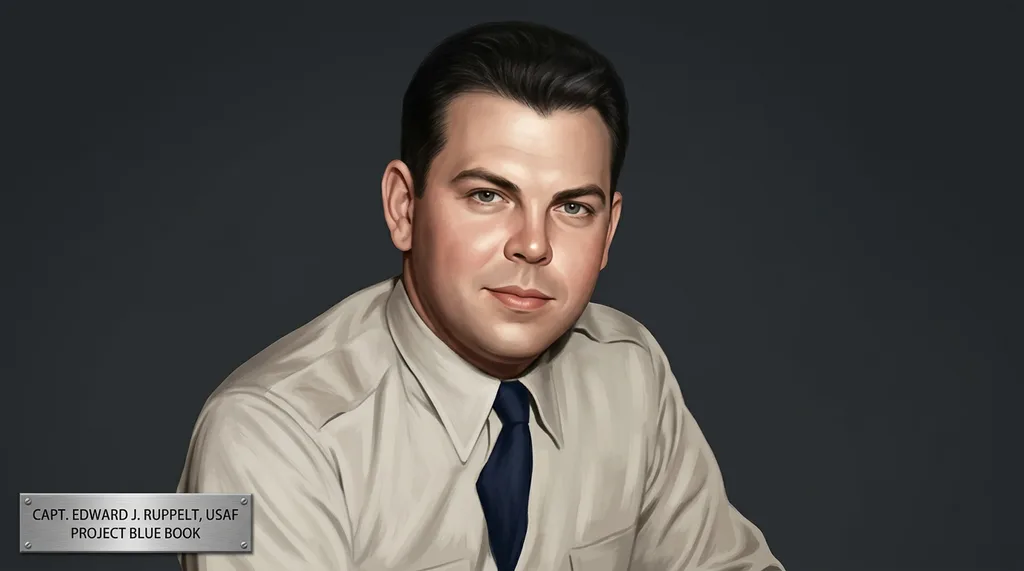
Exactly one week later, around 10:30 p.m. on July 26, the same radar operators detected a new set of unidentified targets. Edward J. Ruppelt, the Air Force officer directing Project Blue Book, later described targets spread in an arc from Herndon, Virginia, to Andrews Air Force Base.
This time, the Air Force sent observers. Maj. Dewey Fournet, Blue Book’s Pentagon liaison, and Lt. John Holcomb, a Navy electronics and radar specialist, took positions inside the Washington National Airport radar room to watch the situation unfold in real time. Blue Book public information officer Albert M. Chop was also present.
The same evasive pattern emerged. As two F-94s arrived from New Castle, the targets disappeared. When the jets left, they returned. During a later intercept attempt, the targets held – pilots were vectored toward them repeatedly, but could only get close enough to see lights before they pulled away. One light reportedly “disappeared” during pursuit.
Lt. William Patterson, one of the F-94 pilots, told the press afterward:
“I was at my maximum speed, but even then I had no closing speed.”
The Washington Post reported a dozen blips being tracked simultaneously, with at least one pilot confirming visual contact with strange lights. Once again, the activity ceased around sunrise.
The Pentagon Responds
On July 29, 1952, the Air Force held what was widely described as the largest Pentagon press conference since World War II. Maj. Gen. John A. Samford, the Air Force Director of Intelligence, led the briefing alongside Maj. Gen. Roger M. Ramey, Director of Operations.
Samford acknowledged the Air Force’s duty to identify aerial phenomena that might pose a threat, but steered the explanation toward atmospheric effects. The official position: temperature inversions – layers of warm air over cooler air – had bent radar beams and created false targets. Visual reports were attributed to misidentified stars, meteors, or aircraft lights.
The press largely accepted the framing. Headlines shifted from “jets chase saucers” to “Washington hot air.” Reported sightings dropped sharply in the following days.
Ruppelt, writing later, was blunt about the strategy:
“Somehow, out of this chaotic situation came exactly the result that was intended – the press got off our backs.”
What the Radar Actually Showed
The Washington radar facilities involved included the ARTC radar room (equipped with a Microwave Early Warning radar) and the airport control tower (using an ASR-1 surveillance radar). The equipment was standard for the era but lacked the clutter-filtering capabilities of modern systems.
| Detail | First Weekend (Jul 19–20) | Second Weekend (Jul 26–27) |
|---|---|---|
| Initial targets | 7 at ~11:40 p.m. | Multiple, up to ~12 at a time |
| Speeds | 100–130 mph, with sudden rapid accelerations | Similar pattern; pilots unable to close |
| Corroborating facilities | Andrews AFB, Bolling AFB | Andrews AFB; Blue Book observers on-site |
| Interceptors | F-94s from New Castle County AFB | F-94s from New Castle County AFB |
| Visual witnesses | Controllers, airline pilot | Controllers, pilots, Blue Book personnel |
| Duration | Until near dawn | Until near dawn |
Controllers noted a distinctive behavior: the targets moved slowly, then accelerated abruptly, sometimes appearing to reverse direction on the scope. Most strikingly, they repeatedly vanished when interceptors arrived and reappeared after the jets departed – a pattern difficult to reconcile with atmospheric artifacts.
The Inversion Debate
The temperature inversion explanation became the official Air Force position and was supported by a May 1953 Civil Aeronautics Administration technical report (Report No. 180), which analyzed unidentified radar targets at Washington National and other airports. The report concluded:
“A surface temperature inversion was almost always noted when such targets appeared on the radar.”
The CAA found that apparent target motion often correlated with winds aloft when properly adjusted, suggesting many returns were propagation effects rather than physical objects.
But several participants pushed back. Lt. Holcomb and Maj. Fournet, who had observed the radar returns firsthand during the second weekend, disputed whether the inversion strength on those specific nights was sufficient to produce the kind of strong, consistent returns they witnessed. Experienced radar operators said they could distinguish weather clutter from the “good” targets they tracked – and pointed to the coincident visual sightings as evidence the returns represented something real.
The Condon Committee (1969) later examined the radar evidence and acknowledged that while atmospheric propagation could explain many anomalous returns, the combination of radar and visual reports remained difficult to fully resolve.
The Ripple Effect
The Washington incidents didn’t just make headlines – they changed policy. The CIA’s Office of Scientific Intelligence issued a memorandum on September 24, 1952, warning that the volume of UFO reports posed a national-security risk: air-defense communication channels could be overwhelmed during a real crisis if flooded with false alarms.
This concern directly led to the Robertson Panel, a CIA-convened group of scientists that met January 14–18, 1953. Chaired by physicist Howard P. Robertson, the panel reviewed the “best” UFO cases – including Washington – and recommended that the government actively work to strip UFOs of their “aura of mystery” through public education and training programs. The goal was pragmatic: reduce the volume of reports to keep defense channels clear.
The panel’s recommendations shaped U.S. government UFO policy for decades, establishing a pattern of official de-emphasis that persisted until the modern UAP disclosure era. The 1952 Washington incidents remain one of the most frequently cited cases in Project Blue Book’s files – a rare convergence of multiple-radar confirmation, multiple independent visual witnesses, military intercept attempts, and high-level government response.
For more on how Blue Book-era events connect to modern UAP policy, see our coverage of the David Grusch whistleblower testimony and the FY2026 NDAA UAP provisions.
Sources: The Washington Post (via Seattle Times) · Edward J. Ruppelt, The Report on Unidentified Flying Objects (Project Gutenberg) · CAA Technical Development Report No. 180 (1953) · Maj. Gen. Samford’s statement (National Archives) · Project Blue Book research guide (National Archives) · CIA memorandum on “Flying Saucers” (1952) · Robertson Panel report (1953) · Condon Report, Radar and UFOs (NCAS mirror) · Saucers Over Washington (National Archives Prologue Blog)