Update (July 10): NASA Administrator Jared Isaacman confirmed the agency has captured unexplained UFO imagery: “based on the data that we have within that imagery, we don’t know what it is.” He credited Trump with ordering agencies to stop burying the material. Full article →
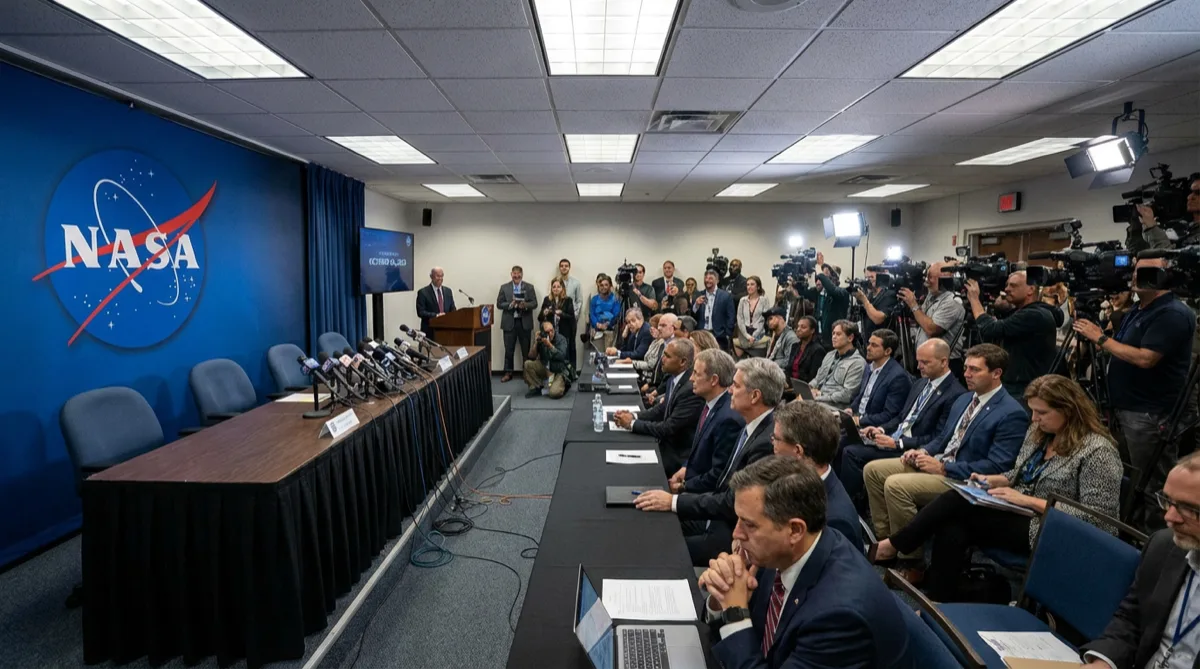
On September 14, 2023, NASA Administrator Bill Nelson stood before a packed briefing room at NASA Headquarters in Washington and made a simple pitch.
“We want to shift the conversation about UAPs from sensationalism to science.”
Behind him was the product of more than a year of work: a 36-page report from an independent panel of 16 scientists, engineers, and policy experts tasked with answering one question – how should the U.S. space agency approach the study of unidentified anomalous phenomena?
The answer was blunt. The data is terrible. And until that changes, no one – NASA included – can say much of anything definitive about what’s in the sky.
Update (May 1): A new Black Vault FOIA release shows NASA personnel revisited how the agency would communicate a confirmed discovery of extraterrestrial life in a June 2025 Teams meeting. The invitation described work to rough out “how an official communications protocol for a definitive discovery of ET life might look,” building on earlier astrobiology communications planning by Linda Billings, Jim Green, and others. The records do not present a final protocol, but they show NASA still actively preparing for the public and social meaning of confirmed life beyond Earth.
The Panel
NASA announced the UAP Independent Study Team in June 2022 and named its 16 members that October. The roster was deliberately heavyweight: chaired by David Spergel, president of the Simons Foundation and one of the world’s most cited astrophysicists, the team included former astronaut Scott Kelly, FAA safety officials, remote sensing pioneers, data scientists, and a SETI researcher.
The mandate was narrow by design. The panel would examine only unclassified data – no access to classified holdings, no overlap with the Pentagon’s All-domain Anomaly Resolution Office (AARO). The goal was to recommend how NASA’s scientific tools and institutional credibility could contribute to a whole-of-government effort.
The study officially kicked off on October 24, 2022. A public meeting followed on May 31, 2023, streamed live under Federal Advisory Committee Act procedures. The final report landed that September.
What They Found
The panel’s central finding was not about what UAP are. It was about what’s missing.
“We found that NASA can help the whole-of-government UAP effort through systematic data calibration, multiple measurements and ensuring thorough sensor metadata.” – David Spergel
The report identified six key obstacles:
- Poor sensor calibration – most UAP reports lack the technical metadata needed to reconstruct what a sensor actually captured
- No multi-sensor correlation – single-source observations can’t distinguish real objects from artifacts
- Eyewitness limitations – human reports are not reproducible and frequently lack the specificity needed for scientific analysis
- Inadequate civilian reporting – existing systems don’t collect structured data suitable for research
- Stigma – researchers and witnesses face ridicule that suppresses both reporting and serious inquiry
- No standardized data framework – without common formats and calibration standards, datasets can’t be compared or aggregated
The panel emphasized that NASA’s fleet of Earth-observing satellites generally lacks the resolution to detect small airborne objects. But those satellites can provide valuable environmental context – atmospheric conditions, weather patterns, ocean state – for events detected by other sensors.
The Recommendations
The report laid out five concrete proposals:
Use NASA’s observation network for context. When UAP events are detected by military or civilian sensors, NASA’s Earth and space assets could provide coincident environmental data to help rule out natural explanations.
Fix the data pipeline. Standardize calibration, metadata, and multi-sensor collection protocols. Consider multispectral and hyperspectral data to distinguish real objects from sensor noise.
Deploy AI and machine learning. NASA has deep expertise in large-scale data curation and analysis. The panel called AI/ML “essential tools” for finding rare anomalies in massive datasets – but only if the underlying data is well-characterized first.
Build a civilian reporting system. The panel proposed a crowdsourced, smartphone-based reporting tool that would capture imaging and sensor metadata from multiple observers simultaneously – a significant upgrade over existing hotlines and web forms.
Tap the aviation safety system. NASA’s long-running Aviation Safety Reporting System (ASRS) already provides confidential reporting for pilots. The panel recommended expanding its use for UAP encounters and integrating the data with FAA air traffic management systems.
A Director Without a Spotlight
Alongside the report, NASA announced the creation of a new position: Director of UAP Research. The agency appointed Mark McInerney, a NASA civil servant with a background in meteorology, climate science, and data management who had previously served as NASA’s liaison to the Department of Defense on UAP matters.
But the announcement itself illustrated the stigma problem the report described. During the briefing, NASA initially refused to name McInerney, citing threats and harassment that study team members had endured throughout the process.
“Some of the threats and the harassment have been beyond the pale, quite frankly.” – Daniel Evans, NASA’s designated federal official for the study
Nicola Fox, NASA’s Associate Administrator for the Science Mission Directorate, framed the role as essential:
“The director of UAP Research is a pivotal addition to NASA’s team.”
McInerney’s mandate included centralizing UAP-related data and communications, leveraging NASA’s AI and analytical capabilities, and serving as the agency’s point of contact for interagency coordination with AARO.
NASA named McInerney publicly later the same day.
The Silence Since
The report was well-received. It was praised for its rigor, its accessible language, and its unflinching acknowledgment that stigma is a real barrier. But what happened next – or rather, what didn’t – has drawn increasing scrutiny.
By July 2024, The Debrief reported that there had been virtually no public updates on implementation. The promised civilian reporting app had not materialized. No data portal had launched. McInerney had not responded to press inquiries. No regular progress reports had been issued.
NASA’s FOIA logs tell a suggestive story. The agency’s FY2025 Q2 log includes entries referencing communications involving the Director of UAP Research and a November 2024 NASA Office of Inspector General briefing on UAPs. The FY2026 Q1 log contains multiple additional UAP-related requests. People are asking questions. NASA isn’t volunteering answers.
McInerney’s current status is itself unclear. Some later references describe him as “former” Director of UAP Research, but no NASA press release announcing a successor has been located.
The Bigger Picture
NASA’s panel was one piece of a broader government reckoning with UAP that accelerated in 2023. That same summer, former intelligence officer David Grusch testified before Congress alleging the existence of secret crash-retrieval programs. The Pentagon’s AARO published its own annual report logging 757 UAP cases in FY2024, though the office has since struggled with accountability and missed deadlines.
Congress, meanwhile, has continued pushing. The FY2026 NDAA ordered AARO to brief lawmakers on 20 years of NORAD intercept data, and a new whistleblower has emerged with claims serious enough to prompt requests for classified SCIF briefings.
NASA’s study was supposed to be the scientific anchor for all of this – the institution that could bring credibility, data standards, and analytical firepower to a topic long dominated by secrecy and speculation. The 16-member panel delivered a credible blueprint. Whether anyone at NASA is still building from it remains an open question.
Timeline
| Date | Event |
|---|---|
| June 9, 2022 | NASA announces independent UAP study |
| October 21, 2022 | 16-member panel roster revealed |
| October 24, 2022 | Study officially begins |
| May 31, 2023 | First public meeting (livestreamed) |
| September 14, 2023 | Final report released; McInerney named UAP Research Director |
| July 12, 2024 | The Debrief reports minimal public follow-through |
| August 22, 2025 | NASA FOIA log includes UAP-related entries |
| January 22, 2026 | NASA FY2026 Q1 FOIA log includes multiple UAP requests |
Sources: NASA UAP Independent Study Team Final Report (PDF) · NASA News Release · Reuters · Associated Press · Space.com · Scientific American · The Guardian · The Debrief · The Black Vault – NASA extraterrestrial life communications FOIA · NASA FOIA release package (PDF)