Between July 1947 and February 1978, the Roswell incident was functionally invisible. No researchers investigated it. No books were written about it. The press never revisited it. In the vast catalog of UFO cases that accumulated during the 1950s and 1960s – the Washington, D.C. radar incidents, the Project Blue Book era, the wave of sightings that led to congressional hearings – Roswell wasn’t on anyone’s list.
It was a two-day story that happened and stopped.
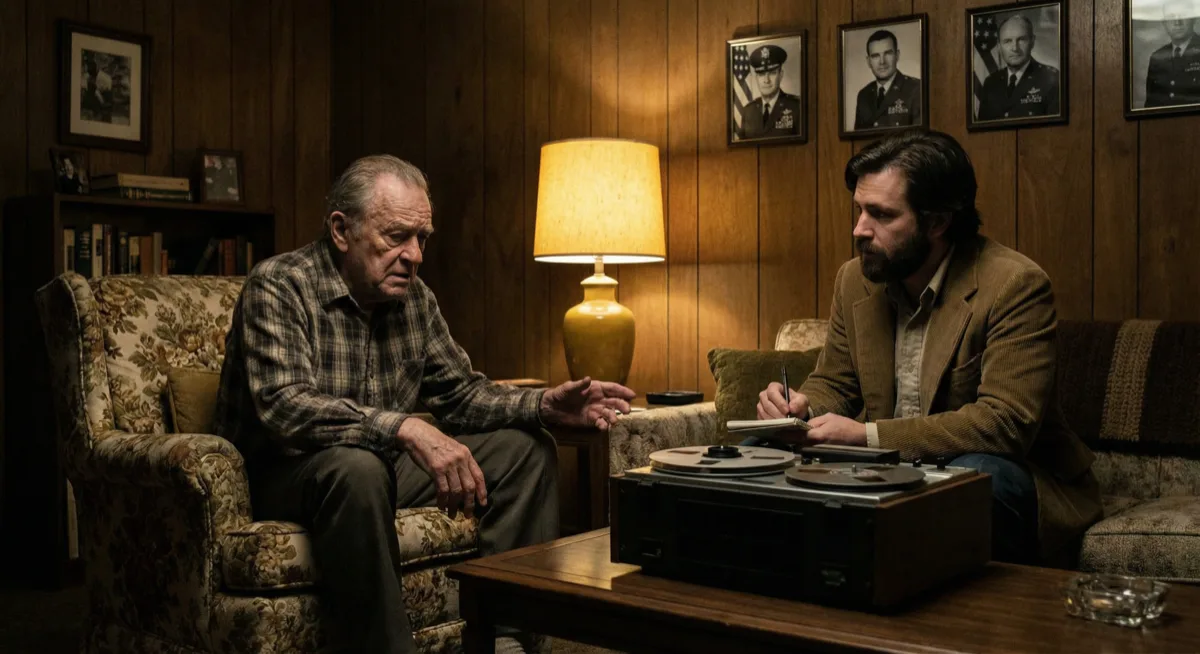
Then, in February 1978, a nuclear physicist named Stanton T. Friedman sat down with a retired military officer in a living room, turned on a tape recorder, and the most famous UFO case in history was born.
The Interview That Changed Everything
Friedman had been lecturing on UFOs for years when a chance lead brought him to Jesse A. Marcel – the same Maj. Marcel who had been the 509th Bomb Group’s intelligence officer in July 1947, the man who had driven out to the Foster Ranch and collected the debris.
Marcel was now retired. He was in his sixties. And he had a story he’d been carrying for thirty years.
In the interview, Marcel claimed the debris he recovered was extraordinary – not conventional materials, not a weather balloon. He said the material that was shown to the press at Fort Worth was not what he had collected. According to Marcel, the debris was switched before photographers arrived, and he was ordered to pose with substitute material – the balloon and radar reflector – for the cameras.
Marcel’s claims were a direct challenge to the official record. If what he said was true, the Fort Worth photo session wasn’t documentation – it was theater.
The interview was the ignition point. Friedman began tracking down other potential witnesses. The press started paying attention. Within two years, the first Roswell book was in production.
The Books That Built the Legend
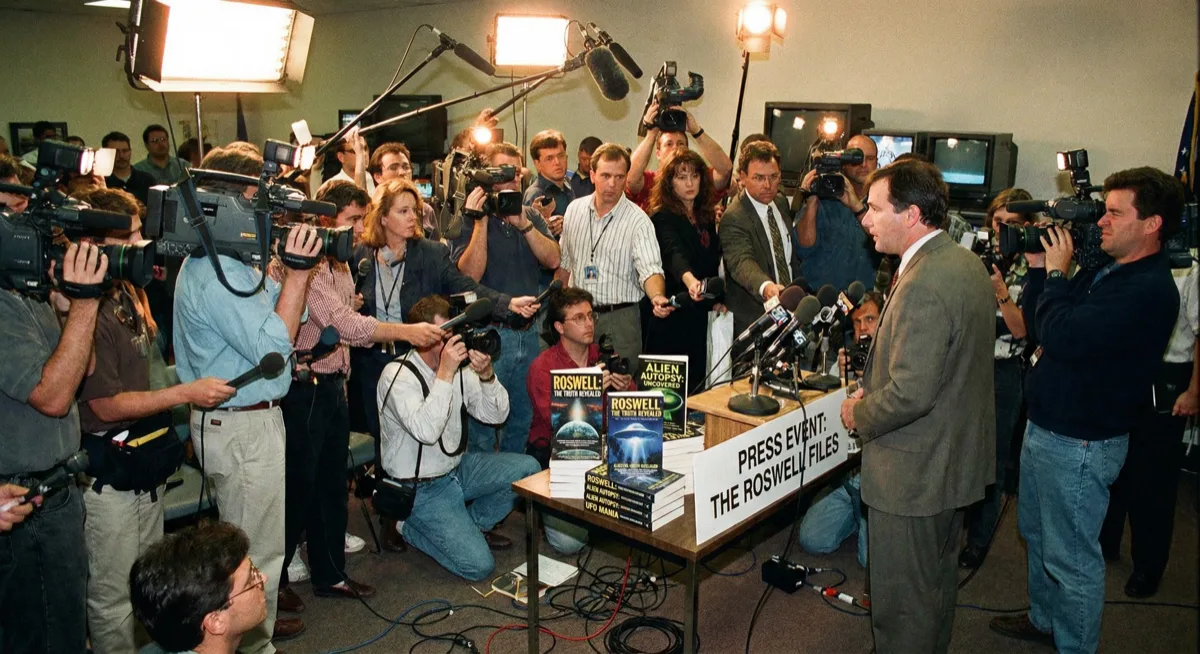
What followed was one of the most intensive witness-hunting campaigns in UFO history. Over the next seventeen years, a succession of books expanded the Roswell story from a debris field on a ranch to a multi-site recovery operation involving bodies, military cordons, and a cover-up reaching the highest levels of government.
| Year | Title | Authors | Key Claims |
|---|---|---|---|
| 1980 | The Roswell Incident | Charles Berlitz & William L. Moore | First widely read book to frame Roswell as a hidden event; introduces additional witnesses beyond the 1947 press record |
| 1991 | UFO Crash at Roswell | Kevin D. Randle & Donald R. Schmitt | Introduces the “bodies” storyline; builds a large witness network; becomes the catalyst for 1990s mainstream coverage |
| 1992 | Crash at Corona | Stanton T. Friedman & Don Berliner | Places the primary debris field near Corona, NM; diverges from Randle/Schmitt on locations and details; creates an alternate researcher camp |
| 1994 | The Truth About the UFO Crash at Roswell | Kevin D. Randle & Donald R. Schmitt | Updated version with additional witnesses; arrives during peak national attention |
| 1997 | The Day After Roswell | Philip J. Corso & William J. Birnes | Claims reverse-engineering and dissemination of Roswell-derived technology through U.S. defense and industry; bestseller; widely disputed by other Roswell researchers |
Each book built on the previous ones, but they didn’t always agree. Friedman and Randle differed on crash locations. Randle and Schmitt’s “bodies” narrative diverged from Friedman’s framing. Corso’s technology-transfer claims were rejected by nearly everyone else in the research community. The researchers investigating Roswell couldn’t agree on what had happened – only that something had.
The disagreements mattered. They meant the “Roswell story” was never a single coherent account. It was a constellation of overlapping, sometimes contradictory claims, held together by the original 1947 press release and Marcel’s late-career recollection.
The Witnesses: Who Came Forward, and When
As the books multiplied, so did the witnesses. Some were compelling. Others were not. Several turned out to be fabricators.
Jesse A. Marcel was the foundation – a credentialed military officer who had been directly involved in the 1947 events. His central claim – that the debris was switched before the Fort Worth press session – gave every subsequent witness a framework to build on. But Marcel’s recollections came more than thirty years after the fact, and key details varied across retellings. He remains the most important and most debated figure in the case.
W. Glenn Dennis, a Roswell funeral home director, came forward in 1989 with a dramatic account. He claimed the military had contacted him about small caskets and that a nurse at the base had told him about bodies and an autopsy. The nurse became a central element of his story – but investigators could never verify that she existed. The identification problem became a major point of contention.
Frank Kaufmann presented himself in the early 1990s as an insider participant with detailed knowledge and documentary proof of a major recovery operation. Prominent researchers initially treated his claims seriously and built significant portions of their narratives around his testimony. Then, in December 2002, investigators examined his papers and found falsified and forged documents along with major inconsistencies. Researcher Kevin D. Randle publicly withdrew confidence:
“No longer has any confidence in the stories told by Frank Kaufmann.”
The exposure was devastating. Kaufmann’s claims had been woven into published books and documentaries. Removing them left visible holes in the narrative.
Gerald Anderson promoted a “Plains of San Agustin” crash-and-bodies scenario involving his family, supported by a diary. The diary and supporting evidence were challenged by critics, and multiple investigators came to treat his account as unreliable.
James Ragsdale claimed proximity to a crash scene with bodies, supporting an expanded “second site” narrative. His accounts varied across interviews, and the chronology and location details were disputed among researchers themselves.
The Alien Autopsy
In 1995, at the peak of Roswell mania, British producer Ray Santilli released what he claimed was authentic footage of an autopsy performed on an alien body recovered from Roswell. The footage aired on television networks worldwide and became a cultural sensation.
It was a hoax.
In 2006, Santilli admitted the footage was fake – what he called a staged “reconstruction.” The admission confirmed what most serious researchers had already suspected, but the damage was significant. The “alien autopsy” had become one of the most widely seen pieces of Roswell-associated material in the world, and its fabrication reinforced the impression that the entire case was built on fraud.
The Cultural Machine
By the mid-1990s, Roswell had become something larger than a UFO case. It was a brand.
The International UFO Museum and Research Center was established in Roswell in the early 1990s, housed in a converted movie theater on Main Street. It became a nonprofit focal point for exhibits, archives, and public programming – and the anchor of a growing tourist economy.
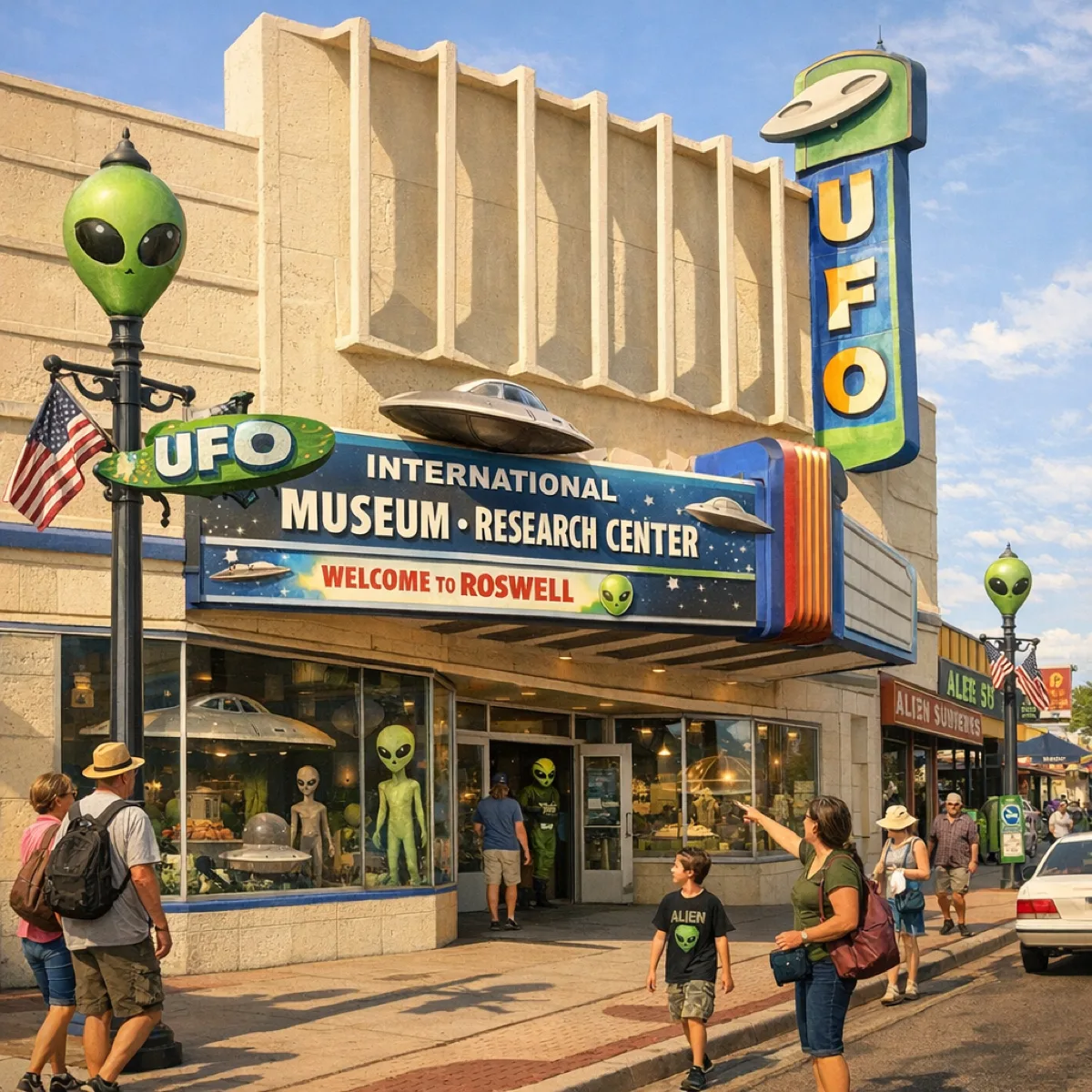
Annual festivals drew tens of thousands of visitors. Gift shops sold alien merchandise. The city’s streetlights were shaped like alien heads. Roswell had achieved something no other UFO case ever had: it had become a place – a destination, an industry, and an identity.
The commercial success had a complicated relationship with the research. On one hand, it kept public attention focused on the case. On the other, it blurred the line between investigation and entertainment. By the time the federal government finally reopened the file in the mid-1990s, it was difficult to separate the documented 1947 events from the mythology that had accumulated around them.
What the Revival Actually Accomplished
The 1978–1997 period did produce something of genuine value: it forced the U.S. government to revisit Roswell with modern investigative tools and public accountability. Marcel’s interview led to books. Books led to press coverage. Press coverage led to a New Mexico congressman requesting a formal federal records search.
But the revival also contaminated the evidentiary record. Witness accounts collected thirty to fifty years after the fact are inherently fragile. Memory changes. Narratives absorb details from other sources. And when fabricators like Kaufmann and Santilli are mixed into the witness pool, it becomes nearly impossible to assess any individual claim with confidence.
The Roswell revival turned a forgotten two-day story into the most famous UFO case in the world. Whether that fame ultimately helped or harmed the pursuit of truth about what happened in July 1947 is a question the case still hasn’t answered.
This is Part 2 of a three-part series on Roswell. Part 1: The Day the Army Said It Caught a Flying Saucer reconstructs the original 1947 events using only contemporaneous sources. Part 3: What the Government Actually Found examines Project Mogul, the Air Force reports, the destroyed records, and the questions that remain open.
Read the full series on the Roswell landing page.
Sources: CUFOS – Frank Kaufmann Exposed · CFI/SUN #75 – Roswell witness credibility · Time – Alien Autopsy hoax history · LA Times – Roswell anniversary coverage (1997) · Britannica – Roswell incident