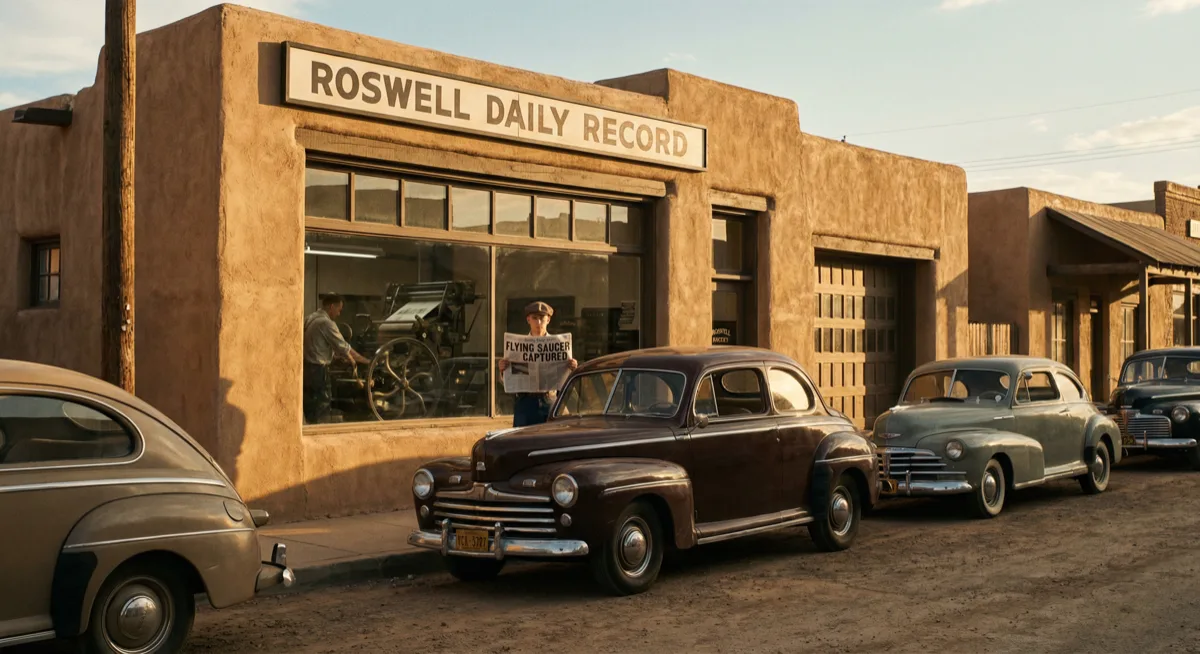
Most people know the Roswell story through a lens ground in the 1980s and 1990s – books, documentaries, museum exhibits, and decades of accumulated claims. Bodies. Hangars. Cover-ups reaching the White House. The legend is enormous.
But in July 1947, the Roswell incident was a two-day newspaper story. It appeared on a Tuesday, died on a Wednesday, and wasn’t mentioned again for thirty years.
This first installment strips the case back to what can be documented from that original window – the newspaper articles, the military records, the FBI teletype, and the photographs – all produced in July 1947, before memory, mythology, and money reshaped the narrative.
The Ranch and the Debris
Sometime in mid-June 1947, a ranch foreman named W. W. “Mack” Brazel found unusual material scattered across a stretch of the Foster Ranch, roughly 75 miles northwest of Roswell near Corona, New Mexico. He didn’t report it immediately. He gathered some of it and stored it in a shed.
On July 7, after hearing radio reports about “flying discs” being spotted across the country, Brazel drove into Roswell and brought samples of the debris to Sheriff George Wilcox. Wilcox contacted Roswell Army Air Field (RAAF).
That afternoon, Maj. Jesse A. Marcel – intelligence officer for the 509th Bombardment Group – drove out to the ranch with Capt. Sheridan Cavitt of the Counter Intelligence Corps to examine the site and collect material.
What happened next made the front page of every major newspaper in America.
The Announcement
At noon on July 8, 1947, the RAAF public information office issued a statement that was immediately picked up by the Associated Press and transmitted worldwide:
“The intelligence office of the 509th Bombardment group at Roswell Army Air Field announced at noon today, that the field has come into possession of a flying saucer.”
The full text, as printed in the Roswell Daily Record that afternoon, said the disc had been “recovered on a ranch in the Roswell vicinity” after “an unidentified rancher” notified Sheriff Wilcox. Major Marcel was named. The object had been “flown to higher headquarters.” No further details were released.
The story moved fast. The Sacramento Bee ran the AP wire version the same day. By the following morning, the Irish Times in Dublin was carrying it on its front page. The 509th Bomb Group’s claim of possessing a flying saucer was, briefly, the biggest news story in the world.
Why the 509th Mattered
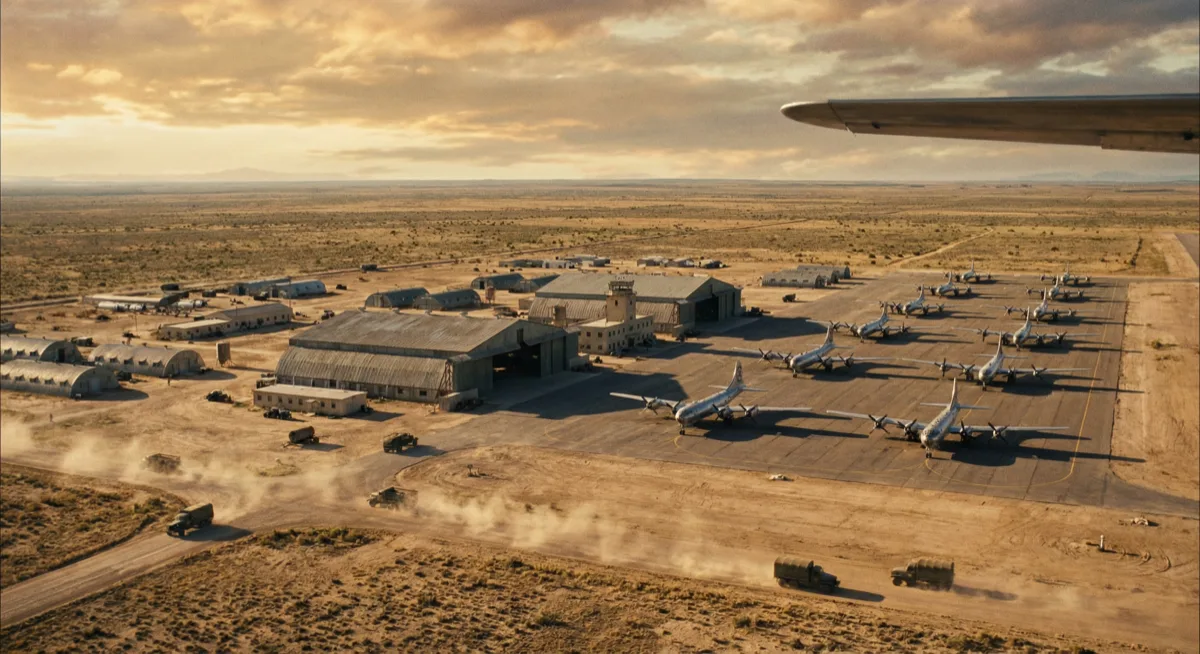
The speed and seriousness of the press reaction had everything to do with the source. Roswell Army Air Field wasn’t an ordinary military installation. It was home to the 509th Bombardment Group – the only unit in the world that had delivered atomic weapons in combat. The 509th had dropped the bombs on Hiroshima and Nagasaki. In 1947, it was the flagship nuclear-capable bomber group under Strategic Air Command.
When the intelligence office of that particular unit announced it had recovered a flying disc, it wasn’t a backwater rumor. It was a statement from the most sensitive military installation in the United States.
The Retraction
The announcement lasted less than a day.
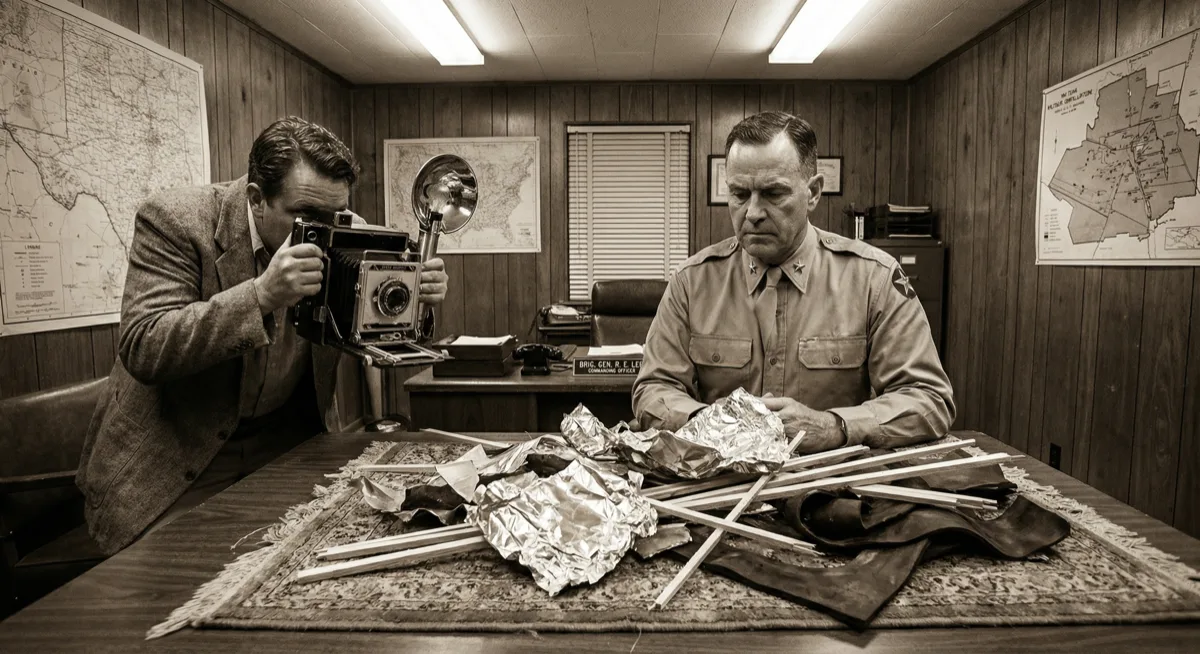
On the afternoon of July 8, the debris was flown to Fort Worth Army Air Field, headquarters of the Eighth Air Force. There, Brig. Gen. Roger M. Ramey – commanding officer of the Eighth Air Force – told reporters the Roswell excitement was not justified. The material, he said, was a weather balloon with a radar reflector.
Photographers were invited in. The resulting photo set, taken at Fort Worth, shows foil-like material and a balsa-wood framework consistent with a Rawin-style radar target – a kite-like reflective structure used for tracking weather balloons. Gen. Ramey, Col. Thomas DuBose (his chief of staff), Maj. Marcel, and Fort Worth weather officer Irving Newton all appear in different frames, posed with the debris.
By July 9, the front page of the Roswell Daily Record carried the reversal: Gen. Ramey’s balloon explanation, and a separate story about Brazel being “harassed” after the initial publicity.
The FBI had already weighed in. A teletype from the FBI Dallas field office to Washington, sent on July 8, relayed Eighth Air Force information describing the object:
“The disc is hexagonal in shape and was suspended from a balloon by cable, which balloon was approximately twenty feet in diameter.”
The teletype noted the object “resembles a high altitude weather balloon with a radar reflector” and that the disc and balloon were being transferred to Wright Field for examination.
Brazel’s Own Words
The July 9 Roswell Daily Record carried what appears to be a direct interview with Brazel – one of the only times the rancher’s own account appeared in print. His description of the debris was plain:
“Rubber strips, tinfoil, paper, tape, and sticks.”
But Brazel also pushed back against the explanation being offered:
“I am sure that what I found was not any weather observation balloon.”
And he made clear he’d learned a lesson about talking to the military and the press:
“But if I find anything else besides a bomb they are going to have a hard time getting me to say anything about it.”
How Fast It Died
The entire public episode lasted roughly 24 hours. On July 8, the world’s only nuclear-armed bomber unit said it had a flying saucer. On July 9, the Eighth Air Force said it was a weather balloon, and the story was over.
The July 1947 combined unit history for the 509th Bomb Group and Roswell Army Air Field – later excerpted in a GAO report – framed the incident as a brief public-relations surge:
The public information office “was kept quite busy” answering inquiries on the “flying disc”… The object turned out to be a radar tracking balloon.
No investigation was announced. No follow-up was reported. The press moved on. The public moved on. The 509th went back to its nuclear mission.
And for the next thirty years, nobody asked Roswell another question.
What the 1947 Record Contains
When the Government Accountability Office conducted a formal records search in the mid-1990s (at the request of New Mexico Congressman Steven Schiff), they found exactly two contemporaneous 1947 documents related to the incident:
- The July 1947 509th/RAAF monthly history report
- The July 8, 1947, FBI Dallas teletype
That was it. The GAO also discovered that RAAF administrative records covering March 1945 through December 1949 and outgoing messages from October 1946 through December 1949 had been destroyed – with no documentation indicating who destroyed them, when, or under what authority.
The documentary record from 1947 is thin by any standard. What survives tells a clear surface story: something was found, someone said “flying saucer,” someone else said “weather balloon,” and the matter was closed. What it doesn’t explain is why the announcement was made in the first place – and what, exactly, the people who made it thought they were holding.
Those questions wouldn’t be asked for another three decades. When they were, the answers would transform a forgotten two-day story into the most famous UFO case on Earth.
| Date | Event |
|---|---|
| Mid-June 1947 | Brazel discovers debris on the Foster Ranch |
| July 7 | Brazel brings samples to Sheriff Wilcox; RAAF contacted |
| July 8, noon | RAAF announces recovery of a “flying saucer” |
| July 8, afternoon | AP wire picks up the story worldwide |
| July 8, evening | FBI Dallas teletype describes “disc” suspended from balloon |
| July 9 | Gen. Ramey announces weather balloon explanation |
| July 9 | Brazel interviewed; says he’s done talking |
| July 31 | Monthly unit history records the incident as a brief PR episode |
This is Part 1 of a three-part series on Roswell. Part 2: How Roswell Was Reborn traces the 30-year silence and the explosive revival that turned a dead story into a global phenomenon. Part 3: What the Government Actually Found examines the federal investigations, Project Mogul, and the questions that remain open.
Read the full series on the Roswell landing page.
Sources: Roswell Daily Record, July 8, 1947 (Wikisource) · AP wire / Sacramento Bee clipping · Roswell Daily Record, July 9, 1947 (scan) · Irish Times, July 9, 1947 (scan) · FBI Dallas teletype (FBI Vault) · GAO/NSIAD-95-187 · Fort Worth Star-Telegram photos (SMU archive)