For forty-seven years, the official position of the United States government on the Roswell incident was the same one Gen. Roger Ramey offered reporters in Fort Worth on July 9, 1947: it was a weather balloon. Case closed.
Then, in the early 1990s, the case was forcibly reopened – not by UFO researchers, but by a U.S. congressman who wanted to know why the government’s own records didn’t add up.
What followed were two federal investigations, a classified Cold War program revealed, a theory about crash-test dummies, and a set of findings that answered some questions while making others significantly harder to ignore.
The Congressman Who Asked
Rep. Steven H. Schiff of New Mexico was not a UFO enthusiast. He was a Republican congressman responding to constituent inquiries about the 1947 incident. When he contacted the Department of Defense for information, he was redirected to the National Archives. When he went to the Archives, the records he was looking for weren’t there.
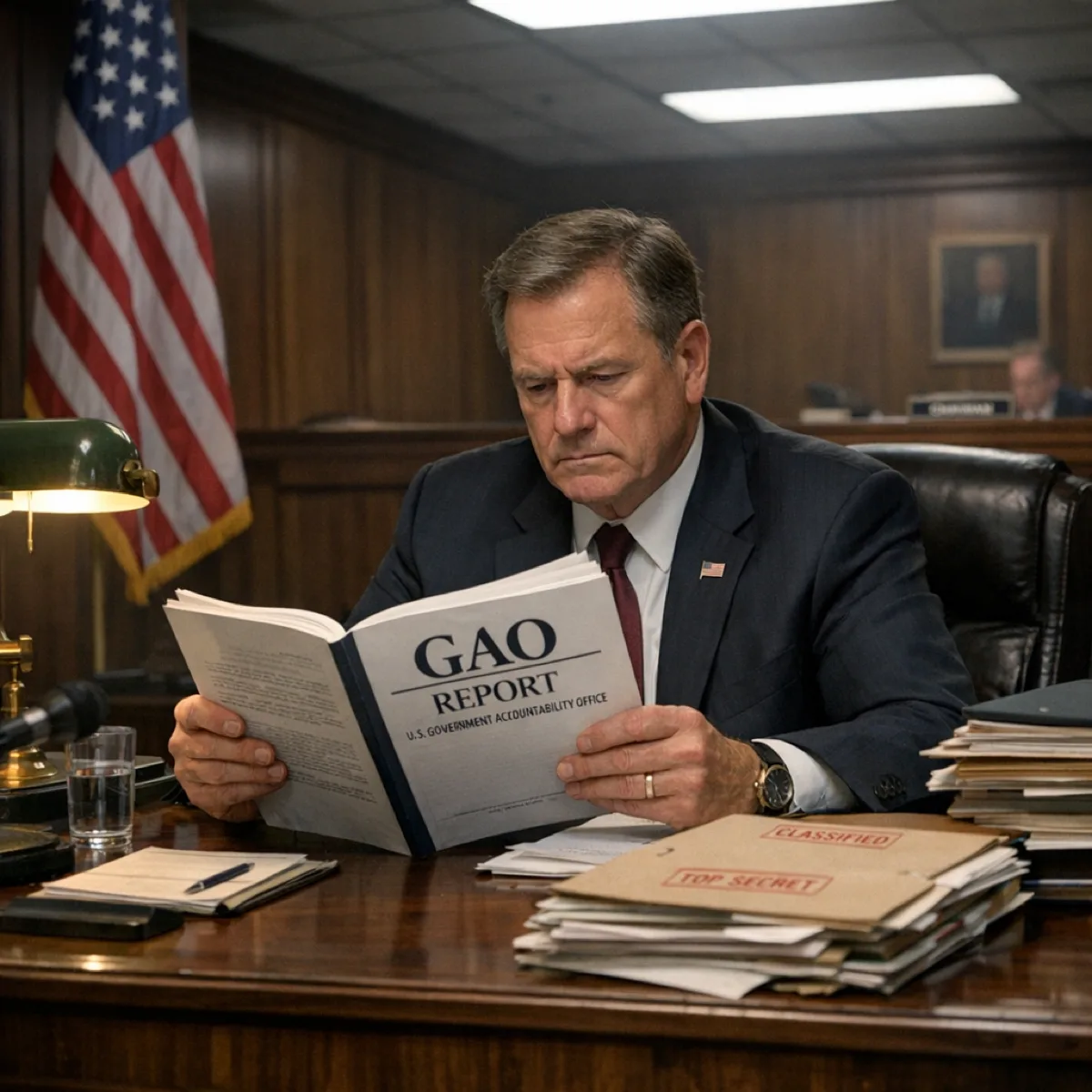
Schiff did what congressmen do when they can’t get a straight answer: he called the Government Accountability Office.
In 1994, the GAO initiated a formal records search across the Department of Defense, the FBI, the CIA, the National Security Council, and other agencies. Their mandate was straightforward: locate and review any records related to the 1947 crash near Roswell.
What the GAO Found – and Didn’t Find
The GAO’s report – GAO/NSIAD-95-187, published July 28, 1995 – is one of the most important documents in Roswell history, and one of the least sensational. It is a records audit, not a crash investigation. But its findings are stark.
The GAO searched classified and unclassified records spanning from 1947 through the 1950s. Across all agencies surveyed, they located exactly two contemporaneous 1947 records related to the incident:
- The July 1947 monthly history report of the 509th Bomb Group/RAAF – which noted the “flying disc” publicity and stated the object “turned out to be a radar tracking balloon”
- The July 8, 1947, FBI Dallas field office teletype – which described the recovered object and relayed the Eighth Air Force’s assessment
“Our search … yielded two records originating in 1947 … a July 1947 history report … and an FBI teletype message dated July 8, 1947.”
That was the surviving documentary record of the most famous UFO incident in history: two documents.
But the GAO’s most significant finding was about what was missing.
“RAAF administrative records … and RAAF outgoing messages … were destroyed. The document disposition form does not indicate what organization or person destroyed the records and when or under what authority the records were destroyed.”
The administrative records covering March 1945 through December 1949 and outgoing messages from October 1946 through December 1949 – the exact period encompassing the Roswell incident – had been destroyed with no accountability trail. The GAO could not determine who ordered the destruction, when it occurred, or why.
The GAO did not speculate about what the missing records might have contained. They simply documented their absence and the irregularity of the destruction.
The Air Force Report: Project Mogul (1994)
Running parallel to the GAO search, the U.S. Air Force conducted its own investigation and published the results in July 1994: Report of Air Force Research Regarding the “Roswell Incident.”
The Air Force concluded that something was recovered near Roswell in 1947 – but that it was not an extraterrestrial craft. The most likely source of the debris, the report said, was a classified government balloon program called Project Mogul.
Project Mogul was a Cold War initiative using high-altitude balloon trains – long chains of balloons carrying acoustic sensors and other instrumentation – to detect the sound signatures of Soviet nuclear tests at extreme altitude. The program was classified, but the balloons and their components were not exotic. They were assembled from standard neoprene weather balloons, balsa-wood frames, radar reflectors made of foil-covered balsa (Rawin targets), and various types of tape – including, in some accounts, tape with decorative printed patterns.
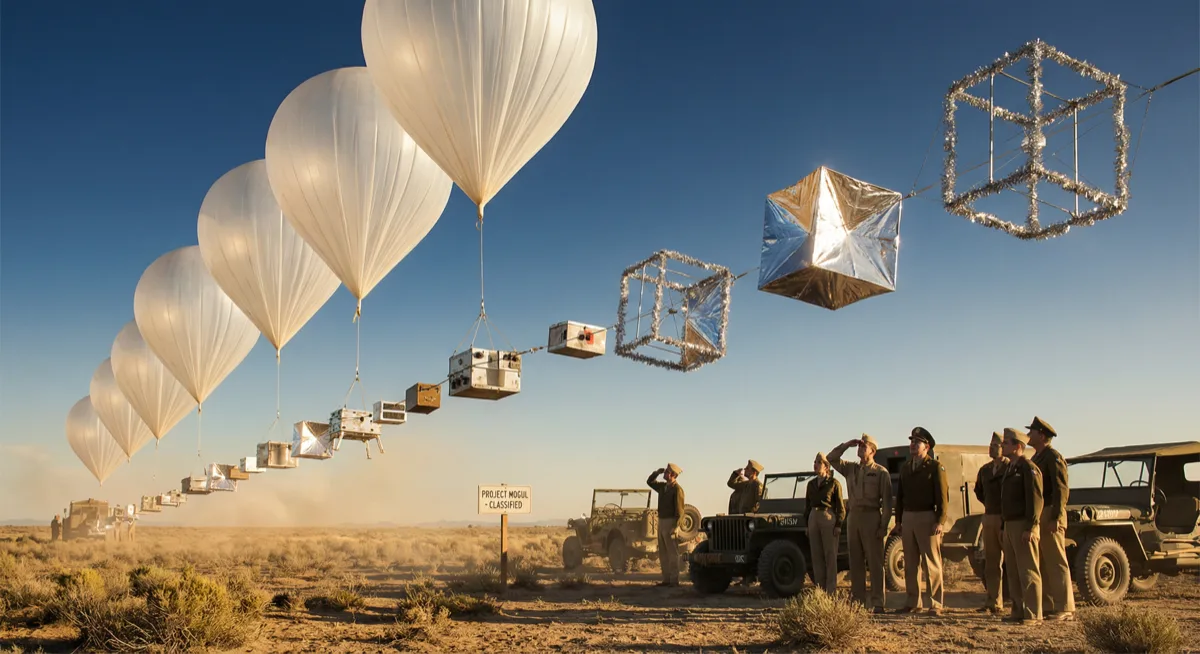
The Air Force’s case rested on a technical match: the debris descriptions from 1947 – rubber strips, tinfoil, paper, tape, sticks – were consistent with the components of a Mogul-type balloon train. The specific candidate was a June 1947 flight launched from the Alamogordo/White Sands region, geographically plausible for landing on or near the Foster Ranch.
The report also explained why a simple “weather balloon” cover story would have been used in 1947: the existence and mission of Project Mogul were classified. Acknowledging the balloon’s true purpose wasn’t an option. So the public explanation defaulted to the nearest unclassified analog – a weather balloon.
The Mogul explanation resolved several elements of the 1947 record. It accounted for the debris descriptions. It explained why the material seemed unfamiliar to a rancher but unremarkable to a weather officer. It provided a reason for the classified-to-mundane pivot in the official narrative.
But it didn’t resolve everything. The specific Mogul flight most often cited as the candidate has no definitive recovery log. Launch and tracking records for that particular balloon train are incomplete. Critics have argued that the match between the Roswell debris and Mogul components is plausible but not proven – an inference, not a documentation trail.
The Air Force Report: “Case Closed” (1997)
Three years later, the Air Force published a second report – The Roswell Report: Case Closed – addressing a different problem: the “alien bodies” claims that had accumulated during the revival era.
The Air Force’s answer was anthropomorphic test dummies.
The report argued that stories of recovered non-human bodies were misidentifications and memory conflations involving U.S. Air Force test programs in New Mexico during the 1950s. The Air Force had conducted high-altitude parachute and ejection-system tests using human-shaped dummies, which were dropped from aircraft and recovered by military teams in the desert. The dummies were transported in insulated bags. Recovery crews wore protective equipment.
The Air Force proposed a psychological mechanism it called “time compression”: witnesses had collapsed separate events from different years – the 1947 debris recovery and 1950s dummy-drop operations – into a single narrative, producing the “alien bodies at Roswell” storyline.
The “Case Closed” report was widely criticized. Press coverage ranged from skeptical to mocking. The central problem was the timeline: the dummy tests cited by the Air Force occurred in the mid-to-late 1950s, years after the 1947 incident. Asking the public to accept that witnesses had merged events separated by a decade into one memory was a significant ask – and most observers, including many who accepted the Mogul explanation for the debris, found the dummy theory unconvincing.
The Ramey Memo
One piece of 1947 evidence remains unresolved and continues to generate research: the Ramey memo.
In one of the Fort Worth photographs, Gen. Ramey is holding a piece of paper in his hand. The paper is partially visible. If its text could be read, it could reveal what senior command believed they were dealing with on July 8, 1947 – before the public explanation was finalized.

Multiple researchers have subjected the photograph to digital enhancement. Different enhancement workflows have produced different apparent letterforms. Claimed readings include phrases that would be extraordinary if confirmed – but no consensus reading has been accepted, and the underlying image quality limits confident transcription.
In 2015, researcher Kevin Randle summarized a renewed effort to locate original negatives and pursue higher-resolution examination. The results were inconclusive. The memo remains legible enough to tantalize and too degraded to resolve.
What Remains Open
After two major federal investigations, the Roswell case sits in an unusual position. The government has provided explanations for both the debris (Project Mogul) and the bodies claims (test dummies). The debris explanation is plausible and widely – though not universally – accepted. The bodies explanation is not.
But neither investigation addressed the questions that matter most:
Why did Roswell Army Air Field publicly announce “possession of a flying saucer” on July 8, 1947? The wording of the announcement is the ignition point for the entire Roswell narrative. Even if the debris was balloon-related, the institutional pathway that produced the language – from a nuclear-armed bomber base – has never been explained.
Who specifically ordered the announcement, and what did they believe they had? Contemporaneous records don’t document the decision chain. Later recollections conflict. And the administrative records and outgoing messages that might contain the answer were destroyed.
Is a specific Mogul flight definitively matched to the Roswell debris? Official explanations rely on technical matching and circumstantial launch timing. The match is reasonable but not documentary. No recovery log for the candidate flight has been found.
What does the Ramey memo say? If legible, the text could clarify what senior command understood on the day the story broke. Decades of enhancement attempts have produced no consensus.
The Roswell case began on a Tuesday afternoon in 1947 with a press release from the world’s most sensitive military installation. Nearly eighty years later, the fundamental question – what prompted that announcement, and what did the people who made it think they were holding – remains unanswered.
The government has told us what Roswell was. It has not explained why the people closest to it, in real time, described it the way they did.
This is Part 3 of a three-part series on Roswell. Part 1: The Day the Army Said It Caught a Flying Saucer reconstructs the original 1947 events from contemporaneous sources. Part 2: The 30-Year Revival traces how a forgotten story became the most famous UFO case in the world.
Read the full series on the Roswell landing page.
Sources: GAO/NSIAD-95-187 (July 1995) · Air Force 1994 Report – Roswell Incident (DoD FOIA) · U.S. Air Force – The Roswell Report · The Roswell Report: Case Closed (Archive.org text) · Kevin Randle – Ramey memo update (2015)