
Update (October 7): Liberation Times published 67 NRC drone reports, February 2024 through March 2026, covering 28 nuclear sites. Every entry is marked Closed Unresolved. Surry, about 20 miles from Langley, recorded December 2024 flights over both reactor buildings. Full article →
Update (August 27): After the interview, NewsNation’s episode page put hard numbers on Johnson’s log: close to 300 drone and UAP flyovers at commercial plants from 2014 to 2025, with fewer than 1% traced to an operator. The page also describes a December 2024 case at Surry in Virginia in which lights vanished and reappeared about a mile away within seconds, then ascended. Coulthart posted declassified NRC records; public ADAMS package ML24233A176 is Johnson’s August 2023 email on adding UAP to flyover reporting guidance. NewsNation → · NRC ADAMS →
Ross Coulthart’s latest Reality Check is not another crash-retrieval leak. It is a security briefing from inside the civilian nuclear regulator.
The guest is Daryl Johnson, who spent about 15 years as a senior intelligence specialist and senior security analyst at the U.S. Nuclear Regulatory Commission. In that job he reviewed suspicious-activity reports from commercial nuclear sites nationwide. On NewsNation, Coulthart introduced him as the man who investigated drone and UAP flyovers at those plants – and said what Johnson found is “gravely concerning”: almost all of the incidents were never identified.
Johnson’s book, Unguarded Skies: Safeguarding America’s Commercial Nuclear Fleet Against UAPs and Drones of Unknown Origin, came out June 28. He describes it as built on unclassified NRC records, public documents, and FOIA releases from that tour. The White House and the NRC have not issued a statement on the interview.
What the Public Record Already Shows
The interview lands on a paper trail that is already in the open. In April, Liberation Times published NRC records the commission sent to AARO – 22 drone incidents at U.S. nuclear power plants between September 2022 and February 2023.
The worst cluster was Susquehanna Steam Electric Station in Pennsylvania: eight incidents in a little over a month. On September 26, 2022, eight drones were in the plant’s airspace for about two hours and 45 minutes. On October 3, at least four objects approached from multiple directions. Three looked like quadcopters. A fourth was triangular and carried a large spotlight.
Columbia Generating Station in Washington logged nine incidents across nearly three months, including one object estimated at 8 to 10 feet across. That site sits a few miles from the old Hanford complex, which has UAP reports going back to the Manhattan Project era.
Congress already told AARO to count this. The FY2022 NDAA requires the office, in consultation with the NRC chairman, to record “unidentified aerial phenomena or drones of unknown origin” at NRC-regulated plants and fuel sites in its annual reports. An NRC spokesperson told Liberation Times in 2023 that the agency takes aircraft, UAS, and UAP threats seriously, requires licensees to report suspicious air activity, and coordinates with intelligence and law enforcement.
Johnson’s point, as Coulthart framed it, is that the reporting stream is larger than those six months – and that identification almost never happens.
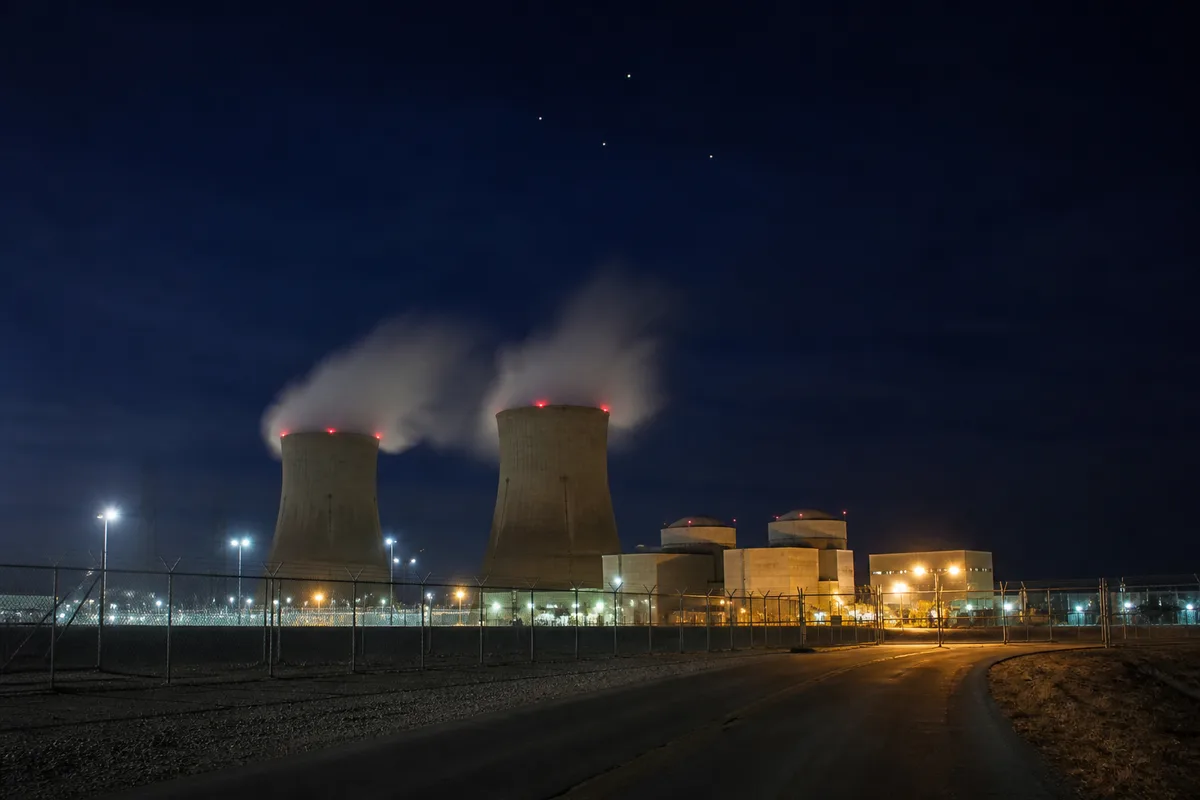
Most Plants Were Not Built to See What Is Overhead
Commercial reactors were licensed around ground-level security: fences, cameras, armed response, vehicle bombs. They were not designed as air-defense sites. Johnson has said that most plants still lack radar or other aerial-detection requirements that would tell operators what is actually in the exclusion zone. Temporary flight restrictions and “see and report” procedures are not the same as tracking.
That gap is why a triangular object with a spotlight can spend time over a boiling-water reactor and leave a paper incident report instead of a radar track. It is also why “drone” and “UAP” sit in the same files. Some of the 2022–23 objects look like quadcopters. Some do not.
The Same Problem, Next Door, at the Bomber Bases
The civilian fleet is not isolated from the military one. In March 2026, jamming-resistant drone waves shut down Barksdale Air Force Base – home to B-52s and Air Force Global Strike Command – for the better part of a week. Langley had 17 nights of it in 2023. Last week, NORTHCOM’s deputy commander told a Huntsville audience that U.S. bases are still “ill-equipped” to stop a small-drone swarm, with detection the biggest hole. That roundup →
Johnson is talking about the commercial reactors that sit outside those fences: the plants that feed the grid, not the bomber tarmac. The reporting channel is the NRC, not NORAD. The objects, and the identification failure, rhyme.
Why Coulthart Put Him On
Coulthart has been arguing for years that whatever is in U.S. airspace shows a persistent interest in nuclear weapons and nuclear power – Pantex, Los Alamos-era green fireballs, plant overlights. Johnson is not a crash-retrieval witness. He is a career analyst who sat on the civilian reporting pipe and has now put the unclassified slice in a book.
That is a different kind of source than a whistleblower describing a vault. It is also harder to wave off as rumor. The Susquehanna triangle is in NRC-to-AARO correspondence. The NDAA already treats unknown-origin drones over NRC sites as a reporting category. Johnson’s claim is that if you read the whole commercial-fleet file, almost none of it resolves.
No NRC press office has confirmed his on-air characterization of the identification rate. The documents Liberation Times published do not include a fleet-wide “percent identified” table. What they do show is a six-month slice in which objects – some quadcopter-shaped, some not – operated over running plants and were written up, not explained.
Sources: Ross Coulthart on X · Unguarded Skies (Amazon) · Liberation Times – NRC FOIA · Barksdale article