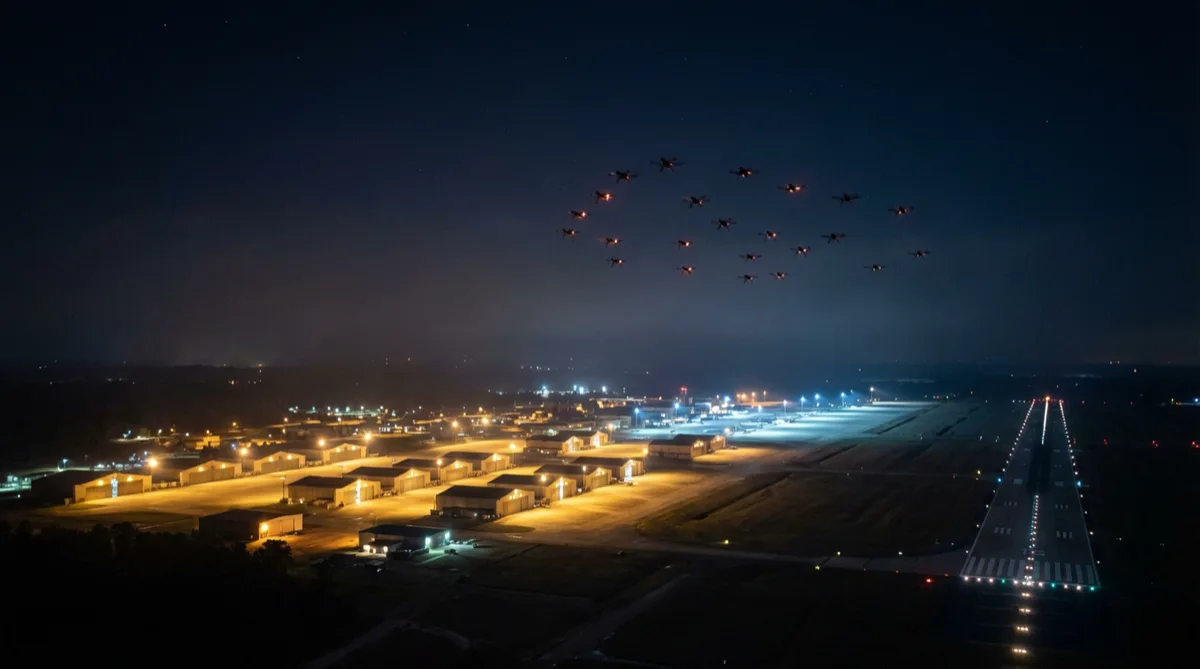
Update (October 7): A new NRC FOIA set includes five December 2024 Surry reports, about 20 miles from the base. One account says a drone passed over both reactor containment buildings. Fort Eustis told the plant a drone was on radar at about 300 feet. Separate PHALANX logs for that month recorded no detects inside Langley’s boundary. Full article →
Update (September 26): Sen. Mike Rounds, asked whether China shut Langley for 17 days in 2023 and forced F-22s to relocate, told Ask a Pol: “I can’t talk about that right now.” He pointed to legislation to keep adversary-controlled buyers off land near sensitive sites, and said U.S. capabilities do not keep the Intelligence Committee awake at night. Ask a Pol → · This week’s roundup →
Update (August 17): At the same Space and Missile Defense Symposium week, Army Lt. Gen. Joseph Jarrard, NORTHCOM deputy commander and U.S. NORAD vice commander, said homeland bases are “ill-equipped” against small-drone swarms because many lack sensors and effectors. Fox News paired the remarks with Secretary Marco Rubio’s UAP-over-bases comments while noting Jarrard was describing cheap attack drones. Fox → · This week’s roundup →
Update (August 12): Retired Gen. Glen VanHerck, NORAD/NORTHCOM commander during the Langley swarms, told a Space and Missile Defense Symposium panel the incursions were “no surprises” after years of homeland domain-awareness warnings – and that commanders felt they lacked authority to act. He still “provided no new details about who was operating the drones,” The War Zone reported. TWZ → · This week’s roundup →
On the evening of December 6, 2023, someone at Joint Base Langley-Eustis in Hampton Roads, Virginia, looked up and saw something that shouldn’t have been there. Unmanned aircraft – multiple, unidentified, unauthorized – were flying over one of the most sensitive air bases in the United States.
It kept happening. For 17 consecutive nights, drones of varying sizes and configurations entered Langley’s restricted airspace after sunset. The base is home to F-22 Raptor stealth fighters and serves as headquarters for Air Combat Command, the organization responsible for organizing, training, and equipping U.S. combat airpower.
The Air Force couldn’t stop them. The FBI couldn’t identify them. And more than two years later, no one has publicly said who was responsible.
What They Saw
The nightly pattern was consistent. Retired Gen. Mark D. Kelly, who was commanding Air Combat Command at the time, described the reports in a CBS 60 Minutes interview:
“The reports were coming in 20-to-30 sightings, same time every evening, 30-to-45 minutes after sunset.”
The drones ranged widely in size:
“The smallest, you know you’re talking about a commercial-size quadcopter. And then the largest ones are probably size what I would call a bass boat or a small car.”
Other accounts filled in details. Some drones were described as approximately 20 feet long, flying at roughly 100 mph. Some were loud – compared to lawnmowers – while others were nearly silent. They flew at varying altitudes and airspeeds, making tracking difficult.
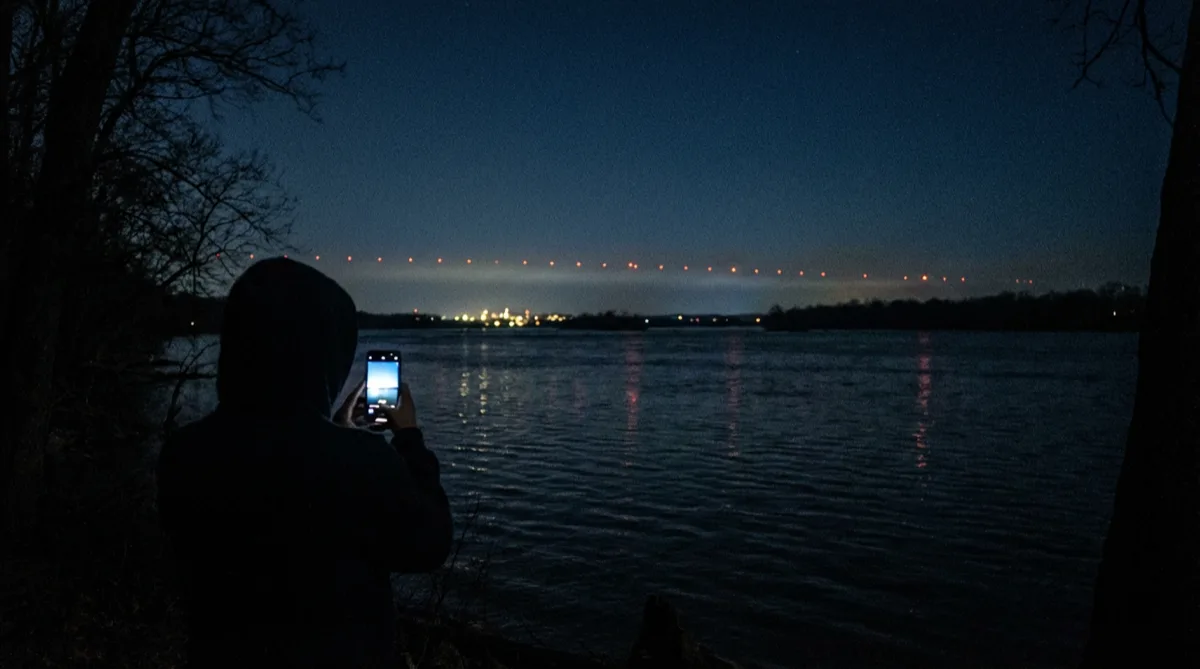
On December 14, civilian Jonathan Butner watched from the James River area as a procession of objects with reddish-orange flashing lights headed toward the base. He filmed for nearly 90 minutes.
“I probably saw upwards of 40 plus. When I first saw that, I was like, ‘Those are going directly over Langley Air Force Base.’”
Butner later turned his video over to the FBI.
The Response
The military’s response unfolded across multiple agencies – and revealed how few tools they had.
Langley notified the FAA and coordinated with local law enforcement and other federal agencies. The FBI, DoD, and the Pentagon’s All-domain Anomaly Resolution Office (AARO) held joint meetings for roughly two weeks trying to identify the source. A NASA WB-57 high-altitude research aircraft was reportedly deployed for observation.
But the most telling response was operational: according to CBS 60 Minutes and Breaking Defense reporting, the Air Force temporarily relocated its F-22 stealth fighters and paused or suspended nighttime training at Langley during the incursion period. The most advanced air-superiority fighter in the U.S. inventory was moved because of drones that couldn’t be identified or stopped.
By October 2024, Langley’s contracting office posted a notice seeking proposals for counter-drone netting to protect aircraft shelters – a physical barrier solution to a problem the base’s electronic defenses hadn’t solved.
Going Public
The story didn’t reach the public for months. The War Zone broke the news on March 15, 2024, after obtaining a statement from a Langley spokesperson:
“The installation first observed UAS activities the evening of December 6 [2023] and experienced multiple incursions throughout the month of December. The number of UASs fluctuated and they ranged in size/configuration.”
“None of the incursions appeared to exhibit hostile intent but anything flying in our restricted airspace can pose a threat to flight safety.”
The Wall Street Journal published a detailed account on October 12, 2024, describing a “17-day swarm” and noting that drones had also been spotted over Naval Station Norfolk and the surrounding Hampton Roads region.
Three days later, Deputy Pentagon Press Secretary Sabrina Singh officially confirmed the incursions:
“Langley Air Force Base did experience incursions of unauthorized unmanned aerial systems (UAS) last year in December 2023. The number of those UAS incursions did fluctuate, but they didn’t appear to exhibit any hostile intent. It’s something that we have kept our eye on.”
She added that the DoD was still assessing who controlled the drones and did not know why they were in the area.
Not an Isolated Case
Langley wasn’t alone. The incursions fit a pattern of unauthorized drone activity over sensitive U.S. installations that has accelerated in recent years:
| Date | Location | Details |
|---|---|---|
| July 2019 | Off Southern California | Drone swarms harassed Navy destroyers during training exercises over multiple nights |
| October 2023 | Nevada National Security Site | Five drones detected over a nuclear weapons experimentation facility |
| August 2024 | Plant 42, Palmdale, CA | Drone incursions over classified aerospace facilities prompted temporary flight restrictions |
| November 2024 | New Jersey military sites | Widespread sightings near Picatinny Arsenal and Naval Weapons Station Earle triggered federal investigation |
The New Jersey drone wave in late 2024 generated the most public attention – roughly 5,000 tips to an FBI hotline – but officials and lawmakers pointed to Langley as the incident that should have triggered a stronger response months earlier.
In May 2024, a senior defense official told reporters that U.S. bases were seeing two to three drone incursions per week, and that officials treat every one as potentially nefarious until proven otherwise.
The Policy Fallout
The Langley incursions became a catalyst for reform – though critics say the response has been too slow.
Sen. Tim Kaine (D-VA) said the incident laid bare a systemic failure:
“We just need to have a protocol for what to do when these drones are sighted, and especially if they’re sighted near military installations, and the Langley event a year ago showed we don’t really have a protocol.”
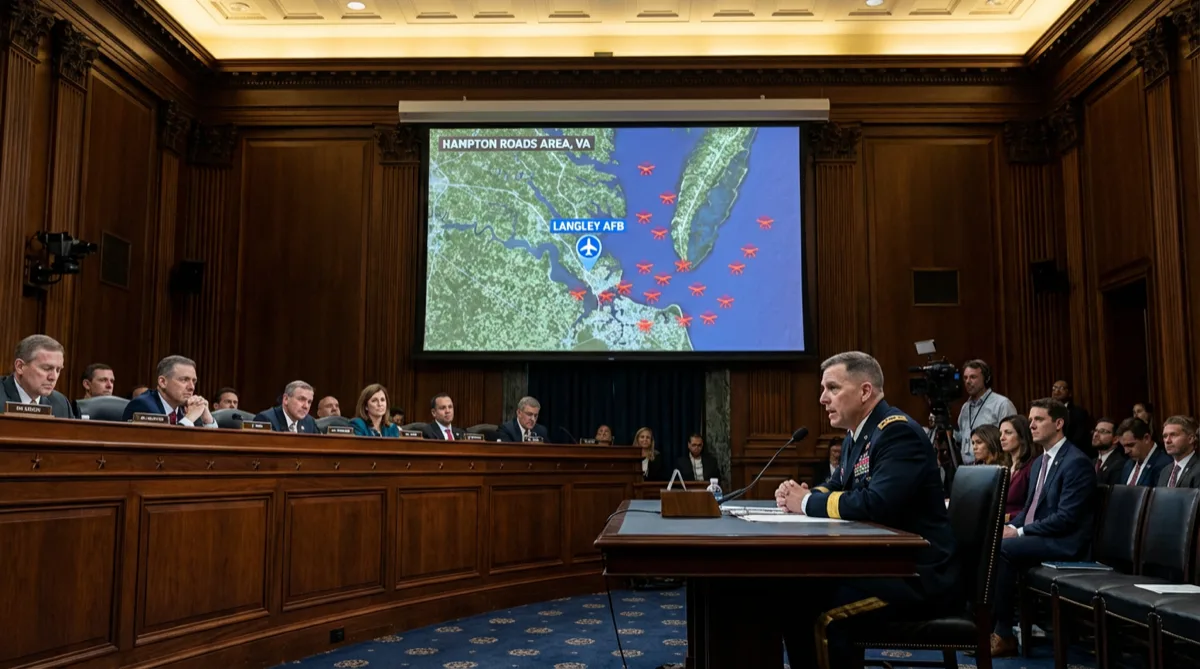
At a House oversight subcommittee hearing in April 2025, Rear Adm. Paul Spedero, Vice Director for Operations on the Joint Staff, was blunt:
“Mass drone incursions over Joint Base Langley-Eustis in December 2023 reminded us that the homeland is no longer a sanctuary, and should our adversary choose to employ drones for surveillance or even attack, we would not be prepared to adequately defend our homeland and only marginally capable to defend our military installations.”
The reforms have been incremental. In April 2025, NORAD/NORTHCOM issued an updated counter-drone standard operating procedure for all U.S. base commanders. The FY2026 NDAA, signed into law in December 2025, included provisions mandating a DoD counter-UAS strategy and expanding reporting requirements for drone incursions at military sites.
But a DoD Inspector General report published in January 2026 found that bureaucratic confusion still leaves many installations exposed. The report identified inconsistent coverage under the legal authorities (Title 10 §130i) that govern which bases can even deploy counter-drone defenses, and found that some installations don’t know whether they qualify.
Virginia lawmakers pursued their own track, introducing state legislation in January 2025 to stiffen penalties for drone operations near defense facilities.
What Remains Unknown
More than two years after the incursions, the central questions remain unanswered:
- Who operated the drones? No individual, group, or nation-state has been publicly identified.
- What was their purpose? The Pentagon said no hostile intent was observed, but some lawmakers have suggested coordinated foreign intelligence collection.
- How did they evade detection and response? The base’s restricted airspace and the presence of advanced radar and fighter aircraft did not prevent 17 nights of overflights.
The debate over attribution mirrors the broader challenge documented across America’s drone incursion problem. Some officials believe many incidents involve hobbyists or lawful operators who wander into restricted zones. Others – including Rep. William Timmons, who chaired the House oversight subcommittee hearing – have characterized the pattern as a potential coordinated adversary intelligence effort.
What isn’t debated is that the drones were real, they were over a critical military installation, and the nation’s most powerful air base didn’t have the tools or authority to deal with them.
Seventeen nights. Zero answers.
Sources: The War Zone (Mar 2024) · Air & Space Forces Magazine · Task & Purpose · WHRO (Oct 2024) · WHRO (Dec 2024) · Wall Street Journal · CBS 60 Minutes · Defense One · Breaking Defense · Army Times · The War Zone – Counter-Drone Netting · WTKR · Reuters