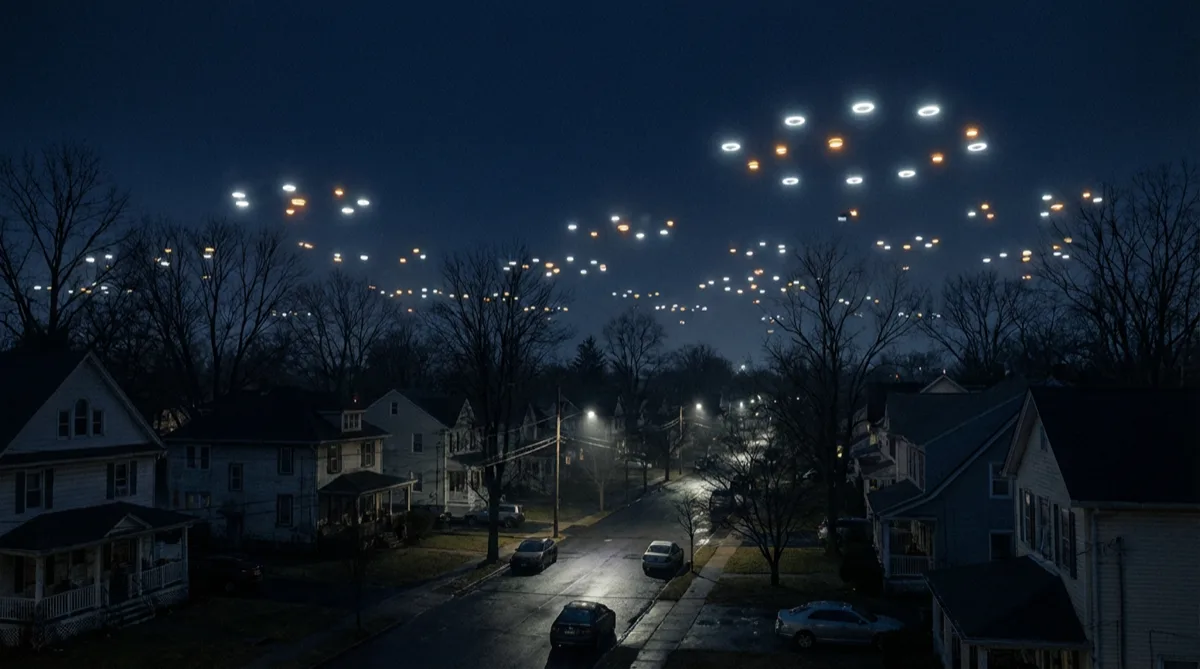
On the night of December 12, 2024, U.S. Senator Andy Kim climbed into a police vehicle in Clinton Township, New Jersey. He wasn’t there for a photo opportunity. For nearly two hours, the senator and Clinton Township Police drove between spots in Hunterdon County where residents had been reporting strange lights in the sky.
They counted dozens.
“People deserve answers. It’s hard for people to feel secure when there are unexplained drones flying overhead and they’re not getting answers they need from the federal investigation.”
Kim’s midnight ride was one snapshot from a six-week stretch that would generate approximately 5,000 tips to an FBI hotline, shut down an airport runway, prompt confirmed incursions over a Navy weapons station, and expose a gap in the country’s ability to identify what is flying in its own airspace.
How It Started
The first reports surfaced quietly. On November 18, 2024, the New Jersey Suspicious Activity Report System logged multiple alerts about unidentified unmanned aircraft systems (UAS) near critical infrastructure. Within two days, FBI Newark had opened a formal investigation.
By November 25, the FAA imposed temporary flight restrictions over sensitive sites including the Picatinny Arsenal area in Morris County. But public attention didn’t ignite until early December.
On December 3, the FBI, New Jersey State Police, and the state’s Office of Homeland Security and Preparedness took the unusual step of publicly asking residents to report information about “a cluster of what look to be drones and a possible fixed wing aircraft” spotted along the Raritan River corridor. An 1-800 tip line and online reporting portal went live.
The floodgates opened.
The Peak Week
Between December 11 and 14, the mystery swallowed the news cycle. Sightings spread across New Jersey and into New York, Connecticut, and Pennsylvania. The key events cascaded rapidly:
December 11 – The Pentagon addressed the wildest theory head-on. Rep. Jeff Van Drew (R-NJ) had publicly claimed that an Iranian “mothership” offshore was launching drones toward the U.S. coast. Pentagon spokesperson Sabrina Singh was blunt:
“There is no truth to that. There is no Iranian ship off the coast of the United States.”
December 12 – The White House, FBI, and DHS issued a joint statement: there was no evidence the sightings posed a national security or public safety threat. Many reports, they said, appeared to be lawful manned aircraft.
“To be clear, they have uncovered no such malicious activity or intent at this stage.” – FBI/DHS joint statement
The same day, U.S. Senators Cory Booker, Chuck Schumer, Kirsten Gillibrand, and Andy Kim fired off a letter demanding a federal briefing. In Delaware County, Pennsylvania, a Reuters witness reported about six craft with red and green blinking lights passing overhead roughly 10 miles from Philadelphia International Airport. In Enfield, Connecticut, police confirmed 15 to 20 drone sightings in a single night.
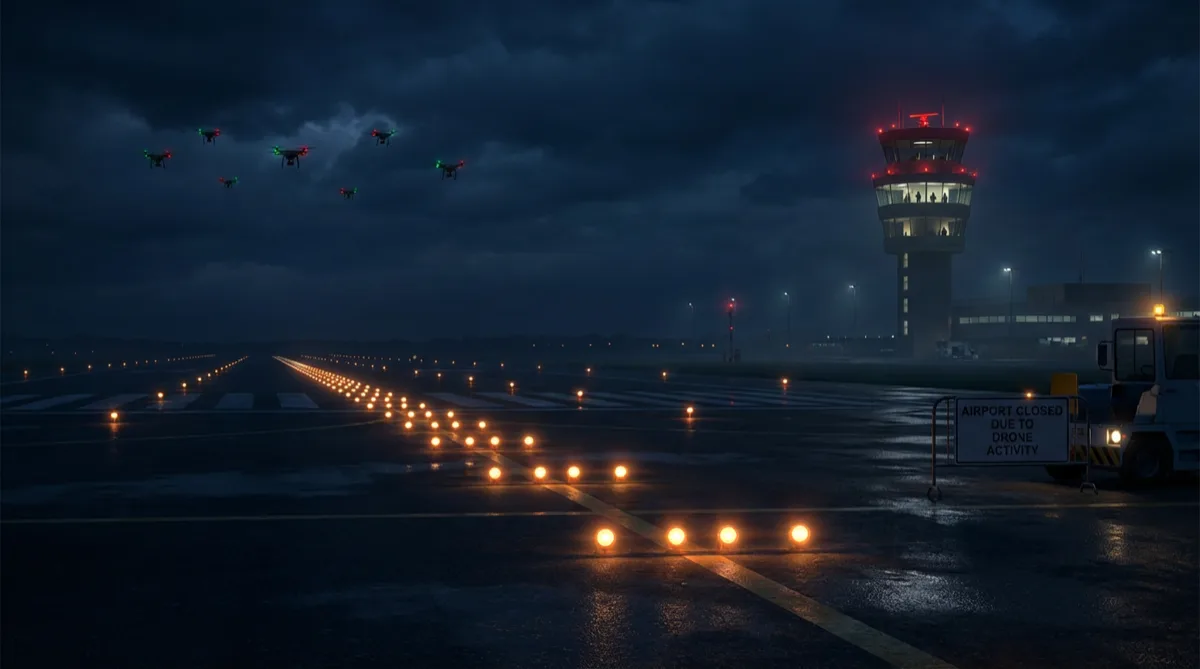
December 13 – Things escalated. Naval Weapons Station Earle in Colts Neck confirmed what had been rumored: “multiple instances of unidentified drones entering the airspace above the installation.” That evening, Stewart International Airport in Orange County, New York, shut its runways for approximately one hour after the FAA flagged a drone report near the field around 9:30 p.m. On Staten Island, local officials reported drones hovering near the Verrazzano-Narrows Bridge, Fort Wadsworth, and Port Liberty.
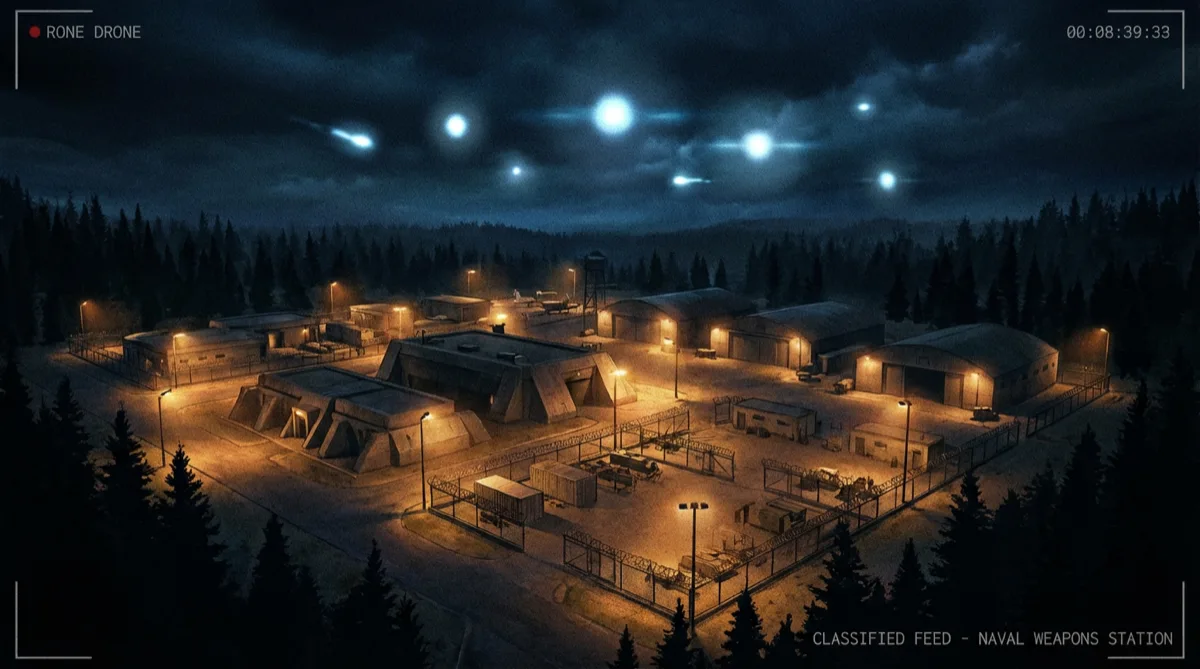
December 14 – An interagency background press call put numbers to the situation: roughly 5,000 tips had come in, but fewer than 100 leads warranted further investigation. White House National Security Communications Adviser John Kirby acknowledged the tension between reassurance and uncertainty:
“While there is no known malicious activity occurring, the reported sightings there do, however, highlight a gap in authority.”
The Government Response
The federal response unfolded on two tracks: telling the public not to worry, while quietly expanding restrictions.
On December 19, the FAA announced 30-day drone flight restrictions over dozens of critical infrastructure sites across New Jersey and New York. The agency cited a dramatic spike in near-airport drone reports – 59 in the first two weeks of December 2024, compared with just 8 in the same period the year before – a 269% increase. The FAA also noted a rise in dangerous laser incidents aimed at aircraft, a side effect of residents trying to “test” whether overhead lights were drones.
New York Governor Kathy Hochul said the restrictions were “purely precautionary” and that there were “no threats to these sites.” New Jersey Governor Phil Murphy told reporters that detection equipment deployed by federal agencies had found “little to no evidence” of wrongdoing.
By December 30, the FAA expanded the restrictions further, extending coverage into mid-January 2025.
What Were People Actually Seeing?
The official position hardened over time. On December 17, Reuters reported that federal officials believed many of the “drones” were actually lawful manned aircraft on standard flight paths, legal drones, and even stars or planets. Electronic detection systems deployed in New Jersey did not corroborate the volume of visual reports.
Connecticut’s Department of Emergency Services and Public Protection echoed the same pattern – reports of “larger drones” flying at night, but investigation coordination with the FBI and TSA yielding few confirmed anomalies.
Several viral theories were systematically debunked:
| Theory | Proponent | Status |
|---|---|---|
| Iranian “mothership” launching drones | Rep. Jeff Van Drew | Rejected by Pentagon |
| Government searching for missing radioactive material | Social media; Belleville Mayor | Debunked – device was already located per NJ DEP |
| Foreign adversary surveillance | Speculation | No evidence of foreign nexus per White House, Coast Guard |
| Hobbyist/commercial drones amplified by copycats | FBI/DHS, White House | Supported by reporting data |
| Misidentified manned aircraft, stars, planets | FBI/DHS, Reuters | Consistent with detection findings |
The most credible remaining thread was the Naval Weapons Station Earle confirmation – a U.S. military installation officially acknowledging unidentified drones in its airspace – and the Coast Guard incident described by Rep. Chris Smith (R-NJ), who said he was briefed that more than a dozen drones had followed a motor lifeboat “in close pursuit” off the coast near Barnegat Light.
The Aftermath
On January 28, 2025, new White House Press Secretary Karoline Leavitt offered the most definitive statement yet: the drones over New Jersey had been “authorized by the FAA” for research and other purposes, and many were hobbyist or recreational. Public curiosity, she said, had amplified the volume of reports.
By April 2025, the FAA announced drone-detection testing in Cape May, New Jersey – part of a broader effort to close the surveillance gaps the episode had exposed.
The Bigger Picture
The New Jersey drone wave was not classified as a UAP event. Pentagon officials consistently characterized the incidents as UAS (unmanned aircraft systems), not UAP (unidentified anomalous phenomena). The Pentagon’s own tracking body, AARO, was not the lead agency – this was a law enforcement and airspace security matter handled by the FBI, DHS, and FAA.
But the episode rhymed with broader patterns in America’s unidentified-object problem. AARO’s FY2024 annual report, released just days before the New Jersey wave began, logged 757 UAP reports in a single year – and resolved the majority as drones and balloons. The FY2026 NDAA, signed into law a year after these events, included provisions specifically targeting drone incursions at military installations and expanding counter-UAS authorities – reforms partly catalyzed by exactly this kind of incident.
What the New Jersey episode made viscerally clear was the same thing Kirby said on December 14: the United States has a gap in its ability to identify, track, and respond to objects in its own airspace. Whether those objects turn out to be hobbyist quadcopters or something harder to explain, the infrastructure to answer the question barely exists.
Five thousand people called the FBI. Fewer than a hundred tips led anywhere. And the lights kept flying.
Sources: FBI Newark · FBI/DHS Joint Statement · Interagency Press Call · Reuters (Dec 13) · Reuters (Dec 17) · Reuters – FAA Restrictions · Reuters – Mothership Rejected · AP – Detection Devices · AP – Schumer · ABC News – Earle · ABC News – Stewart Airport · ABC News – Fact-Check · CT DESPP · CT Insider · CBS NY · Sen. Andy Kim · ABC7 NY – Leavitt · Reuters – Cape May Testing