In December 2023, drones swarmed Langley Air Force Base for 17 straight nights. The Pentagon had no answers. F-22 Raptors were relocated. Congress demanded accountability. Nothing happened.
Two and a half years later, the same thing just happened again – at a nuclear weapons base, during a war.
Six Days Over Barksdale
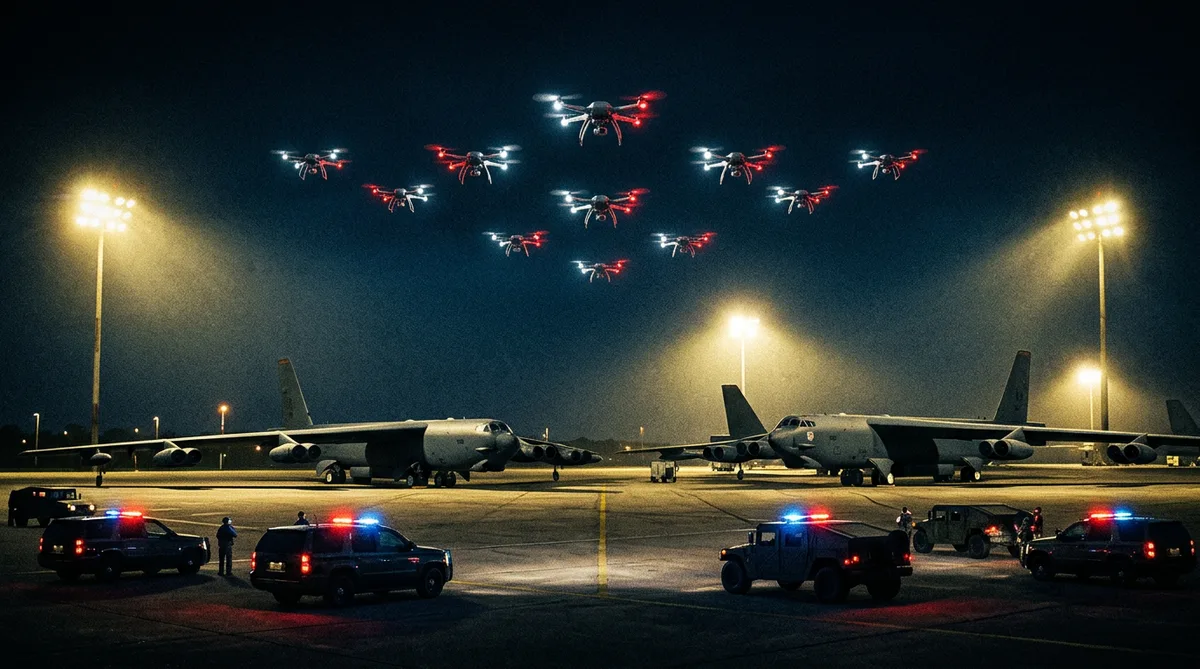
Between March 9 and 15, 2026, Barksdale Air Force Base in Bossier City, Louisiana experienced a coordinated drone incursion campaign. A confidential military briefing dated March 15, leaked to ABC News, reveals that what initially appeared to be a single drone sighting on March 9 was the opening act of a week-long operation.
Security forces observed multiple waves of 12 to 15 drones operating over sensitive areas of the installation, including the flight line. The drones flew for approximately four hours each day, with activity recorded every day except March 13 and 14. A shelter-in-place order was issued on March 9 and lifted later that day, but unauthorized flights continued for nearly a week.
Barksdale is not an ordinary base. It is one of only two U.S. installations that house B-52H Stratofortress long-range bombers capable of carrying nuclear weapons. It serves as headquarters for Air Force Global Strike Command, which oversees the entire U.S. strategic bomber fleet and intercontinental ballistic missile forces – two of the three legs of the nuclear triad.
The drones were flying over America’s nuclear deterrent. During active combat operations against Iran.
Custom-Built, Jamming-Resistant, Evasion-Aware
The briefing’s technical conclusions are the most alarming part of this story. These were not consumer-grade quadcopters bought on Amazon.
Military analysts determined the aircraft were custom-built by someone with “advanced knowledge” of signal operations. Key characteristics:
- Non-commercial signal profiles – the drones used frequencies and protocols not found in any commercial drone system
- Long-range control links – the operators were far from the base
- Resistance to electronic jamming – the Air Force’s standard countermeasures failed
- Deliberate evasion patterns – entry and exit routes were designed to prevent triangulation of the control source
- Knowledge of the base layout – the drones maneuvered carefully around restricted zones
Perhaps most unsettling: the operators left the drones’ lights on. Rather than running dark to avoid detection, they wanted to be seen. The briefing interpreted this as deliberate security-response testing – someone watching how the base reacted to each wave. That is reconnaissance doctrine, not hobbyist carelessness.
“Certainly, it seemed to be more than just your average drone enthusiast who just pushed it too far. It looked like this was deliberate and intentional to see just how they would react.” – Mick Mulroy, former Deputy Assistant Secretary of Defense
The Operational Cost
Each wave of drones forced the flight line to shut down. At a base that was actively launching B-52 missions supporting combat operations, this created immediate operational risk. The briefing stated plainly:
“The drone incursions at BAFB pose a significant threat to public safety and national security since they require the flight line to be shut down while also putting manned aircraft already in-flight in the area at risk.”
Military analysts assessed “with high confidence” that unauthorized drone flights over the base would continue. Capt. Hunter Rininger of the 2nd Bomb Wing confirmed the incidents:
“Barksdale Air Force Base detected multiple unauthorized drones operating in our airspace during the week of March 9th. Flying a drone over a military installation is not only a safety issue, it is a criminal offense under federal law. We are working closely with federal and local law enforcement agencies to investigate these incursions.”
No group or individual has claimed responsibility. The origin and operator remain unknown.
Not Just Barksdale
The Louisiana incursions did not happen in isolation. Within the same period:
- Fort Lesley J. McNair in Washington, D.C. – where Secretary of State Marco Rubio and Defense Secretary Pete Hegseth reside – detected unidentified drones. The sighting prompted a White House meeting to assess the response. Officials considered relocating both cabinet members.
- Joint Base McGuire-Dix-Lakehurst in New Jersey and MacDill Air Force Base in Florida (home to U.S. Central Command) raised their force protection level to Charlie – the second-highest state of alert, indicating a specific threat has been identified.
- The pattern follows Langley’s 17-night siege in December 2023, drone incursions at Belgium’s Kleine Brogel nuclear weapons base in November 2025, and over 350 detected drone incursions across more than 100 U.S. military bases documented by House Republicans in 2024.
Mellon: “The Time for Effective Action Is Long Overdue”

Former Deputy Assistant Secretary of Defense for Intelligence
View full profile →Christopher K. Mellon, the former Deputy Assistant Secretary of Defense for Intelligence who has been sounding the alarm on UAP for years, responded to the Barksdale reports on X:
“These overflights of U.S. bases have been going on for years and are becoming more commonplace and aggressive. The time for effective action, bringing some to ground if necessary, is long overdue.”
Mellon’s comment – “bringing some to ground” – is notable from a former senior defense official. It suggests that the measured calls for investigation are giving way to frustration that the military still cannot protect its own installations from unidentified aircraft.
The Legal Bottleneck
The U.S. military currently cannot shoot down drones over its own bases without confirming “hostile intent” – a legal threshold that the Barksdale briefing language seems carefully constructed to approach but not explicitly cross. The drones were “deliberate and intentional,” displayed “advanced knowledge,” resisted jamming, and systematically evaded detection. But no weapon was fired. No bomb was dropped. So the legal framework treats them as a nuisance, not a threat.
Belgium, facing similar incursions at Kleine Brogel, authorized military shoot-downs. The U.S. has not. Congress is expected to fast-track expanded authority under 10 U.S.C. § 130i to cover more installations before this session ends, but the legislation has been “expected” for two years now.
The hardware to defeat these drones may exist. The legal authority to use it does not.
What Nobody Will Say
The question that hangs over every one of these incidents – from Langley to New Jersey to Barksdale – is the one nobody in an official capacity will answer: who is operating these drones?
The capabilities described in the Barksdale briefing – custom construction, jamming resistance, knowledge of military base layouts, multi-day coordinated operations – narrow the list of plausible operators considerably. Consumer hobbyists are out. Most nation-state drone programs would not risk operating over a nuclear bomber base on U.S. soil during a war. That leaves a small number of possibilities, none of them comfortable.
Ross Coulthart, who has been reporting on the base incursion pattern for over a year, put it directly:
“Drone swarms shut down one of the largest and most national security sensitive Air Force bases in the United States during a major war. And we’re told the Air Force was powerless to stop it. These drones were ‘superior’ to anything in Ukraine. Why is this not a major story?”
It should be.
Sources: ABC News · DroneXL · Newsweek · Shreveport-Bossier Journal · The Town Talk