The words governments use to describe unidentified objects in the sky are not accidental. Every shift in terminology – from “flying saucer” to “UFO” to “UAP” – has carried a deliberate signal about what is being taken seriously, what is being investigated, and what is being dismissed.
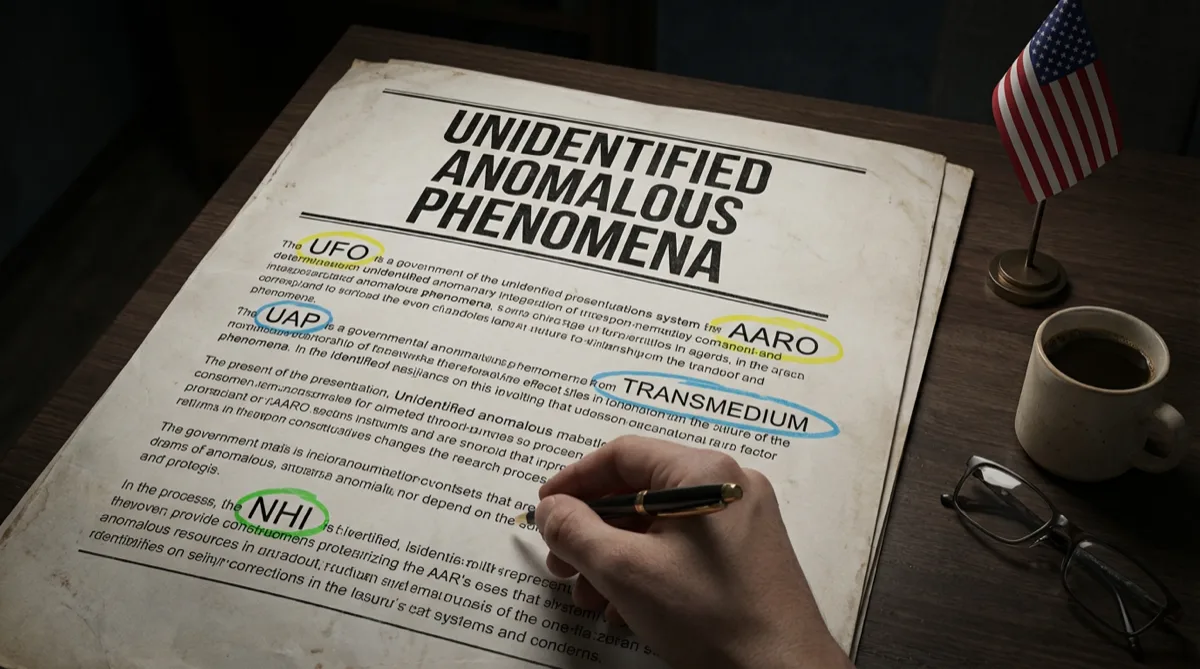
Today, the language has moved further than most people realize. Terms like UAP, NHI, and transmedium now appear in U.S. federal law, Pentagon reports, and congressional hearing transcripts. Understanding what they mean – and why they replaced older language – is essential to following the disclosure process as it unfolds.
This guide covers every major term you’ll encounter in UAP reporting, from Cold War-era classifications to the vocabulary of today’s congressional hearings.
Why the Words Matter
The terminology shift is not cosmetic. It serves several concrete purposes:
Destigmatization. For decades, the phrase “UFO” carried so much cultural baggage that military pilots refused to file reports. NASA’s 2023 UAP Independent Study Team found the same problem persists:
“The negative perception surrounding the reporting of UAP poses an obstacle to collecting data on these phenomena.”
Changing the language is a deliberate attempt to change the culture of reporting.
Scope expansion. “UFO” implies something flying. The newer term “UAP” – especially with “anomalous” replacing “aerial” – is designed to cover objects in the air, underwater, in space, and transitioning between domains. That broadening is not theoretical; it’s written into law.
Legal precision. When Congress writes definitions into statute, those definitions determine what gets reported, what gets audited, and what oversight committees can demand access to. The word choices in the FY2024 and FY2026 NDAAs are deliberate instruments of oversight.
Agnostic framing. Terms like “NHI” allow officials to discuss claims about non-human agency without committing to any specific explanation – extraterrestrial, interdimensional, or otherwise. This is how David Grusch and other witnesses navigate congressional testimony under oath.
The Core Terms
UFO – Unidentified Flying Object
The term most people know. Edward J. Ruppelt, head of the Air Force’s Project Blue Book, is widely credited with promoting “UFO” as a replacement for “flying saucer” in the early 1950s.
“Obviously the term ‘flying saucer’ is misleading when applied to objects of every conceivable shape and performance. For this reason the military prefers the more general, if less colorful, name: unidentified flying objects.”
– Edward J. Ruppelt, The Report on Unidentified Flying Objects
In formal usage, “unidentified” is a classification state – it means “we don’t know what this is yet.” It does not imply any particular explanation. UFO remains the dominant term in public and media conversation, but it has been largely replaced in U.S. government contexts by UAP.
UAP – Unidentified Anomalous Phenomena
The current U.S. government umbrella term. Its evolution tells its own story:
- “Unidentified Aerial Phenomena” was used during the 2020–2021 period when the UAP Task Force was established and the first ODNI reports were issued.
- “Unidentified Anomalous Phenomena” replaced it in later legislation and AARO reporting, explicitly broadening the scope beyond airborne objects to include submerged and transmedium cases.
The shift from “Aerial” to “Anomalous” was not a minor edit. It was designed to cover detections across all domains – air, sea, space – and to accommodate reports like those from the USS Nimitz encounter, where objects were tracked moving between the air and water.
USO – Unidentified Submerged Object
Objects observed in water or entering/exiting water. The term is common in civilian UFO research and media coverage but less common in formal U.S. government language, because submerged cases are now treated as a subset of the statutory UAP definition.
USO reports are frequently discussed in connection with the 2004 USS Nimitz encounter, where sonar operators and pilots described objects interacting with the ocean surface.
NHI – Non-Human Intelligence
This term entered mainstream public discourse through recent congressional hearings, most notably David Grusch’s July 2023 testimony. It appears in proposed legislation and UAP records-collection frameworks, including language about “technologies of unknown origin” and “non-human intelligence.”
NHI is deliberately agnostic. It could refer to extraterrestrial life, interdimensional entities, advanced AI, or categories not yet conceived. The term signals that a claim involves agency or intelligence – not merely an unidentified object – without committing to any specific origin theory.
Transmedium
Objects or devices observed transitioning between domains – space to atmosphere, atmosphere to water, or vice versa – without apparent performance degradation.
This isn’t informal shorthand. “Transmedium objects or devices” is formally defined in 50 U.S.C. § 3373, the section of U.S. code governing UAP reporting and oversight. Its inclusion in law means that transmedium reports are specifically within the scope of what must be tracked and disclosed.
Government Programs and Offices
AATIP – Advanced Aerospace Threat Identification Program (2007–2012)
The program that started the modern UAP era in public awareness. AATIP was a Pentagon-associated effort focused on investigating unidentified aerial phenomena and advanced aerospace threats, widely reported as running from 2007 to 2012 with approximately $22 million in funding.
Luis Elizondo is commonly associated with the program in media reporting. When the program’s existence was publicly revealed in 2017, it triggered the chain of events that led to official video releases, congressional hearings, and eventually AARO.
Disputes exist over role descriptions and how the program was characterized – treat claims about specific responsibilities as contested unless tied to primary documentation.
UAPTF – Unidentified Aerial Phenomena Task Force (2020–2022)
Established in August 2020 under U.S. Navy leadership and USD(I&S) cognizance, the UAPTF was created to “improve understanding and gain insight into UAP and potential threats to national security.” Its work fed directly into the landmark June 2021 ODNI preliminary assessment – the first official U.S. government report to Congress acknowledging the reality of unidentified objects in military airspace.
The UAPTF was succeeded by AOIMSG (a short-lived 2021 entity) and then by AARO.
AARO – All-domain Anomaly Resolution Office (2022–present)
The Pentagon’s current UAP office, established by DoD memorandum in July 2022. AARO is tasked with synchronizing efforts across the Department of Defense and other agencies to detect, identify, and attribute objects of interest in, on, or near military installations and operating areas – across all domains.
AARO’s annual reports are now a primary public source of UAP data. The 2024 report documented 757 cases, a dramatic increase driven by expanded reporting channels.
Security and Classification Terms
These terms come up constantly in UAP discourse because the central tension of the disclosure debate is about access – who is allowed to know what, and whether oversight mechanisms are functioning.
SAP / CAP – Special Access Programs / Controlled Access Programs
Security constructs that impose additional safeguarding and access requirements beyond standard classification controls. SAPs are generally used in DoD and broader national security contexts; CAPs are Intelligence Community control systems.
These terms are critical to UAP discourse because whistleblower allegations often claim that relevant information is sequestered behind enhanced access controls – effectively hidden from congressional oversight and even from officials who hold top-secret clearances.
SCIF – Sensitive Compartmented Information Facility
A certified, accredited secure area for processing, storing, and discussing Sensitive Compartmented Information (SCI) under DNI standards.
Members of Congress frequently request SCIF briefings on UAP topics because classified sensor data, sources and methods, and program allegations cannot be discussed in open settings. When you hear that a congressional hearing went “behind closed doors,” it typically means it moved into a SCIF.
Read-in / Read-on
Being formally granted access to a compartmented program or SAP after approval and a need-to-know determination. This explains a recurring frustration in the disclosure debate: officials with top-secret clearances can still be denied access to specific programs if they haven’t been “read in.”
The Five Observables
A popular analytic framework for distinguishing UAP reports from conventional aircraft. Associated with AATIP-era commentary, this shorthand describes five reported characteristics:
| Observable | Description |
|---|---|
| Anti-gravity lift | Sustained hovering or lift without conventional aerodynamic surfaces or visible propulsion |
| Instantaneous acceleration | Rapid changes in velocity or trajectory without gradual buildup |
| Hypersonic velocity without signatures | Extreme speeds without sonic booms, contrails, or thermal signatures |
| Low observability | Difficulty tracking visually or on sensors; sometimes described as stealth-like |
| Trans-medium travel | Movement between air and water (or other domains) without performance loss |
These characteristics appear repeatedly in high-profile cases, including the USS Nimitz Tic Tac encounter and the USS Roosevelt incidents.
Sensor and Video Terminology
FLIR / ATFLIR
FLIR (Forward Looking Infrared) refers to infrared imaging systems that detect and track objects via heat signatures. ATFLIR (Advanced Targeting Forward Looking Infrared) is a specific advanced targeting pod used on F/A-18 aircraft.
The three officially released Navy UAP videos were captured via these infrared targeting systems, which is why they appear in grayscale with targeting overlays.
The Three Pentagon Videos
- FLIR1 / “Tic Tac” – Captured November 2004 during the USS Nimitz encounter. Shows an oblong white object nicknamed “Tic Tac” by witnesses based on its resemblance to the candy.
- Gimbal – Captured January 2015 during USS Roosevelt operations. Shows an object appearing to rotate; debate continues over whether the rotation is the object itself or a sensor/gimbal artifact.
- Go Fast – Also January 2015, USS Roosevelt. Shows an object appearing to move at high speed; analysis debates center on whether apparent speed reflects actual motion versus parallax and sensor geometry.
The Department of Defense officially released all three in April 2020:
“The Department of Defense has authorized the release of three unclassified Navy videos, one taken in November 2004 and the other two in January 2015.”
Range Fouler
U.S. Navy aviator term for a UAP that interrupts training or operations in military operating areas or restricted airspace. The term appears in ODNI UAP reporting as a term of art tied to operational safety.
Close Encounter Classification
Developed by astronomer J. Allen Hynek in his 1972 book The UFO Experience: A Scientific Inquiry, this system remains the most widely used framework for categorizing UFO encounters by proximity and type:
| Type | Description |
|---|---|
| CE-I (First Kind) | Visual sighting of an unidentified object at close range (~500 feet) |
| CE-II (Second Kind) | Close encounter involving physical effects – ground traces, electromagnetic interference, physiological effects |
| CE-III (Third Kind) | Close encounter involving reported occupants or entities |
| CE-IV (Fourth Kind) | Abduction – a later addition by other researchers, not part of Hynek’s original scheme |
| CE-V (Fifth Kind) | Voluntary/initiated contact – popularized by Steven Greer; controversial and not standard in academic or government usage |
Hynek, who founded the Center for UFO Studies (CUFOS), began his career as a skeptic hired by the Air Force to debunk sightings for Project Blue Book. He became one of the most credible advocates for serious scientific study of the phenomenon.
Civilian Organizations
Several civilian groups have played significant roles in UAP research and advocacy:
- NUFORC (National UFO Reporting Center) – The primary civilian clearinghouse for public UFO/UAP reports. Frequently cited in media and used as a data source for sighting statistics.
- MUFON (Mutual UFO Network) – The largest civilian UFO investigation organization. Methodology and conclusions vary by chapter and investigator.
- NICAP (National Investigations Committee on Aerial Phenomena) – Influential U.S. civilian group active from the 1950s through the 1970s. A historical reference point for civilian pressure on government transparency.
- CUFOS (Center for UFO Studies) – Founded by J. Allen Hynek. Associated with the “scientific ufology” approach in the post-Blue Book era.
- GEIPAN – French government unit within CNES (the French space agency) that investigates aerospace phenomena reports. Often referenced as an example of how other nations handle UAP officially.
Key Concepts in the Disclosure Debate
Disclosure broadly refers to the movement advocating public release of government-held UAP information. It ranges from FOIA-driven transparency efforts to broader political activism, and its meaning varies widely depending on who is using it.
Crash retrieval refers to the claimed recovery of downed or landed craft or material of unknown origin. These claims are central to modern allegations – including Grusch’s congressional testimony – but evidence remains classified or anecdotal.
Reverse engineering refers to claimed technical exploitation of recovered materials or technology. This is a common element in whistleblower narratives; the distinction between allegation and documented fact is critical.
Legacy programs is shorthand for alleged long-running, historically continuous UAP-related programs. The term is frequently used in hearings and commentary but is typically not acknowledged in released official documentation.
Whistleblower in the UAP context refers to a person using lawful reporting channels – such as Inspector General processes – to report allegations of wrongdoing, including potential unlawful concealment from congressional oversight. Recent whistleblower protections in the NDAA and new witnesses coming forward in 2026 have made this one of the most active areas of the disclosure process.
Official vs. Informal Language
The same phenomenon gets described very differently depending on who is speaking:
| Context | Typical Language |
|---|---|
| U.S. government / DoD | UAP, transmedium, all-domain, anomalous |
| Congressional hearings | Mix of statutory (UAP, transmedium) and witness framing (NHI, crash retrieval) |
| Civilian researchers | UFO, USO, alien, craft, abduction |
| Media | UFO (headlines), UAP (policy coverage) |
Understanding which register someone is using tells you a lot about their assumptions. When a Pentagon spokesperson says “UAP,” they are using a legally defined term. When a civilian researcher says “craft,” they are making an interpretive claim about what was seen.
The National Archives (NARA) summarized the current statutory scope in its 2024 guidance on the UAP Records Collection:
“records relating to unidentified anomalous phenomena, technologies of unknown origin, and non-human intelligence”
That single sentence – appearing in official government records guidance – contains three terms that would have been unthinkable in any federal document a decade ago.
Sources: The Report on Unidentified Flying Objects (Gutenberg) · U.S. Navy – Establishment of UAPTF · DoD – Statement on Navy Videos · ODNI – 2022 Annual Report on UAP · DoD – AARO Establishment Memo · AARO UAP Report User Guide · 50 U.S.C. § 3373 – Transmedium Definition (Cornell) · NARA – UAP Records Collection Guidance · NASA UAP Independent Study Team Final Report · SCIF Definition (NIST) · ICD 906 – Controlled Access Programs (ODNI) · House Oversight UAP Hearing Transcript (Rev)