
On the evening of March 11, 2026, air traffic control at Berlin Brandenburg Airport spotted something near a Bundeswehr helicopter hangar that shouldn’t have been there – a “luminous flying object” with no flight plan and no transponder.
Within minutes, every takeoff and landing was halted. For 38 minutes, Germany’s capital airport went silent. Police scrambled. A search turned up nothing. An airport spokesperson told the Tagesspiegel: “The suspicion was not substantiated.”
It was the second time in five months that Berlin’s airport shut down over an unidentified aerial object. And it’s part of a pattern now stretching across the continent that European leaders are calling hybrid warfare.
What Happened at BER
Flight operations were suspended from 6:40 p.m. to 7:18 p.m. local time on Wednesday, March 11. Air traffic controllers had detected the object shortly before 7 p.m. near the Bundeswehr helicopter hangar adjacent to the airport grounds. The airport followed standard aviation security protocol – a full ground stop until the threat was cleared.
Police conducted a close-range search of the area. They found no drone, no debris, no identifiable aircraft. The object – whatever it was – was gone.
The airport characterized the response as “routine procedure,” but 38 minutes of zero operations at a major international hub is anything but routine. Flights were delayed, passengers stranded, and the incident fed a growing public anxiety about objects in European airspace that authorities cannot identify or intercept.
The Second Time in Five Months
On October 31, 2025, Berlin Brandenburg had shut down for nearly two hours after a drone sighting. That incident was more disruptive – flights were diverted to Hamburg, Basel, and other cities. A police helicopter was deployed. Berlin’s nighttime flight ban had to be lifted to clear the backlog. Again, the object was never found.
The March incident was shorter but in some ways more unsettling. It occurred near a military facility on airport grounds. And it happened despite the fact that Germany had spent the intervening months building an entirely new defense apparatus specifically to prevent this.
The European Airport Crisis
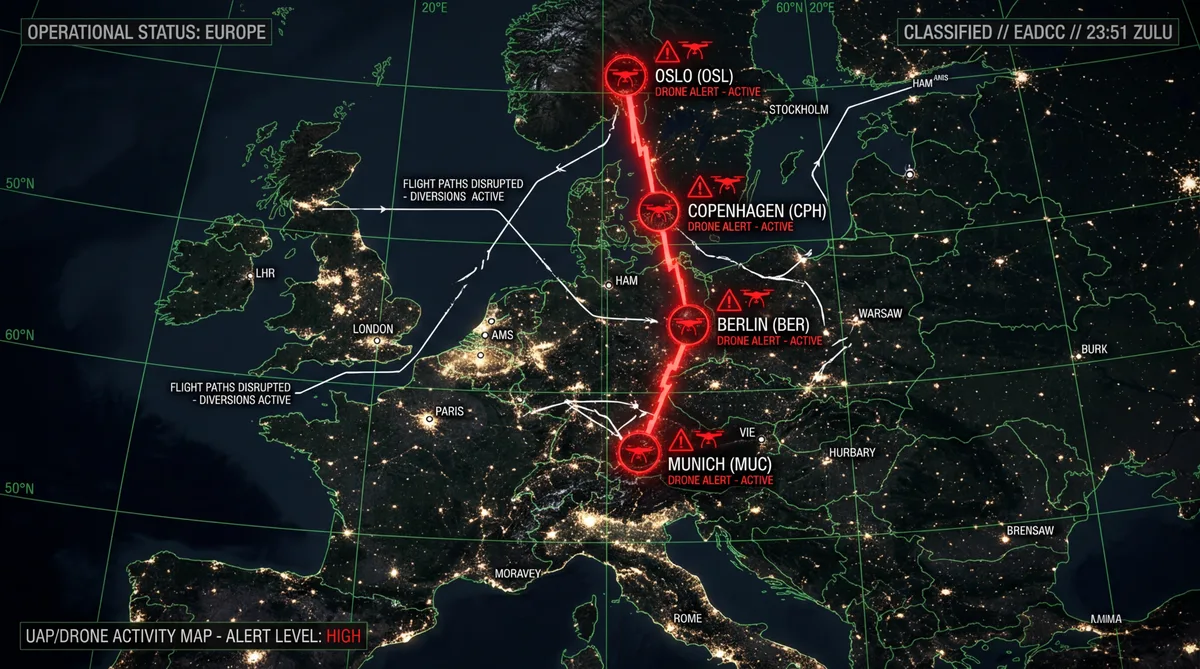
Berlin is not an outlier. Since September 2025, unidentified drones have forced closures at major airports across Northern Europe in what aviation security experts are calling an unprecedented wave:
| Date | Airport | Duration | Outcome |
|---|---|---|---|
| Sep 23, 2025 | Copenhagen (CPH) & Oslo (OSL) | ~4 hours each | 20,000+ passengers affected at CPH alone, 35+ flights diverted |
| Oct 2025 | Munich (MUC) | Closed twice in 24 hours | 17 departures affected, 15 arrivals diverted, ~3,000 passengers |
| Oct 31, 2025 | Berlin (BER) | ~2 hours | Flights diverted to Hamburg, Basel, Barcelona |
| Mar 11, 2026 | Berlin (BER) | 38 minutes | Object near military hangar, nothing found |
| Mar 2026 | St. Petersburg Pulkovo | Hours | 100+ flights canceled or delayed |
The Copenhagen and Oslo closures are particularly notable – two capitals, two airports, shut down simultaneously on the same day. That is not hobbyist activity.
Russia: The Accused
European leaders have been increasingly blunt about attribution. German Chancellor Friedrich Merz has publicly accused Russia of orchestrating drone incursions over German airports, military bases, and energy infrastructure as part of a “hybrid warfare” campaign.
Swedish Prime Minister Ulf Kristersson went further in March 2026: “The likelihood of this being about Russia wanting to send a message to countries supporting Ukraine is quite high.” He added that Sweden has “confirmation” that drones entering Polish airspace in September 2025 were Russian.
EU Commission President Ursula von der Leyen characterized the incursions as attempts to “sow division” across Europe.
Moscow has denied all involvement.
The attribution question is the same one hanging over drone incursions at U.S. military installations – from Langley Air Force Base in 2023 to Barksdale’s nuclear bomber base in March 2026. Sophisticated, coordinated, jam-resistant, and never conclusively attributed.
Germany’s Response
In December 2025, Germany opened a Joint Drone Defence Centre in Berlin – a new inter-agency coordination hub bringing together federal police, state police, and the Bundeswehr. Interior Minister Alexander Dobrindt said Germany faces “hybrid war tactics, almost every day.”
The center’s mandate includes:
- Real-time inter-agency coordination for drone incidents
- Data pooling to develop predictive models of drone operator behavior
- Collaboration with the Bundeswehr on detection and neutralization technology
- Protection of airports, military sites, and energy infrastructure
Germany also launched a dedicated drone defense police unit expected to eventually employ more than 130 officers. And Chancellor Merz’s cabinet approved legislation authorizing police to shoot down unidentified drones in cases of “acute threat or serious harm.”
Despite all of this, a luminous object still shut down Berlin’s airport three months later. And police still found nothing.
The Transatlantic Pattern
What’s happening over European airports mirrors what’s been happening over American military bases – and in some cases, the incidents are more brazen.
The New Jersey drone mystery in late 2024 saw unidentified craft operating over critical infrastructure for weeks. Langley Air Force Base endured 17 consecutive nights of drone activity that forced the relocation of F-22 Raptors. Barksdale saw custom-built, jamming-resistant drones flying over nuclear bombers during active combat operations against Iran.
In every case: sophisticated operators, no attribution, no interception, and authorities left explaining why the world’s most advanced militaries cannot stop objects flying over their most sensitive sites.
Gen. Gregory Guillot, Commander of NORTHCOM/NORAD, told the Senate Armed Services Committee that only about 25% of detected drones over U.S. military installations can currently be defeated. Europe’s track record appears no better.
The question is no longer whether this is a problem. It’s whether anyone – on either side of the Atlantic – has a solution.
Sources: Kyiv Post · IBTimes UK · Aviación al Día · CP24/AP · Tagesspiegel · Euronews · DW · BBC · AP/Munich · The Defense Post · Reuters · Moscow Times