The Pentagon’s invitation-only UAP workshop last August was never a secret after it happened. DefenseScoop reported it in March. AARO posted an 18-page white paper in February. What the public paper did not do is name who talked.
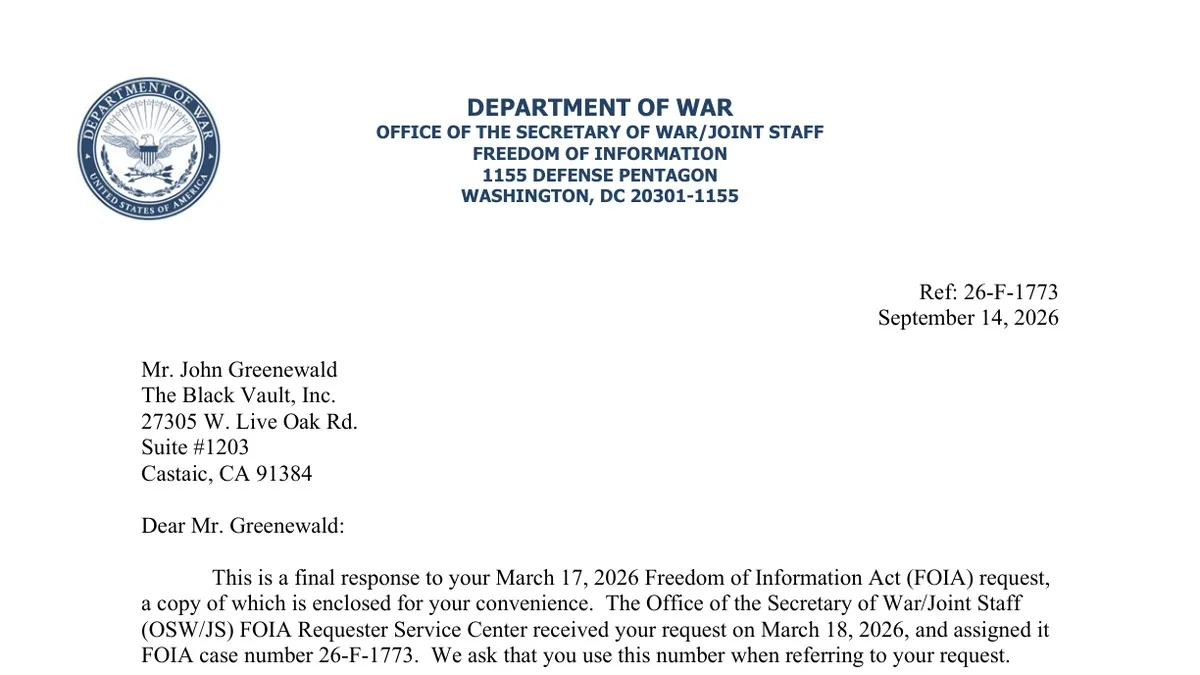
John Greenewald at The Black Vault published the administrative record this week. Case 26-F-1773, filed March 17, 2026, one day after Brandi Vincent’s story. The Department of War’s response letter is dated September 14, 2026. AARO located 89 pages. It withheld 19 in full under FOIA exemption (b)(5). It released 70 with (b)(5) and (b)(6) cuts.
This is not a new sensor video. It is the guest list, the Vienna address, and a Pentagon calendar entry for Uruguay’s official UAP office.
The Working Agenda Names Names
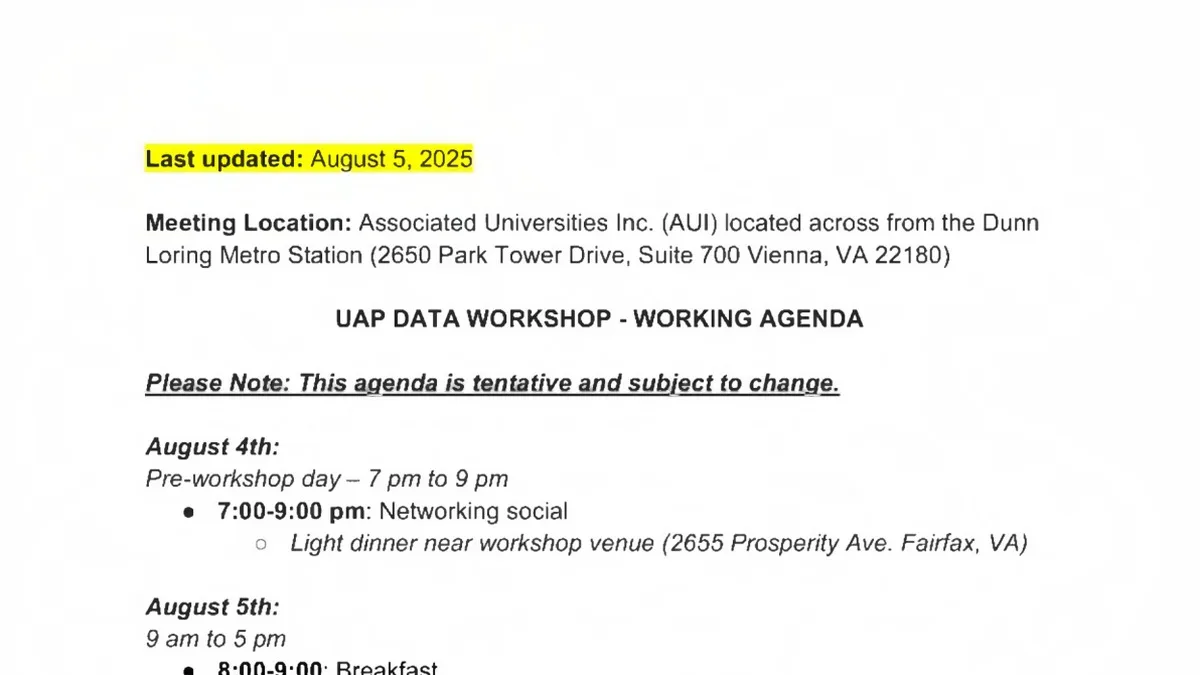
An August 5, 2025 working agenda puts the meeting at Associated Universities, Inc., 2650 Park Tower Drive, Suite 700, Vienna, Virginia – across from the Dunn Loring Metro. Opening remarks: AUI’s Tim Spuck and Adam Cohen, AARO Director Jon Kosloski, and Gretchen Stahlman of Florida State University’s School of Information.
The keynote – “Setting the stage: Importance of good UAP data” – was assigned to Robert Powell of the Scientific Coalition for UAP Studies and Kosloski.
Laura Domine, then a Center for Astrophysics postdoc on the Galileo Project’s infrared arrays, had the first technical session. The AI panel: Abigail Haddad, Elliott Hauser (University of Texas at Austin), Duncan McCaskill (formerly Navy Chief Digital and Artificial Intelligence Office), and Matthew Szydagis (University at Albany). Day two named Stephen Breuhl of Vanderbilt University Medical Center and a narrative-data panel with Michael Cifone, Rice special-collections head Amanda Focke, RAND’s Ben Gibson, and NUFORC chief technical officer Christian Stepien.
NUFORC and the Society for UAP Studies had already said they attended. The FOIA agenda is the first Pentagon-side list that matches those disclosures to a clock and a room.
The workshop’s subject was narrative reports – witness language that does not look like a targeting-pod clip. AARO’s public paper already said: standardize metadata, connect databases, use AI with a human in the loop. The new pages do not rewrite those findings. They show who AARO asked to help write them.
A Pentagon Morning With CRIDOVNI
The more consequential paper trail is foreign. Names of the visitors are redacted under (b)(6). Their office is not: CRIDOVNI, the Uruguayan Air Force commission that takes unidentified-aerial-phenomena reports.
July 2025 email from an AARO partner-engagement officer offered hotel nights and proposed August 4 – the day before the workshop – at the Pentagon:
“On 4 August (Monday), would you two be available for a meeting at the Pentagon to provide briefings on our respective work at CRIDOVNI and AARO?”
The visit went through Foreign Visit Request and Pentagon Force Protection Agency systems. A July 29 schedule: CRIDOVNI mission brief 1000–1030, AARO mission brief 1030–1100, “Discussion of Briefings and Future Collaboration” 1100–1200, then lunch and a private Pentagon tour. A reservation named Kosloski and AARO chief technology officer Josh Reiter.
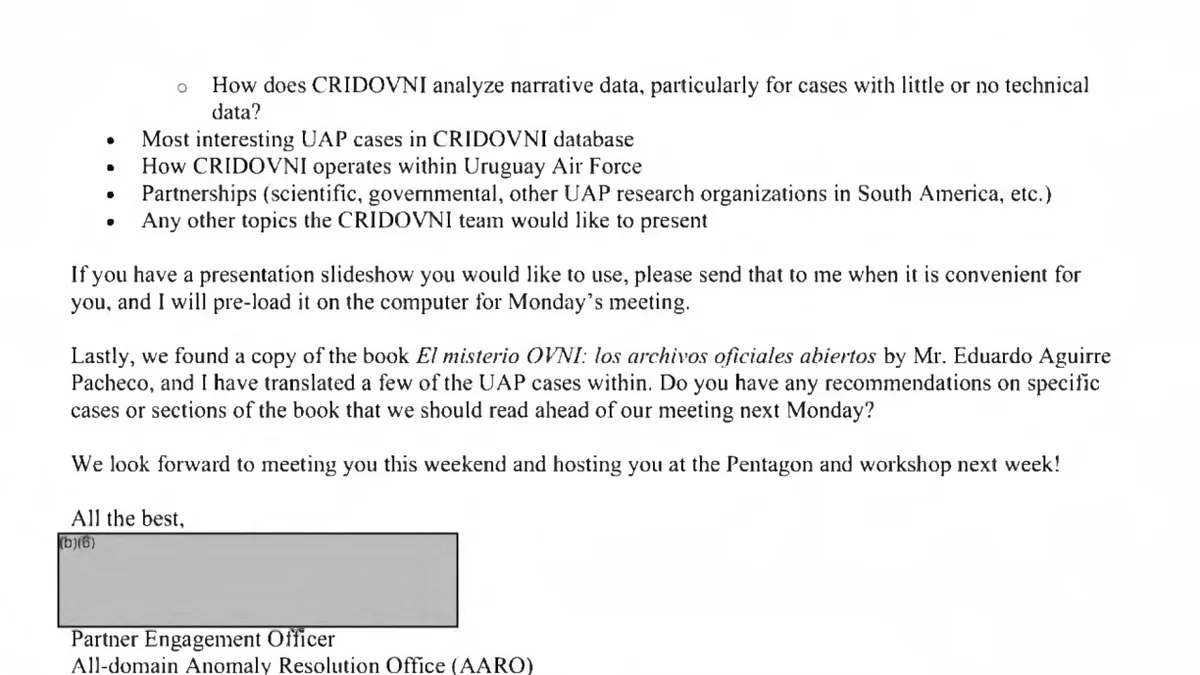
AARO’s question list asked how CRIDOVNI investigates cases with little or no technical data, what its notable cases are, and how it sits inside the Uruguayan Air Force. The Uruguayan correspondent wrote that a working relationship was “of special interest.” The released pages do not say whether any information-sharing agreement followed.
AARO also wanted more of South America in the room. An official wrote that the office had no other registered guests from South America, had sent an invitation toward Chile’s SEFAA through a Washington contact, and had gotten no reply. Then this line:
“AARO plans to hold a follow-on data workshop in early 2026, so if you have contact information for other UAP research organizations in South America that you could share with us, we would very much appreciate it and like to extend invitations to them as well.”
That email is dated before the first workshop convened. In March 2026, Pentagon spokesperson Sue Gough told DefenseScoop AARO hoped for future workshops “as needed” but had none to announce. The FOIA file does not say whether the early-2026 event happened, slipped, or died in the 19 withheld pages.
What 19 Pages Still Hide
Greenewald’s request was broad: attendees, presentations, transcripts, recordings, after-action reports, drafts of the public paper, contracts, IRB files, and future-workshop records. AARO answered with 89 pages and a (b)(5) wall across 19 of them – “subjective evaluations, opinions and recommendations.” Several released sheets are a page number and a withholding stamp.
The package does include a DD Form 1910 clearance for the white paper. Kosloski is listed as author. AUI would post the 18-page document; AARO would promote it and link it from AARO.mil. That is the paper already on the AARO records page.
Put next to this week’s Navy dump of Scott Bray’s UAP emails, the pattern is the same: a named FOIA, a count of pages withheld in full, and a usable middle – enough to see the bureaucracy, not enough to see the closed session.
The full PDF is on The Black Vault (26-F-1773).