Update (September 24): Loeb posted first triangulation results from three Las Vegas sites (Sphere, Hideout, Wildhorse). For May 24–30, 2026, 365 three-site tracks split into aircraft-like speeds (116–298 m/s; 284 on ADS-B) and 64 slow objects later identified as small clouds. No anomalous tracks that week. Three-site aircraft distances were within 5% of ADS-B. Medium → · This week’s roundup →
Update (July 6): Since this article was published, Loeb has been appointed to chair the UAP Science Advisory Council – a government body reporting to the White House, Pentagon, FBI, and ODNI. The council has 15 members and has requested 50+ items from the Pentagon. He also revealed that a former Lockheed Martin executive confirmed crash retrieval involvement. Full article on the council →
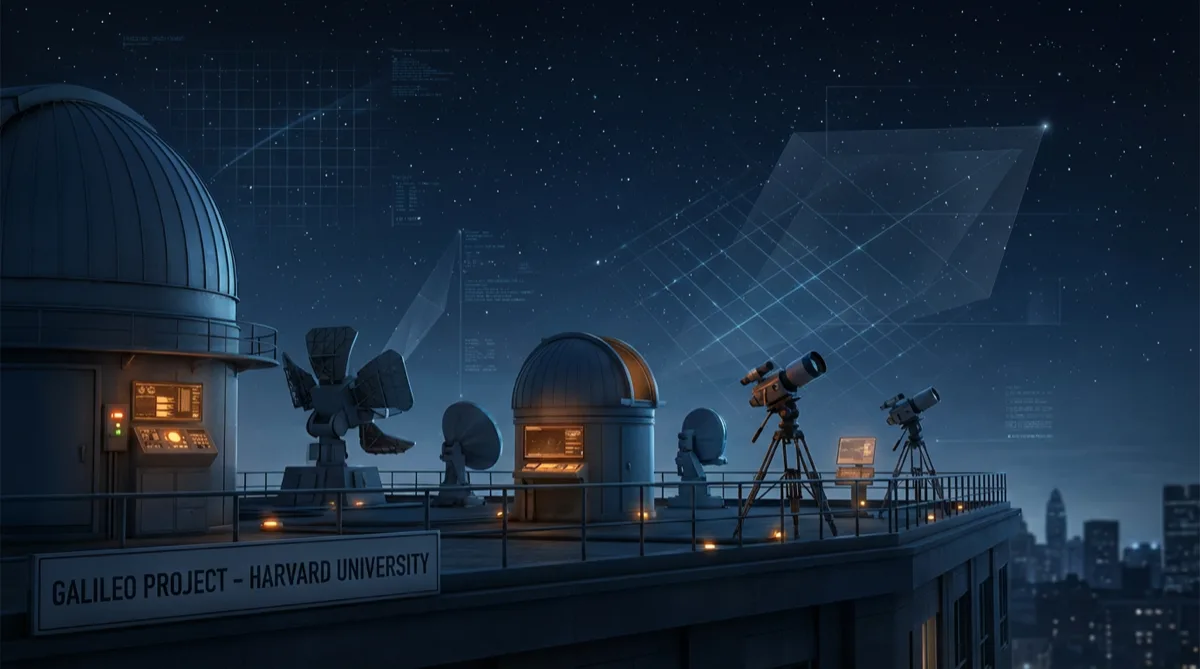
On March 3, 2026, Harvard astrophysicist Avi Loeb published a Medium post titled “A Scientific Alternative to Government Disclosure: The Galileo Project is Now Capable of Discovering UAP.” The argument was direct: stop waiting for classified archives to open. His project can now collect its own multimodal data, compute 3D kinematics of aerial objects, and test whether anything in the sky falls outside known human-made performance envelopes.
“This method of triangulation, enabled by accurate time stamps, allows us to measure the three-dimensional velocity and acceleration of objects and determine whether any of them lies outside the performance envelopes of human-made technological objects, such as drones, balloons, airplanes, helicopters or satellites.”
It’s a compelling pitch – and Loeb has the credentials to make it. He holds an h-index of 131, chaired Harvard’s Astronomy Department for nearly a decade (2011–2020), and co-founded the Black Hole Initiative. But credentials and results are different things. This article separates what the Galileo Project has actually built and published from what Loeb says it can do.
The Galileo Project – Origins and Mission
The Galileo Project launched in July 2021 at Harvard, founded by Loeb and co-founder Frank Laukien. Its stated mission: “Bring the search for extraterrestrial technological signatures from accidental or anecdotal observations and legends to the mainstream of transparent, validated and systematic scientific research.”
The founding was driven in part by Loeb’s controversial hypothesis about ‘Oumuamua – the first detected interstellar object, which Loeb argued could be an artificial light sail based on its anomalous trajectory. That hypothesis drew sharp criticism from mainstream astrophysicists who favored natural explanations (outgassing, hydrogen ice models), but it also generated enormous public interest and fundraising momentum.
The project is funded entirely through private donations routed through Harvard’s giving system. Early reporting cited ~$1.755 million in the first two weeks after launch. A later New York Times profile quoted Loeb saying the project had raised “some $5 million” – a self-reported figure without independent audit confirmation.
What They’ve Built
The Galileo Project’s most concrete output to date is instrumentation and methodology – not UAP identifications.
Multimodal Ground-Based Observatories
The core concept is a continuous aerial census using synchronized sensors: optical cameras, infrared arrays, radar, and audio detectors working together to detect, track, and classify everything in the sky above an observation site.
A 2023 paper published in the Journal of Astronomical Instrumentation laid out the scientific case and system design for these multimodal observatories. A companion paper described the integrated computing platform for detection and tracking.
All-Sky Infrared Camera Array
A November 2024 arXiv preprint describes commissioning of an all-sky infrared array using eight FLIR Boson 640 long-wave infrared cameras. The system is calibrated and validated against ADS-B aircraft transponder data – meaning it can match what it sees in infrared to known aircraft positions. This is genuine, verifiable engineering work.
SkyWatch Passive Radar
A May 2023 preprint describes SkyWatch, a passive multistatic radar system that exploits FM radio transmitters of opportunity to measure 3D position and velocity of objects at altitudes up to ~80 km and distances up to ~150 km. Phase 1 testing was conducted around the Harvard–Smithsonian Center for Astrophysics.
These systems represent real investment in purpose-built UAP observation infrastructure. Nothing comparable exists in the civilian scientific space at this scale.
What They’ve Found
This is where the gap between capability and results becomes clear.
As of early March 2026, no peer-reviewed paper from the Galileo Project has reported a definitive UAP identification – no object confirmed as anomalous after surviving conventional explanation. The published papers are about instruments and methods, not discoveries.
The project’s FAQ describes an aspiration for an “open-access, observational data archive,” but no publicly accessible raw data repository has been located. If such an archive exists, it hasn’t been widely publicized.
This doesn’t mean the project has failed. Building scientific infrastructure takes time, and the absence of anomalous findings this early could simply mean the observatory pipeline hasn’t been running long enough at sufficient sites. But it does mean Loeb’s March 2026 claim that the project is “now capable of discovering UAP” is a statement about readiness, not results.

The IM1 Expedition – Interstellar Spherules or Coal Ash?
The Galileo Project’s most high-profile output isn’t about UAP at all – it’s about an interstellar meteorite.
In 2023, Loeb and collaborators conducted an ocean expedition to the predicted impact site of CNEOS 2014-01-08 (“IM1”) near Papua New Guinea. They used magnetic sleds to dredge the ocean floor and recovered tiny metallic spherules. A peer-reviewed paper published in Chemical Geology (September 2024) reported chemical classification of the recovered materials and discussed possible origins.
The underlying claim – that IM1 was an interstellar meteor – has been directly challenged. A 2023 paper in Geophysical Journal International argued the interstellar origin is unlikely given uncertainty in the original velocity estimate. A separate re-evaluation paper in the same journal ecosystem raised further questions about the spherules’ origin and potential contamination.
Loeb’s team has stood by their findings and continued analysis. The scientific debate is ongoing and unresolved – which is how science is supposed to work. But the IM1 episode illustrates a pattern: Loeb makes bold public claims, the peer-reviewed record is more measured, and the media coverage tends to follow the claims rather than the caveats.
Loeb’s Public Presence – Context That Matters
Loeb is not an occasional commentator. He writes daily essays on Medium – his own description – covering UAP, interstellar objects, Galileo Project updates, and commentary on government disclosure. In February 2026 alone, multiple posts appeared on topics ranging from “bizarre lights in West Texas” to volunteer recruitment for the project.
He has published two books related to extraterrestrial life: Extraterrestrial: The First Sign of Intelligent Life Beyond Earth (2021, Houghton Mifflin Harcourt) and Interstellar: The Search for Extraterrestrial Life and Our Future Among the Stars (2023, Harper).
This volume of output is relevant because it shapes how the project is perceived. When a Harvard professor with an h-index of 131 writes daily about discovering alien technology, each post carries institutional weight – even when the content is speculative commentary rather than peer-reviewed science.
No sourced record of Loeb testifying before Congress on UAP was identified in the research for this article. The project frames itself as independent of government task forces, built around open data and scientific methods rather than classified briefings.
The Government Disclosure Gap Loeb Is Targeting
Loeb’s “scientific alternative” framing is aimed squarely at a real problem.
As of early 2026, U.S. government UAP disclosure remains split between public-facing reports from the All-domain Anomaly Resolution Office (AARO) and classified holdings that independent researchers cannot access. AARO’s caseload exceeds 2,000 reports, but its most sensitive sensor data and intelligence assessments stay behind classification barriers. Two major congressionally mandated reports – the Historical Record Report Volume II and the 2025 Annual Report – remain overdue.
President Trump’s February 2026 directive to release UAP files has created new momentum, but even advocates like Christopher Mellon have warned that the process will be slow and that the most significant findings will go to the White House, not the National Archives.
“What data does the U.S. government store in its classified archives? We do not know.” – Avi Loeb
Loeb’s argument is that this opacity makes government disclosure structurally unreliable for scientific purposes. Independent instrumentation is the only path to verifiable answers. It’s a reasonable position – but it also conveniently positions the Galileo Project as the primary vehicle for that independence.
Other Independent Efforts
The Galileo Project isn’t the only civilian scientific effort in this space.
The Scientific Coalition for UAP Studies (SCU) focuses on case analysis and publishes reports and holds conferences. UAPx conducts field investigations and data collection around UAP hotspots. NASA’s 2023 UAP study panel recommended appointing a Director of UAP Research – a position filled by Mark McInerney, though NASA’s operational follow-through has been limited in public visibility.
What distinguishes Galileo is the Harvard affiliation, the scale of instrumentation investment, and Loeb’s personal profile. Whether that translates into results remains to be seen.
What to Watch For
This article will be updated as the Galileo Project publishes new results. The key questions going forward:
- Has the observatory pipeline detected anything anomalous? The first peer-reviewed detection paper – even a null result – would be significant.
- When will raw data be publicly available? The project promises open access. Delivering on that would set it apart from both government programs and other civilian efforts.
- Can the IM1 spherule findings be independently replicated? Peer review continues; independent lab analysis would resolve the ongoing dispute.
- What is the project’s actual budget and donor transparency? Self-reported figures exist but no audited disclosures have been located.
The Galileo Project represents the most serious attempt to build purpose-built scientific infrastructure for UAP observation outside of government. Whether it produces discoveries or contributes to the growing body of “instruments that found nothing unusual” will be determined by data, not Medium posts.
Sources: Loeb Medium post (March 3, 2026) · Galileo Project (Harvard) · arXiv – Multimodal observatories · arXiv – IR array commissioning · arXiv – SkyWatch radar · Chemical Geology – IM1 spherules · GJI – IM1 critique · Nature – Loeb profile · Harvard faculty page · AARO · Galileo funding page