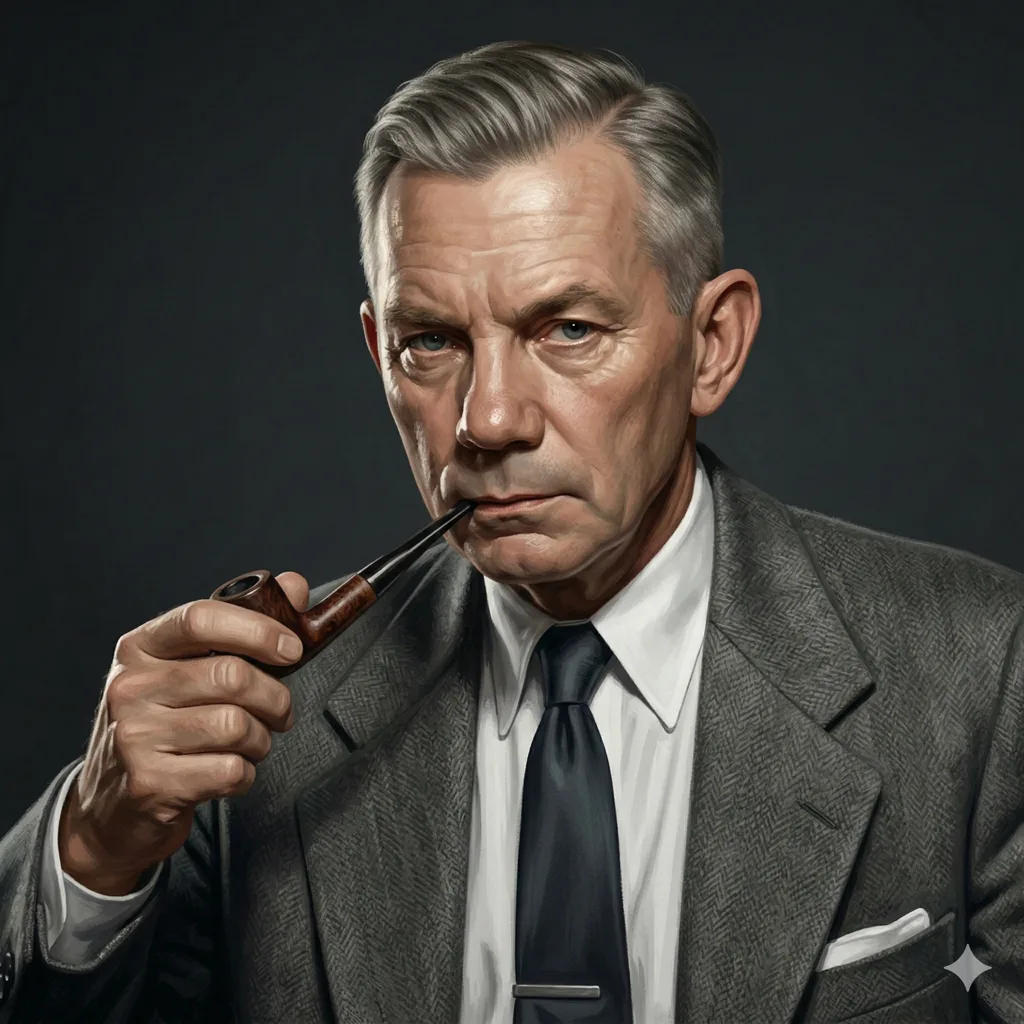
James Vincent Forrestal
- Date
- May 22, 1949
- Location
- Bethesda Naval Hospital, Maryland
- Official Ruling
- Suicide
James Vincent Forrestal served as the first United States Secretary of Defense from 1947 to 1949, having previously served as Secretary of the Navy during the closing years of World War II. On May 22, 1949, he fell from a 16th-floor window of the National Naval Medical Center in Bethesda, Maryland, where he had been hospitalized for nearly two months. A bathrobe cord was found knotted around his neck. The official investigation was classified for decades. His death remains one of the most debated cases in American political history – and one of the most frequently cited in UFO literature.
Background
Forrestal was a Wall Street banker turned wartime leader. He served as Under Secretary of the Navy beginning in 1940 and became Secretary of the Navy in 1944, overseeing the branch through the final campaigns of the Pacific War. When the National Security Act of 1947 unified the military branches under a single Department of Defense, President Truman appointed Forrestal as its first secretary.
The position placed Forrestal at the apex of the U.S. national security apparatus during a period of extraordinary tension. The Cold War was intensifying. The Berlin Blockade was underway. The Soviet Union was months away from detonating its first nuclear weapon. Forrestal was known as a fierce anti-communist and a proponent of aggressive defense spending – positions that sometimes put him at odds with Truman’s budget priorities.
By early 1949, Forrestal was showing visible signs of strain. He was replaced as Secretary of Defense by Louis Johnson on March 28, 1949. Five days later, on April 2, he was admitted to the National Naval Medical Center at Bethesda for what was described as exhaustion and depression. He was placed on the 16th floor in a VIP suite.
What Happened
In the early morning hours of May 22, 1949 – sometime around 2:00 a.m. – Forrestal left his room during what investigators later described as a five-minute gap in the nursing watch. He walked to a nearby diet kitchen, also on the 16th floor. The kitchen had a window secured only by thumb latches – no locks, no bars. He pushed the screen window open and fell 13 stories to a third-floor canopy below.
A bathrobe cord or sash was found knotted tightly around his neck. Whether Forrestal attempted to hang himself from a nearby radiator and the cord broke, or whether the cord was tied around his neck before the fall, has never been definitively resolved.
Beside his bed, investigators found a book of poetry – The Oxford Book of English Verse – open to “Chorus from Ajax” by Sophocles. On sheets of hospital memo paper, Forrestal had been copying verses from the poem in his own hand. The transcription stopped abruptly mid-word, breaking off at “nightingale” – specifically, at “night” on one line with “ingale” apparently never written.
What Doesn’t Add Up
The Navy convened an investigation the following day, led by Rear Admiral Morton D. Willcutts, commanding officer of the National Naval Medical Center. The Willcutts Review Board took testimony over five days beginning May 23, 1949, and submitted its findings on July 13. The report did not use the word “suicide.” It stated that Forrestal died from injuries sustained in the fall and that no one in the Navy was responsible for his death.
The full report was classified and withheld from the public for decades. When the Washington Post obtained portions of it in 1994, reporter Walter Pincus wrote that “the report says Forrestal tied a bathrobe sash around his neck and leaped from a 16th-floor window.”
Several details have sustained questions over the years. Forrestal’s brother Henry told reporters he had been denied access to visit James in the days before the death. Forrestal had reportedly been improving and was expected to be discharged. The window in the diet kitchen was unsecured on a floor housing a high-profile patient under psychiatric observation. The nursing gap – however brief – occurred in the early hours of the morning when the corridor was otherwise unmonitored.
No autopsy report has been made fully public. The bathrobe cord was never forensically analyzed in any publicly available record. The Willcutts Report itself, even after partial release, left critical questions unaddressed – including who, if anyone, was in the corridor during the relevant timeframe.
The MJ-12 Connection
Forrestal’s name entered UFO discourse through the so-called Majestic-12 (MJ-12) documents. In 1984, researcher Jaime Shandera received a roll of undeveloped film, mailed anonymously, which purportedly showed a November 18, 1952 briefing document prepared for President-elect Eisenhower. The document referenced a September 24, 1947 executive memo from President Truman to Secretary Forrestal, authorizing the creation of “Operation Majestic-12” – a secret committee to manage the recovery and investigation of crashed extraterrestrial craft.
Forrestal was listed as one of the twelve original members. His death, per the documents, led to his replacement on the committee by General Walter Bedell Smith.
The FBI investigated the MJ-12 documents and stamped them “BOGUS.” Most mainstream historians and many UFO researchers consider them fabrications. Nevertheless, the documents have been central to decades of UFO conspiracy literature, and Forrestal’s death is frequently cited as evidence of silencing – a claim for which no direct evidence exists.
Researchers including Richard Dolan and the late Stanton Friedman have written extensively about both the MJ-12 documents and Forrestal’s death, arguing that the classified nature of the Willcutts Report and the unusual circumstances warrant continued scrutiny. Frank Olson, a CIA biochemist who fell from a hotel window four years later under similarly disputed circumstances, is often discussed alongside the Forrestal case.
Key Quotes
“Forrestal tied a bathrobe sash around his neck and leaped from a 16th-floor window.”
– Walter Pincus, The Washington Post, reporting on the declassified Willcutts Report, 1994
“Worn by the waste of time – / Comfortless, nameless, hopeless save / In the dark prospect of the yawning grave.”
– From “Chorus from Ajax” by Sophocles, the passage Forrestal was transcribing at the time of his death
Sources
- “Forrestal Plunges to Death from Hospital Window,” The New York Times, May 23, 1949.
- Walter Pincus, “Rebuffing the Conspiracy Theorists: Secret Report on Forrestal’s Death,” The Washington Post, 1994.
- “Forrestal’s Leap,” The Washington Post, 1999.
- Willcutts Review Board report, partial text available at ariwatch.com.
- FBI Records Vault, “Majestic 12.” https://vault.fbi.gov/Majestic%2012
- Richard Dolan, UFOs and the National Security State, Volume 1 (2002).
- Stanton Friedman and Don Berliner, Crash at Corona (1992).