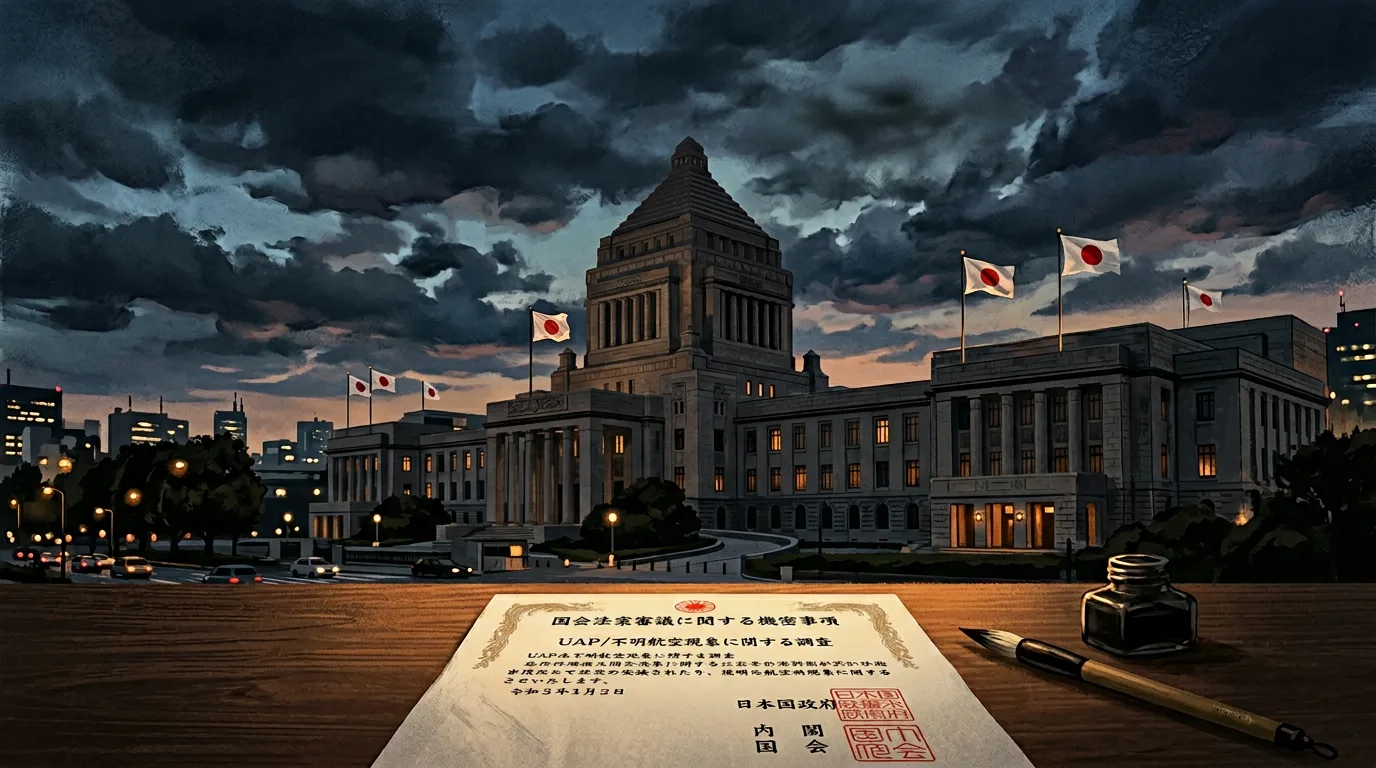
On March 24, 2026, Japan’s bipartisan Parliamentary Group for the Study of Unidentified Anomalous Phenomena from a National Security Perspective announced it will formally propose the creation of a dedicated government body to oversee UAP intelligence. The proposal, to be finalized at the group’s 4th General Assembly on March 30, would place a specialized office directly under the Deputy Chief Cabinet Secretary for Crisis Management – integrating UAP into Japan’s national security apparatus for the first time.
The announcement was made via an official statement posted on X by former MP Yoshiharu Asakawa, the group’s assistant chair, who has been driving parliamentary action on UAPs for several years.
A Direct Response to Trump’s Declassification Order
The parliamentary group explicitly tied its proposal to President Trump’s February 19, 2026 executive order mandating the full disclosure of UAP-related data. Their statement framed the move as an urgent need to keep pace with America’s shift toward transparency:
«As the allied United States charts an unprecedented course toward transparency, the league asserts that the Japanese government must urgently develop information-sharing protocols and build a crisis management framework aligned with international standards to ensure national defense.»
The logic is straightforward: if U.S. declassification releases data that includes joint operations, shared intelligence, or incidents in Japanese airspace, Tokyo needs its own framework to process, verify, and respond to that information. Being caught unprepared by an ally’s disclosures would be a strategic embarrassment.
The Genkai Nuclear Power Plant Incident
A key catalyst for the proposal is an ongoing investigation into a UAP incident near the Genkai Nuclear Power Plant in Saga Prefecture. Unidentified luminous objects were observed above the facility, triggering reports from both the plant operator and local police.
The parliamentary group found what it calls “irreconcilable contradictions” between the operational records of Kyushu Electric Power Company and the official explanation provided by the Saga Prefectural Police, which dismissed the objects as a misidentified aircraft. The group views these discrepancies as a serious vulnerability in the security of Japan’s energy infrastructure.
This mirrors a pattern seen globally. In the United States, UAP incursions over nuclear facilities have been documented extensively – from Langley Air Force Base to the recent Barksdale AFB drone swarms. France’s GEIPAN has investigated similar incidents at nuclear sites. Japan’s parliamentary group appears to be drawing the same conclusion that U.S. lawmakers have reached: whatever these objects are, their apparent interest in nuclear infrastructure makes them a security priority regardless of their origin.
From Fringe to Framework
Japan’s path to this moment has been remarkably fast. The parliamentary group was only established in June 2024, chaired by former Defense Minister Yasukazu Hamada with former Environment Minister Shinjiro Koizumi (now Defense Minister) as secretary general.
In its first two years, the group has:
- May 2024 – Launched with bipartisan membership, treating UAPs as a potential national security threat rather than a curiosity
- 2024-2025 – Called for improved information gathering and deeper U.S.-Japan cooperation on UAP intelligence
- March 2026 – Proposed a dedicated government body under the Cabinet Secretariat’s crisis management division
- Ongoing – Investigating the Genkai nuclear power plant incident as a test case
Asakawa told Sentinel News that this is not the group’s first attempt at institutional reform:
«Actually, I already submitted a proposal to the Minister of Defense back in May of last year to establish a specialized department. Unfortunately, we haven’t received a positive response from the Ministry of Defense yet. This time, we are proposing the establishment of an organization within the Cabinet Secretariat. Our perspective is that the government as a whole should address the UAP issue, not just from a national security standpoint, but also from a crisis management perspective.»
The shift from a defense-only approach to a whole-of-government crisis management framework is significant. It suggests the group has concluded that UAP incidents touch multiple domains – defense, energy, civilian airspace, and international intelligence sharing – and cannot be siloed within a single ministry.
International Context
Japan is not acting in isolation. A growing number of allied nations are building or expanding their UAP investigation infrastructure:
| Country | Body | Status |
|---|---|---|
| United States | AARO (DoD) | Operational since 2022; facing congressional criticism |
| France | GEIPAN (CNES) | Operational since 1977; oldest civilian UAP program |
| United Kingdom | MoD UAP Desk | Closed in 2009; no current official program |
| Canada | No dedicated body | Parliamentary questions raised in 2024 |
| Brazil | CBUFO / FAB | Periodic investigations since 1969 |
| Japan | Proposed | Cabinet Secretariat office under proposal |
If adopted, Japan would join the small group of nations with a dedicated government UAP office explicitly tied to crisis management and national security – rather than the science-focused model used by France’s GEIPAN.
What Comes Next
The 4th General Assembly is scheduled for March 30, 2026 at the House of Representatives Members’ Office Building in Tokyo. The proceedings will be streamed live on Niconico News and YouTube Live, with full media access.
The assembly will focus on two priorities: Japan’s security response to the Trump declassification order, and modernizing the country’s UAP reporting and analysis structure.
Japan’s approach is notably measured. The parliamentary group emphasizes that it does not claim to confirm extraterrestrial life. Its framing is purely security-oriented: unidentified objects are penetrating sensitive airspace, official explanations don’t hold up, and the government needs a coordinated response.
That framing – treating UAP as a security problem first and an existential question second – may be exactly the pragmatic approach that gets institutional buy-in where more speculative arguments have failed.
Sources
- Yoshiharu Asakawa (@asakawayosiharu) on X, March 24, 2026 — official announcement
- Sentinel News — “Japan: Lawmakers Push for UAP Investigation Body,” March 25, 2026
- Sankei News — “超党派UAP議連「日本も情報の精査を」,” March 7, 2026
- Reuters — “Japan lawmakers want govt to guard against security risks of UFOs,” May 29, 2024
- South China Morning Post — “Japan sets up parliamentary group to probe UFO sightings,” June 2024