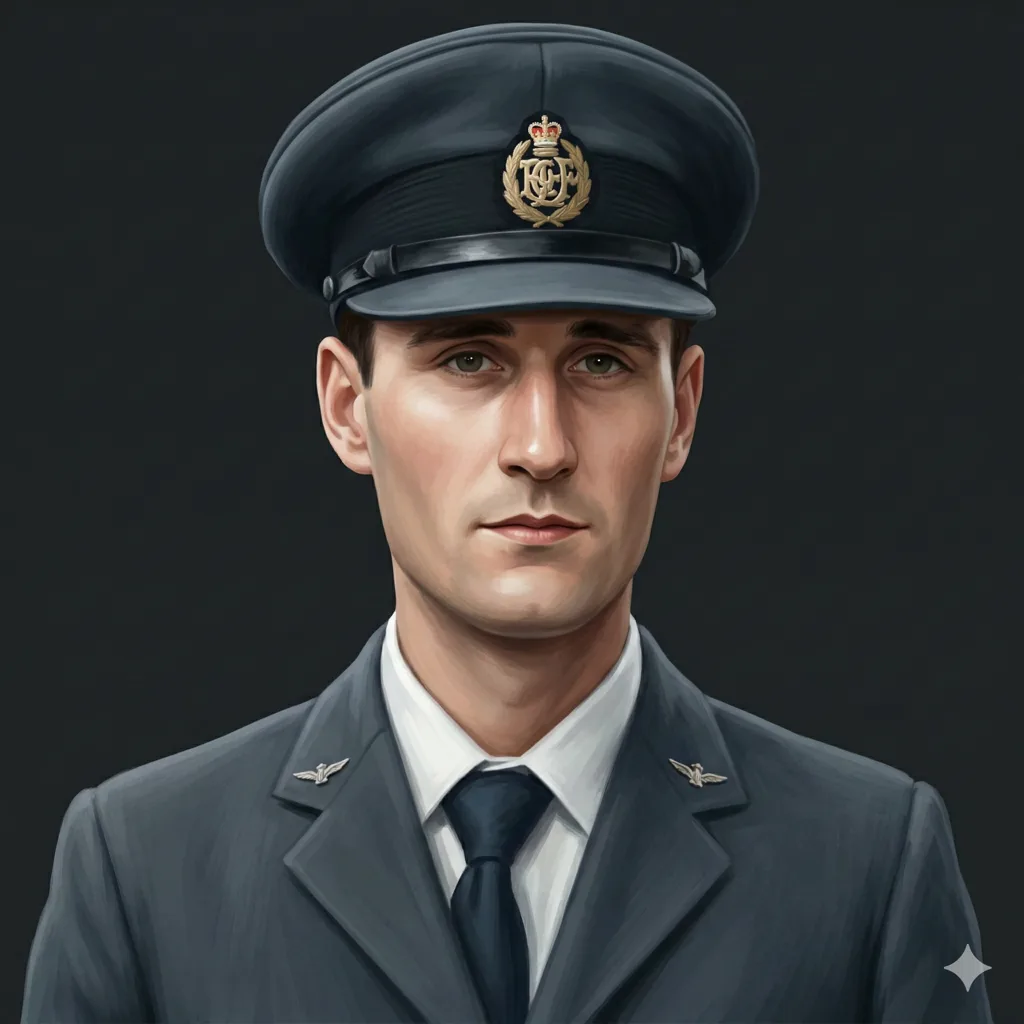
Frederick Paul Valentich
- Date
- October 21, 1978
- Location
- Bass Strait, Australia
- Official Ruling
- Cause unknown – presumed fatal
On the evening of October 21, 1978, a 20-year-old Australian pilot named Frederick Valentich took off from Moorabbin Airport in Melbourne in a single-engine Cessna 182L, registration VH-DSJ, for a routine training flight across Bass Strait to King Island. He never arrived. Over the course of six minutes, Valentich radioed Melbourne air traffic control with increasingly alarmed reports of an unidentified aircraft that was orbiting above him, approaching at speed, and exhibiting flight characteristics unlike any conventional aircraft. His final transmission was cut off mid-sentence by seventeen seconds of metallic scraping sounds. No trace of Valentich or his aircraft has ever been found.
The case is one of the most thoroughly documented real-time UFO encounters in aviation history. The primary evidence is not a witness account recalled after the fact – it is an official air traffic control transcript recorded as the events unfolded. That transcript, along with the subsequent investigation by the Australian Department of Transport, forms the evidentiary foundation of a case that remains open and unresolved nearly five decades later.
Background
Frederick Paul Valentich was born on June 9, 1958, in Melbourne, Victoria. He was the son of Guido and Alberta Valentich. By the accounts of family and friends, he was a young man consumed by two passions: flying and UFOs. He held a Class Four instrument rating and had approximately 150 hours of flight time – enough for a private pilot but well short of a commercial license. He had twice been rejected by the Royal Australian Air Force and had failed five of his initial commercial pilot examination subjects, passing all on subsequent attempts. He was, in other words, an earnest but still-developing pilot.
His interest in UFOs was well known to those around him. He had told his father he had observed a UFO moving rapidly over Moorabbin Airport in the days before the flight. His father, Guido, later told reporters: “He was interested in UFOs, and he told me the last time I saw him he expected to see them on the trip.”1
Valentich filed a flight plan for a direct route to King Island, listing the purpose as picking up passengers – though no passengers were expecting him, a detail that has never been satisfactorily explained. Weather conditions were clear with a trace of cloud at altitude. Visibility was excellent. The sun had set approximately 40 minutes before his departure.
What Happened
The air traffic control transcript – published by the Australian Transport Safety Bureau (ATSB, formerly the Bureau of Air Safety Investigation) in its investigation file V116/783/1047 – records the following sequence, beginning at 7:06 PM local time:
Valentich: “Melbourne, this is Delta Sierra Juliet. Is there any known traffic below five thousand?”
Melbourne: “Delta Sierra Juliet, no known traffic.”
Valentich: “Delta Sierra Juliet. I am – seems to be a large aircraft below five thousand.”2
Over the next several minutes, Valentich reported that the object passed over him at high speed – “at least three times at speeds I could not identify” – and that it was “not an aircraft.” He described four bright lights, and said the object appeared to be “long” in shape. He reported engine trouble – “rough idling” and “coughing” – and then said the object was hovering above him.
Valentich: “It is hovering and it’s not an aircraft.”2
At 7:12 PM, seventeen seconds of unidentified metallic scraping or grinding sounds were recorded. Then silence. Melbourne ATC received no further transmissions from VH-DSJ.
An air and sea search was launched immediately and continued for four days, covering over 1,000 square miles of Bass Strait. No wreckage, oil slick, debris, or personal effects were found. The aircraft’s emergency locator transmitter – designed to activate on impact – was never detected.
The ATSB investigation (file 197802563) was unable to determine the cause of the disappearance. Its conclusion states: “The reason for the disappearance of the aircraft has not been determined.”3
What Doesn’t Add Up
The Valentich case is unusual because the central evidence – the ATC transcript – is not in dispute. It is an official government document, recorded in real time, and publicly available. The question is not whether Valentich said what he said. The question is what he was looking at.
Several alternative explanations have been proposed:
-
Spatial disorientation. Some aviation experts have suggested Valentich became disoriented, mistook celestial objects or ground lights for an aircraft, flew inverted, and crashed into Bass Strait. Spatial disorientation is a documented cause of general aviation accidents. However, Valentich’s communications describe a dynamic object – one that moved, orbited, approached, and hovered – which is inconsistent with a static light source. He also described engine problems, which spatial disorientation does not explain.
-
Staged disappearance. A 1983 report noted that Valentich had expressed interest in “going bush” – disappearing into the Australian outback. Investigators found this theory unconvincing: Bass Strait is one of the most treacherous bodies of water in the Southern Hemisphere, and a Cessna 182 does not have the range to reach any destination that would allow for a staged disappearance from the reported position. No evidence of Valentich alive after October 21, 1978, has ever surfaced.
-
Conventional aircraft encounter. The possibility that Valentich encountered a military or civilian aircraft was investigated and effectively ruled out. No known traffic was in the area. The behavior described – orbiting, hovering, extreme speed – is inconsistent with any known fixed-wing or rotary-wing aircraft of the period.
-
UFO encounter. This is what the transcript describes, and it is what Valentich himself reported in real time to air traffic control. Multiple independent witnesses in the Bass Strait area reported seeing unusual lights in the sky on the same evening. Roy Manifold, an amateur photographer at Cape Otway, captured an image at approximately 6:47 PM showing a fast-moving object exiting the water – an image that has been analyzed but never definitively explained.4
In 1983, an engine cowl flap identified as consistent with a Cessna 182 was found washed ashore on Flinders Island, northeast of the last known position. It was never confirmed as belonging to VH-DSJ.
Key Quotes
“It is hovering and it’s not an aircraft.” – Frederick Valentich, ATC transmission, October 21, 1978, 7:09 PM2
“The reason for the disappearance of the aircraft has not been determined.” – Australian Transport Safety Bureau, Investigation File V116/783/10473
“He was interested in UFOs, and he told me the last time I saw him he expected to see them on the trip.” – Guido Valentich, father of Frederick Valentich1
“Delta Sierra Juliet – that strange aircraft is hovering on top of me again. It is hovering and it’s not an aircraft.” – Frederick Valentich, final substantive ATC transmission2
Sources
- Haines, Richard F. Melbourne Episode: Case Study of a Missing Pilot. Los Angeles: L.D.A. Press, 1987.
- Australian Transport Safety Bureau. ATC transcript, occurrence V116/783/1047, October 21, 1978. Reproduced by UFOR Research.
- Australian Transport Safety Bureau. Investigation file 197802563 (V116/783/1047). Department of Transport, Commonwealth of Australia.
- “The Disappearance of Frederick Valentich.” ABC News Australia, October 21, 2016. abc.net.au.
- “Frederick Valentich.” Wikipedia. en.wikipedia.org/wiki/Frederick_Valentich.