
On the same night that Vice President JD Vance told a podcaster he believes UFOs are “demons”, Bill Maher devoted a segment of Real Time to making the opposite case – and doing it with the kind of clarity that the disclosure community has been waiting to hear from a mainstream voice.
His argument was simple: the evidence has shifted so dramatically that the people still dismissing it are the ones who sound like conspiracy theorists.
“My opinion changes when the information changes.”
’It’s Not Weirdos and Beardos’
Maher opened by acknowledging that the UFO topic used to be easy to laugh off. He’s a comedian. He knows the terrain.
“Yes, there was a time when the only actual contact we heard about aliens was from rural people who had been abducted and anally probed. But you don’t hear about that anymore. Why? My guess is the aliens gathered all the information they needed about us… [and] now they seem to be in a different phase. They seem to want to be spotted. Why else for this constant ‘playing peek-a-boo’ with our military? And it’s serious people [saying this] now.”
Then he pivoted to the evidence – the part that matters.
“They keep seeing things move through air and ocean in ways that defy our physics. Military pilots who say, ‘Yeah, I saw something doing Mach 10, and then it stopped on a dime and disappeared.’ That’s not a drone. That’s not something from another country. Even Elon is like, ‘Not me.’”
The line that landed hardest:
“It’s not weirdos and beardos saying this. It’s guys with buzz cuts and security clearances who are spilling the tea, and politicians who you don’t think are crazy people.”
Maher named names. He pointed to bipartisan interest from Marco Rubio, Kirsten Gillibrand, and Chuck Schumer – who sponsored the UAP Disclosure Act – as evidence that the political establishment is treating this seriously even if the media hasn’t fully caught up.
The Government’s Private Position
The sharpest moment came when Maher drew a distinction between what the government says publicly and what officials acknowledge behind closed doors.
“The government’s official public line is, ‘We don’t know what these things are.’ But, in private, what they say is, ‘No, seriously, we don’t know what these things are, but they didn’t leak from a lab in China.’”
That line captures something the disclosure community has been articulating for years. The All-domain Anomaly Resolution Office (AARO) has catalogued 757 cases it cannot explain. The Pentagon’s own sensors have recorded objects exhibiting capabilities – hypersonic speeds, transmedium travel, no visible propulsion – that no known human technology can replicate. The government isn’t denying the observations. It’s just refusing to say what they imply.
Maher also referenced former President Obama’s comments – “They’re real, but I haven’t seen them” – and noted that Congress has held historic hearings on unidentified aerial phenomena, with military and intelligence witnesses testifying under oath.
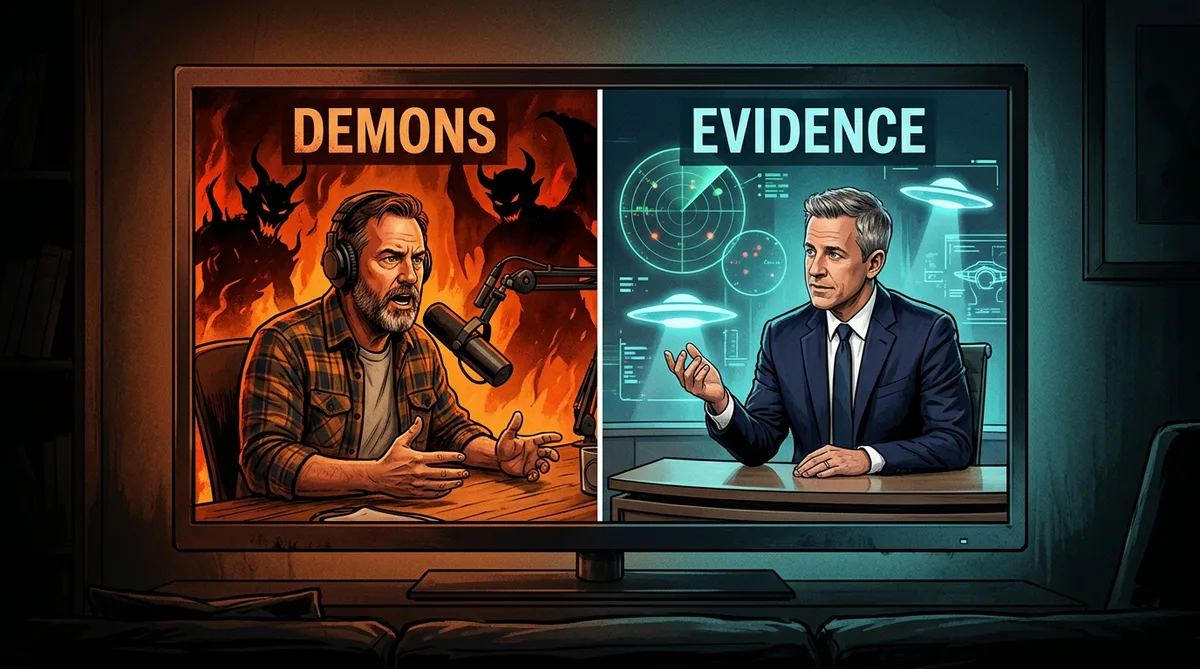
Same Night, Opposite Conclusions
The timing is worth underscoring. On March 27, 2026, two things happened on American television:
On a conservative podcast, the Vice President of the United States said UFOs are demons, framed the entire phenomenon through Christian theology, and suggested that investigating it further was essentially engaging with the devil’s deception.
On HBO, a comedian laid out the military evidence, cited bipartisan congressional action, quoted intelligence officials, and argued that anyone still dismissing the data is the one who needs to explain themselves.
One of these people has the highest security clearance in the country and pledged to “get to the bottom of” classified UFO files. The other is a talk show host. It was the talk show host who engaged with the evidence.
Maher’s Long Road to This Moment
This wasn’t a one-off. Maher has been building toward this position for months.
In January 2026, he devoted an entire episode of his Club Random podcast to UFOs, sitting down with Dan Farah, director of the documentary Age of Disclosure. The conversation – over an hour and twenty minutes – covered crash retrievals, what intelligence officials told Farah on camera about non-human beings, and underwater UAP activity tracked by U.S. submarines.
Maher’s concerns were characteristically idiosyncratic. He worried less about alien intentions and more about first impressions:
“If they do say ‘take us to your leader,’ and that is Donald Trump… I mean, he is the president of America, and that is the leader of the free world. If they’re going to base their ideas about how we all are… There’s a lot there.”
“I wouldn’t want them to think we’re that narcissistic. I wouldn’t want them to think we’re that corrupt.”
In November 2025, Maher featured Farah on Real Time alongside Marjorie Taylor Greene, who said she wanted to know more about UAPs. Maher told his audience flatly: “UFOs are real, and so are the cover-ups.”
And on the March 20, 2026 episode of Real Time – just one week before the UFO monologue – Rep. Anna Paulina Luna appeared as a guest. Luna chairs the Task Force on the Declassification of Federal Secrets and has said the Trump administration is “very serious” about releasing UFO files. Whether that conversation influenced Maher’s decision to devote a segment to the topic the following week is speculation, but the proximity is notable.
Why This Matters
Bill Maher reaches an audience that doesn’t typically follow UAP disclosure. His viewers are politically engaged, culturally literate, and largely skeptical of both conspiracy thinking and institutional obfuscation. When Maher tells that audience that the evidence has crossed a threshold – that the credible witnesses now outnumber the cranks, that the sensor data is real, that the government’s own position is “we don’t know” – it moves the needle in a way that disclosure-focused media alone cannot.
The contrast with Vance makes it sharper. The vice president offered theology. Maher offered evidence. One of them cited the Bible. The other cited military pilots, Senate legislation, and radar returns.
The question for the American public isn’t which framework they prefer. It’s which one holds up when the files – if they’re ever actually released – become public.
Sources: Fox News · Newsweek · Bill Maher Substack · HBO Max