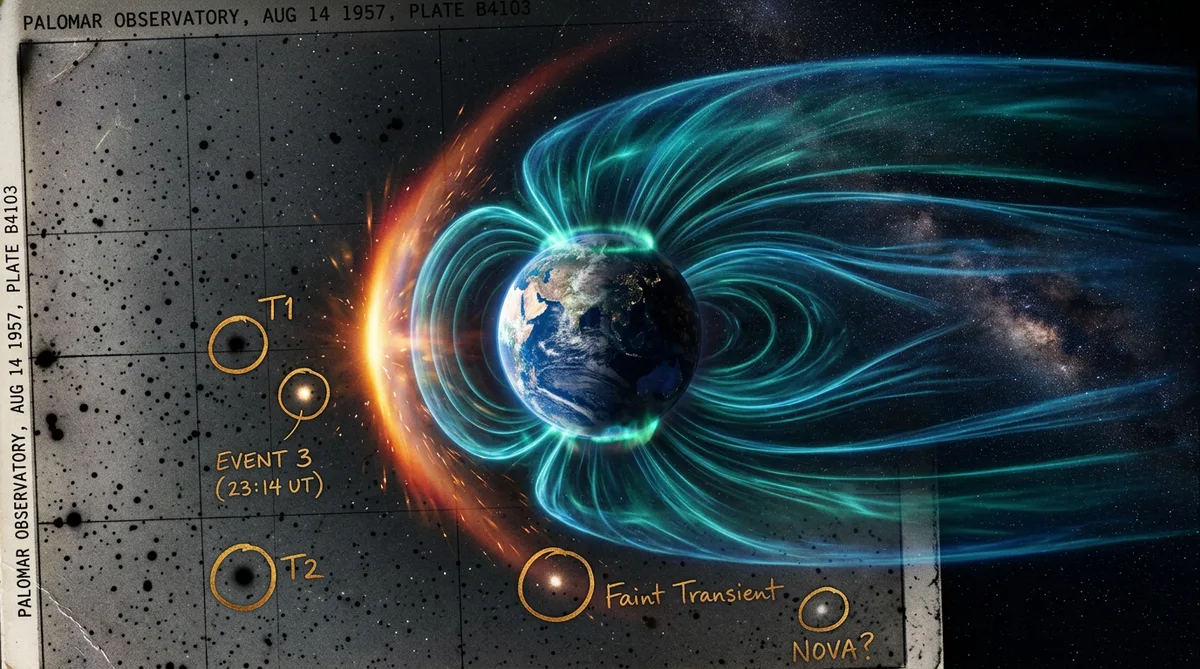
The skeptical explanations for the VASCO transients just got harder to defend.
On April 2, 2026, independent researcher Kevin Cann posted a new paper asking a simple question nobody had thought to ask about the mysterious flashes on 1950s photographic plates: what happens to them during solar storms? The answer blows up the two most common dismissals – cosmic rays and photographic plate defects.
The transients don’t increase during storms. They disappear.
The finding
Cann took the same dataset used by Bruehl & Villarroel in their 2025 paper – 2,718 nights of observations from the Palomar Observatory Sky Survey, covering over 107,000 transient detections on plates shot between 1949 and 1958 – and compared it against historical records of geomagnetic storms.
Scientists measure storm intensity with something called the Kp index – a 0-to-9 scale of how disturbed Earth’s magnetic field is. When the sun blasts charged particles at Earth, the Kp number goes up. Cann sorted every observation night by how stormy the magnetic field was that day, then checked how often the mystery flashes appeared.
The result is a clean staircase down:
| Kp range | Days with transients |
|---|---|
| 0–4 (quiet) | 17.4% |
| 5 (minor storm) | 12.7% |
| 6 (moderate storm) | 8.3% |
| 7 (strong storm) | 5.1% |
| 8–9 (severe storm) | 2.4% |
The statistical significance is strong – p = 0.0007 – meaning there’s less than a 1-in-1,000 chance this pattern is random. The transient rate doesn’t just drop; it drops in lockstep with storm intensity.
Why this matters
Skeptics have offered two main explanations for these flashes: cosmic ray hits on the film and plate defects from handling or processing. Both just ran into a wall.
Cosmic rays. During solar storms, Earth’s magnetic shield gets battered, and more high-energy particles reach the ground. If cosmic rays were causing the flashes, you’d expect more of them during storms. Instead, they nearly vanish.
Plate defects. Scratches, dust, and chemical residue on old film have nothing to do with what the sun is doing. If the flashes were just film damage, they’d show up randomly regardless of storm conditions. Instead, they follow a precise, structured decline.
Neither explanation survives the data. Something real is being suppressed during storms.
The nuclear-test correlation gets stronger
An earlier paper by Bruehl & Villarroel found something strange: the flashes appeared more often on days when nuclear bombs were being tested in the atmosphere. The correlation was suggestive but not rock-solid – 2.6 sigma. Doherty (2026) independently confirmed it with different statistical methods.
Now Cann has added storm activity and moon phase as controls – factors that could have been throwing off the numbers. Instead of weakening, the nuclear-test link gets stronger: from 2.6 sigma to 3.1 sigma (p = 0.002). That means there’s only a 1-in-500 chance it’s a coincidence.
And here’s the kicker: nuclear test days weren’t calmer than average. They were actually slightly stormier. So you can’t explain the nuclear correlation away by saying “those just happened to be quiet days with more detections.” The signal holds up even after accounting for the new variable.
So what are they?
Cann’s interpretation: whatever is producing these flashes is physically affected by conditions near geosynchronous orbit – about 22,000 miles up, where Earth’s radiation belts live. During storms, those belts get hammered with charged particles, and the flashes drop off. That’s what you’d expect if the flashes came from objects up there whose visibility depends on the space environment around them.
This lines up with earlier VASCO findings. Villarroel’s team already noticed that the flashes appear less often in Earth’s shadow – the part of the sky where sunlight can’t reach orbiting objects. If the flashes were film damage or cosmic rays, they’d show up evenly across the plate. They don’t.
Now there are two independent physical clues – shadow geometry and storm sensitivity – both pointing the same direction: a population of objects in near-Earth orbit, behaving like real things in space, not random marks on film.
Open science
Cann published his entire analysis as a downloadable script on the Open Science Framework at osf.io/8ryhk. The data is public. Anyone with basic Python skills can download it and reproduce every number in the paper. That’s how science is supposed to work.
The cumulative picture
This preprint is the latest in a series of independent analyses converging on the same uncomfortable conclusion about the VASCO transients:
- Villarroel et al. (2021) – Nine simultaneous transients on a single 1950 plate, consistent with reflections from flat objects in geosynchronous orbit
- Bruehl & Villarroel (2025) – Transient rates correlate with atmospheric nuclear tests at 2.6 sigma
- Villarroel et al. (2025) – Aligned transients on plates match the signature of tumbling reflective objects crossing the field of view
- Busko (2026) – Independent confirmation from Hamburg Observatory plates: transients are sharper than stars, consistent with sub-second flashes
- Doherty (2026) – Independent replication of the nuclear-test correlation with weather controls
- Cann (2026) – Geomagnetic anticorrelation rules out cosmic rays and plate defects; nuclear signal strengthens to 3.1 sigma
Six analyses. Four independent researchers or teams. Three different datasets. The artifact explanations are running out of room.
Sources
- Cann, K. – “Geomagnetic storm suppression of photographic plate transient detections in the POSS-I archive” (arXiv:2604.04950, April 2026)
- Bruehl, S. & Villarroel, B. – Scientific Reports (2025)
- Villarroel, B. et al. – “Exploring nine simultaneously occurring transients on April 12th 1950” (Scientific Reports, June 2021)
- Busko, I. – “Searching for Fast Astronomical Transients in Archival Photographic Plates” (arXiv:2603.20407, March 2026)
- Open Science Framework reproduction archive (osf.io/8ryhk)
- GFZ Potsdam – Kp index archive