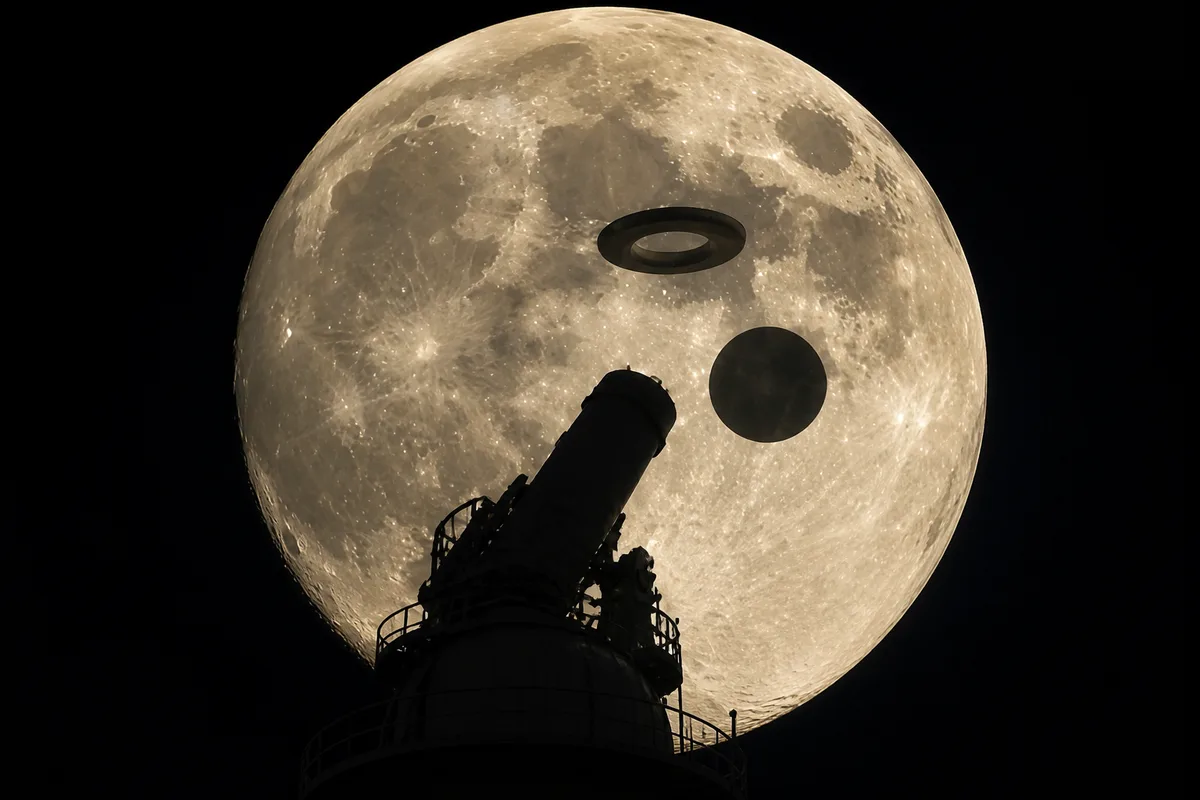
A national space agency’s observatory has pointed a telescope at the Moon, recorded more than twenty objects it cannot explain, measured their size, speed, and rotation – and published the conclusion that the Moon is being used as a base by what it calls a technologically advanced civilisation.
That is not a podcast claim. It is the abstract of a 2026 paper from the Main Astronomical Observatory (MAO) of the National Academy of Sciences of Ukraine – the country’s national observatory – titled UFO Dynamics on the Moon (DOI: 10.13140/RG.2.2.13866.79042), by Boris Zhilyaev, Vladimir Petukhov, and Sergey Pokhvala.
The paper has been circulating quietly since January. A widely shared review thread by Brian Roemmele this week put it in front of the disclosure community. The data deserve the attention.
An Observatory That Has Been Doing This for Years
MAO is not a fringe outfit. It is Ukraine’s primary astronomical institution, founded in 1944, and Zhilyaev is a Doctor of Science with asteroid 14346 Zhilyaev named after him. Petukhov carries an h-index of 9 across conventional astronomy work.
Since 2018, the observatory has run a dedicated instrumental UAP program – the only national-academy program of its kind that publishes its kinematics openly:
- 2022 (arXiv: 2208.11215, 2211.17085) – Two meteor stations 120 km apart, synchronized cameras. They split UAP into “Cosmics” (luminous) and “Phantoms” – dark objects, contrast of only a few percent, with the color characteristics of a near-zero-albedo body: something that does not emit and absorbs almost everything that hits it, visible only because it shields background Rayleigh-scattered light.
- Two-station parallax results – luminous objects at 620, 1130, and 1174 km altitude moving at 78 to 282 km/s, flickering at 10–20 Hz. Their words: “The detection of these objects is an experimental fact.”
- Combat-zone object – a UAP recorded by the Ukrainian armed forces at an estimated 8 km altitude, ~2.5 Mach, roughly 6 km wide and 1.5 km tall.
- Their stated methodology follows Jacques Vallée’s CAIPAN/CNES workshop framework – the same lineage as France’s official GEIPAN program.
Notably, the 2022 papers ended with a disciplined sentence: “The authors do not interpret these objects.” The lunar series – Observations of UFOs on the Moon, Anomalous Phenomena Near the Moon, UFOs on the Moon (2025), and now UFO Dynamics on the Moon (2026) – progressively drops that restraint.
What the Cameras Saw
The observations were made on September 7, 2025 (with supporting data from August 16) from Vinarivka, south of Kyiv, using an Intes-Alter M603 telescope and an ASI 294 Pro camera recording at 20 frames per second – fast enough to catch events ordinary video would miss entirely. Standard bias/dark/flat calibration, MATLAB processing, frame alignment to cancel lunar motion, and a phase-discrimination Fourier technique that uses the Moon’s own global light curve as a reference to reject atmospheric flicker and tracking error.
More than 20 distinct objects appear across the frames, in two classes:
| Class | Behavior | Key measurements |
|---|---|---|
| ”Atmospheric” (anchored) | Hold position to ~1 pixel (0.75 arcsec) across 100-frame sequences | Flashes of 100–500 ms at ~1 magnitude; pulsed few-Hz spectra with harmonics; sizes ~0.3–1.8 km depending on albedo |
| ”Continental” (moving) | Traverse the lunar disc | Discs 25–40 km across; toroids ~36 km; speeds 11–20 km/s; ~1% brightness wobble at 3.0, 4.5, and 6.0 Hz |
The anchored objects are the stranger half of the paper. In several cases, objects separated by tens to hundreds of kilometers show statistically significant correlated brightness changes at 95% confidence – they brighten and dim in sync. Whatever they are, they are not independent.
The Toroid
The continental objects get the most complete analysis. One toroid – doughnut-shaped, roughly 36 km across – was tracked at translational speeds up to 11 km/s. Bright surface features appear to move, implying rotation with a period of about 180 seconds. That yields a centrifugal acceleration of ~2200 cm/s² – roughly twice Earth’s surface gravity.
The authors’ interpretation is blunt: spin-generated artificial gravity. A rotating station does not need to explain why it rotates.
Equally strange is the photometry. The toroids’ albedo is ~0.061 – nearly identical to the lunar surface – and their residual intensities are consistent across red, green, and blue channels. They absorb rather than emit. In color and brightness they are, in the authors’ words, “virtually indistinguishable from the Moon.” If these objects are real, they are camouflaged against the lunar background – which would explain why decades of lunar photography have produced so little.
From “We Do Not Interpret” to “Technologically Advanced Civilisation”
The paper’s closing claims, in the authors’ own words:
“UFOs are observed on Earth and in near-Earth space. We believe that the Moon serves as a base for UFOs. UFOs can reach Earth in 20 minutes. On Earth, they manifest as UAP phenomena. UFOs demonstrate intelligent behavior and can be regarded as a technologically advanced civilisation.” – Zhilyaev, Petukhov, Pokhvala, UFO Dynamics on the Moon (2026)
At 11–20 km/s, the Earth-Moon transit time checks out arithmetically – roughly 5 to 9 hours at those speeds, faster for the higher-velocity objects in their earlier papers. The 20-minute figure implies the fastest end of their measured range. They are not being poetic. They are quoting their own kinematics.
One honest flag inside their own series: an earlier lunar paper gave a toroid rotation of 157 seconds and 461 cm/s² (~0.5g); the new paper gives 180 seconds and 2200 cm/s² (~2.2g). Whether those are two different objects or refined analysis of one is not stated. And every size and speed estimate carries an explicit albedo assumption – the authors say so themselves.
The Test That Would Settle It
The lunar observations come from a single station. MAO’s atmospheric UAP work is considerably stronger precisely because of its two-station, 120 km baseline – parallax kills the artifact question. The same fix applies here: one additional telescope, anywhere in Europe, pointed at the same lunar longitude on the same night. Correlated detection from two sites would end the debate over instrument artifacts in a single observing run.
That is the experiment to demand – not journal gatekeeping. The Academy has ignored this program for eight years; the data kept coming anyway.
Why It Lands Now
The paper arrives mid-disclosure: PURSUE tranches are releasing orbital footage (the STS-80 drop shows objects in low Earth orbit maneuvering in ways that rhyme with MAO’s near-Earth measurements), Grusch is on Capitol Hill describing four types of non-human intelligence, and the White House Science Advisory Council keeps saying what is missing is exactly this: instrumented, quantitative observation. Ukraine’s national observatory has been producing it – in wartime, on a shoestring – since before any of those efforts existed.
Sources
- Zhilyaev, Petukhov, Pokhvala – UFO Dynamics on the Moon (2026)
- MAO NASU forum – paper announcement
- Zhilyaev et al. – Unidentified aerial phenomena I. Observations of events (arXiv:2208.11215)
- Zhilyaev et al. – Unidentified aerial phenomena II. Evaluation of UAP properties (arXiv:2211.17085)
- Zhilyaev et al. – Observations of variable objects (arXiv:2306.13664)
- Brian Roemmele – detailed review thread
- UFOUAP – Loeb UAP Science Advisory Council
- UFOUAP – PURSUE Release 04: STS-80