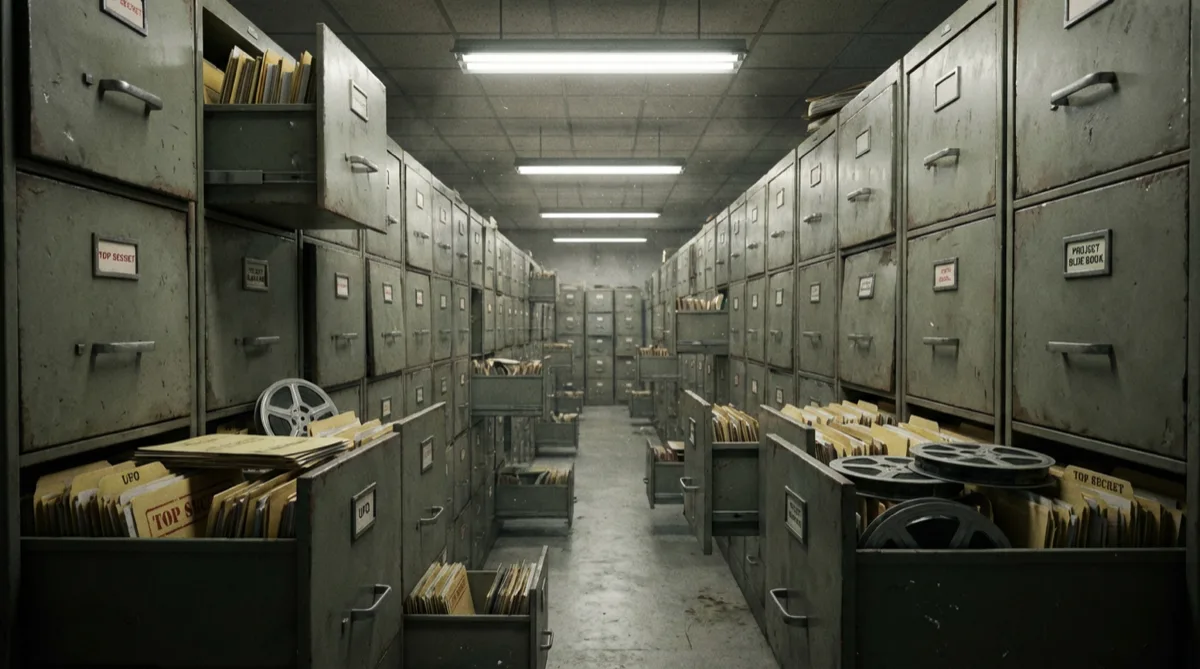
On Monday, George Knapp announced that the Disclosure Foundation has obtained 334 pages of formerly Top Secret UMBRA intelligence reports from the National Security Agency. The documents – which the NSA fought for over 40 years to keep sealed – contain Cold War-era radar tracking data, military intelligence messages, and encounters between fighter jets and unknown objects.
The classification level alone tells a story. Top Secret UMBRA is the NSA’s highest sensitivity marking for signals intelligence. These weren’t routine balloon reports filed in a drawer. They were protected at the same level as the most sensitive intercepts in the U.S. intelligence community.
What the Files Contain
The 334 pages are heavily redacted – the NSA removed dates, locations, and identifying information throughout. But what remains is still extraordinary:
The 13-Fighter Encounter: In one incident, 13 MIG fighter jets were scrambled to chase a single UFO detected on military radar. The aircraft type (MIGs) suggests a Soviet or allied nation, but the NSA redacted the specific country.
MIGs Attacking a UFO: In a separate encounter, six MIGs were dispatched and were seen “attacking said UFO.” The outcome of that engagement is not described in the released portions.
The Star-Shaped Object: Witnesses reported a luminous star-shaped UFO moving “up and down at a fast speed and at a very high altitude,” displaying abilities that made it “impossible to be an aircraft.” The description matches the eight-pointed object captured on radar in a 2013 CENTCOM video released as part of PURSUE.
The Splitting Fireball: One of the last reports describes an “elongated ball of fire” moving in the distance before it split into three separate “balls of fire.” Object-splitting behavior was also flagged by Rep. Burlison in the PURSUE documents as “orbs launching other orbs.”
Silent Craft: Multiple reports describe objects flying without making any noise: “The UFO had two yellow lights, was flying at low altitude, and changed its heading from north to west over this point. No noise was heard.”
23 Soviet UFO Chases: Across the full release, Soviet jets chased 23 UFOs during the Cold War – a systematic pattern of military engagement with unknown objects that mirrors U.S. encounters from the same era.
The 40-Year Legal Battle
The files exist because of a 1980 FOIA lawsuit filed by a citizen group demanding the NSA reveal what it had learned about unidentified objects since World War II.
The NSA fought hard. Chief Policy Officer Eugene Yeates filed classified affidavits with the court arguing the documents needed to remain sealed. The court allowed a summary memo – the Yeates Memo – to be created, but the memo itself remained classified until 2009.
The actual underlying documents referenced in that memo were never released. Until now.
The Disclosure Foundation picked up the case and filed a new FOIA request specifically targeting the “supporting materials” referenced in the Yeates Memo. When the NSA denied the request, the Foundation appealed – and the NSA’s own appeals board ruled the denial was improper and ordered the release.
Hunt Willis, Chief Legal Officer for the Disclosure Foundation, said: “It is simply unacceptable for security classification exemptions to remain on government documents that pre-date the Civil Rights Act. We are committed to having the courts review the legitimacy of these redactions.”
Why Top Secret UMBRA?
The classification is the puzzle. Dozens of the released reports conclude that the objects were “likely balloons” or “unidentified aircraft.” Yet every single one carries the Top Secret UMBRA marking.
If these were genuinely mundane, there would be no reason to classify them at the highest SIGINT level and fight for four decades to keep them sealed. Either the redacted portions contain information far more significant than what’s visible – or the classification itself was designed to prevent public access regardless of content.
Chris Sharp (Liberation Times) called the release “incredible work” and noted that “the NSA plays a major role in the UAP story.”
Context: A Second Disclosure Track
This release is separate from – and complementary to – the PURSUE portal launched by the White House on May 8. PURSUE releases come from the Department of War and AARO. The NSA files come from an independent FOIA effort by a private foundation.
Together, they represent two disclosure tracks operating simultaneously:
- Executive branch (PURSUE) – ordered by the President, managed by the Pentagon
- Judicial branch (FOIA litigation) – forced by nonprofits through the courts
The Disclosure Foundation has indicated it will continue fighting to remove the remaining redactions. The missing information – where these encounters happened, when, and what the government concluded about them – is what would transform these documents from historical curiosities into actionable intelligence.
Sources: