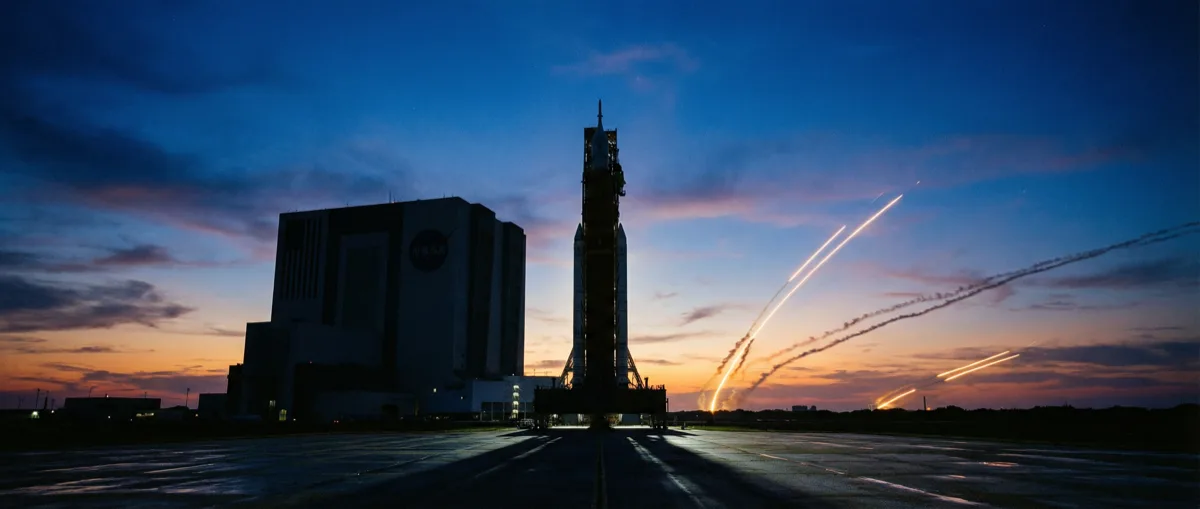
On February 27, 2026, NASA announced a sweeping overhaul of its Artemis lunar program. The agency is adding a new mission in 2027, converting the previously planned Artemis III lunar landing into a low Earth orbit test flight, and pushing the first crewed touchdown on the Moon to 2028 – at least six years after the program’s only flight to date.
Administrator Jared Isaacman framed the changes as a step forward. But the numbers tell a different story – one where the world’s most storied space agency is scrambling to keep pace with companies that didn’t exist when NASA last put boots on the Moon.
What Changed
Under the revised architecture, the Artemis sequence now looks like this:
| Mission | Target | Objective |
|---|---|---|
| Artemis II | Spring 2026 | Crewed lunar flyby – four astronauts loop around the Moon and return |
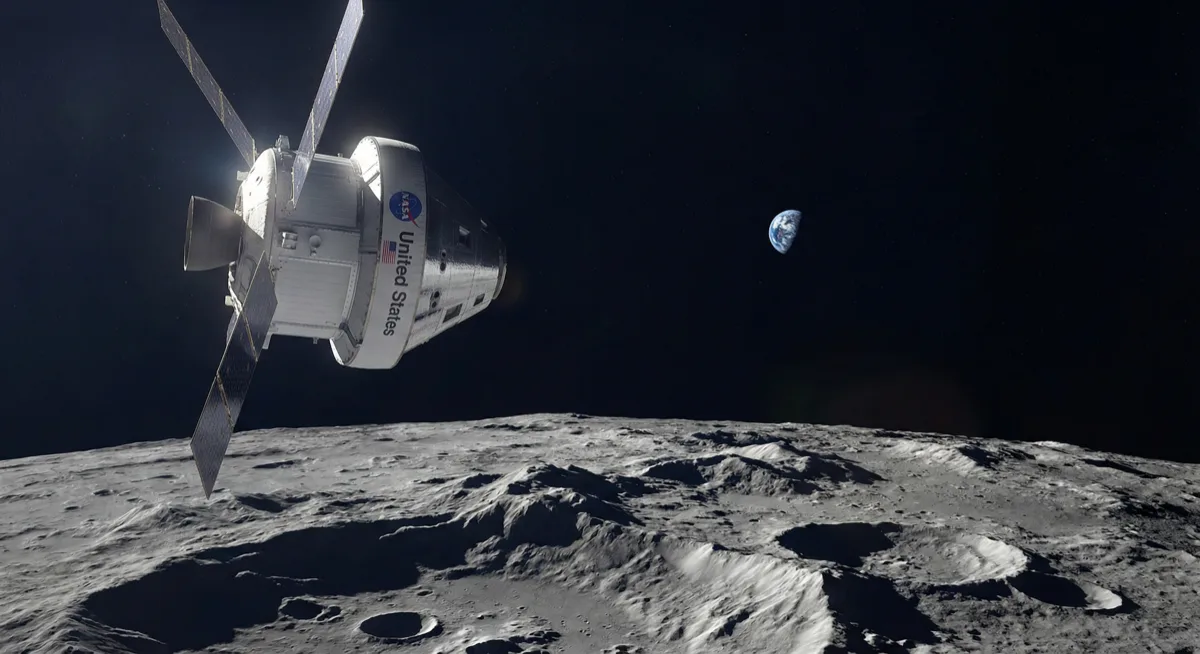
| Artemis III (revised) | 2027 | LEO rendezvous and docking test with commercial lunar landers |
| Artemis IV | 2028 | First crewed lunar landing under the new plan |
| Artemis V+ | 2029– | At least one surface landing per year |
The original Artemis III was supposed to be the landing mission. Now it’s a dress rehearsal in low Earth orbit – a docking and systems checkout with one or both of NASA’s contracted lunar landers (SpaceX’s Starship HLS and Blue Origin’s Blue Moon). NASA also confirmed it is standardizing on the SLS Block 1 configuration and walking away from the planned upgraded upper stage, effectively canceling a Boeing contract for a more powerful variant.
“We’re getting back in the business of launching moon rockets with great frequency. We’re not launching moon rockets every three years after today. We’re going to start launching them every single year.”
– Jared Isaacman, NASA Administrator
The Cadence Gap
Isaacman’s promise of yearly Moon missions is ambitious. But it highlights just how far behind NASA’s launch cadence has fallen compared to the commercial sector.
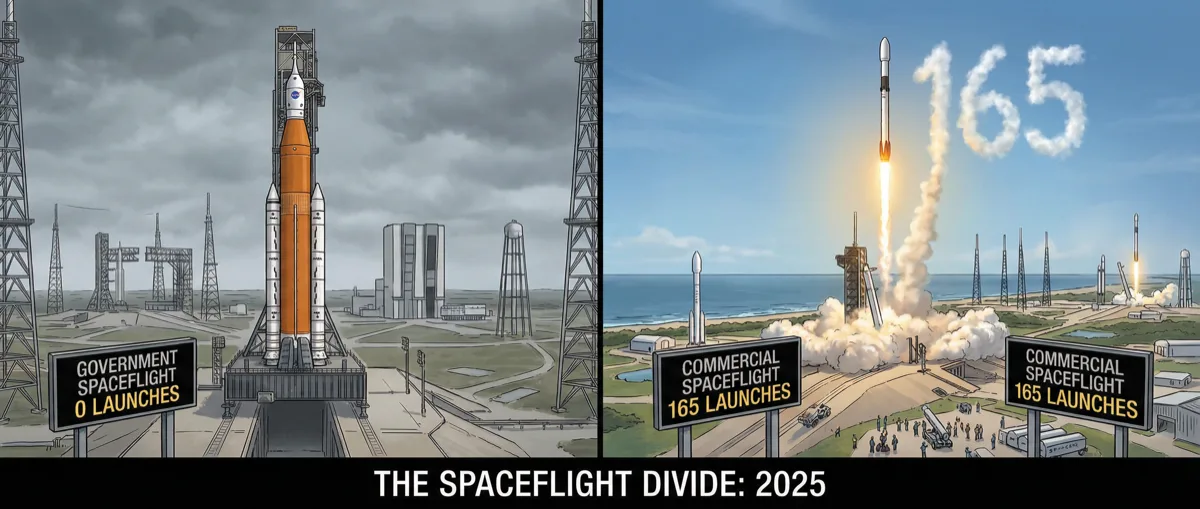
In 2025, SpaceX alone conducted 165 Falcon 9 orbital launches plus five Starship test flights. Blue Origin flew New Glenn twice. Rocket Lab put up 18 Electron missions. Meanwhile, NASA’s SLS – the most powerful rocket ever built – launched exactly zero times.
The sole SLS flight in history was Artemis I, an uncrewed test in November 2022. Over three years later, the rocket has not flown again. Artemis II has been delayed repeatedly; on February 25, 2026 – just two days before the overhaul announcement – NASA rolled the SLS/Orion stack back into the Vehicle Assembly Building to troubleshoot a helium flow issue.
The Cost Problem
The cadence gap is inseparable from the cost gap. NASA’s own Office of Inspector General has estimated the production and operations cost for each SLS/Orion flight at roughly $4.1 billion for the first four Artemis missions. The total projected Artemis campaign spend from fiscal year 2012 through 2025 stands at approximately $93 billion.
For comparison:
| Vehicle | Operator | Est. Cost per Launch | Payload to LEO |
|---|---|---|---|
| SLS Block 1 | NASA | ~$4.1 billion | 95,000 kg |
| Falcon 9 | SpaceX | ~$67 million | 22,800 kg |
| Vulcan Centaur | ULA | ~$110 million | 25,600 kg |
A single SLS launch costs roughly what SpaceX spends on 61 Falcon 9 flights. Even accounting for SLS’s far greater payload capacity – 95 metric tons to low Earth orbit versus Falcon 9’s 22.8 – the cost per kilogram tells the story: approximately $43,000/kg on SLS versus roughly $2,900/kg on Falcon 9.
NASA’s revised architecture tacitly acknowledges this reality. The agency is now leaning harder on commercial lunar landers built by SpaceX and Blue Origin to do the actual work of getting astronauts to the surface. SLS and Orion serve as the crew transport to orbit – while the private sector handles the rest.
Commercial Dominance Is Accelerating
The broader trend is unmistakable. Commercial operators now account for 70% of all orbital launch attempts worldwide, up from roughly 55% just three years ago.
| Year | Global Launches | Commercial | Government | Commercial Share |
|---|---|---|---|---|
| 2022 | 186 | ~102 | ~84 | ~55% |
| 2023 | 223 | 145 | 78 | 65% |
| 2024 | 263 | 182 | 81 | 69% |
| 2025 | 329 | 230 | 99 | 70% |
That trajectory isn’t slowing. SpaceX’s Starship – designed to carry 150,000 kg to LEO, more than any rocket in history – conducted five near-orbital test flights in 2025. Blue Origin’s New Glenn, capable of 45,000 kg to orbit, is ramping up. Both companies are operating at a pace that makes NASA’s goal of one SLS launch per year look modest.
Why It Matters
None of this means NASA is irrelevant. The agency still leads in deep-space science, planetary exploration, and the kind of long-horizon research that no private company has an incentive to fund. The Artemis program, for all its delays, is attempting something genuinely hard – returning humans to the lunar surface for sustained operations, not just a flags-and-footprints visit.
But the overhaul announced today is an implicit admission that the old way of doing business – a government-designed, government-built mega-rocket flying once every few years at billions per shot – cannot keep up. Isaacman, himself a former private astronaut who commanded the Polaris Dawn mission, appears to understand this. The 2027 LEO test mission is designed to wring risk out of the commercial lander systems before betting a landing on them in 2028.
The competitive pressure is real, too. China has publicly stated its goal of landing taikonauts on the Moon by 2030. NASA leadership referenced this directly in the announcement, framing the accelerated cadence as a national priority.
Whether NASA can actually hit yearly landings starting in 2028 remains an open question. The agency’s track record with Artemis timelines – three years and counting between its only flight and the next one – suggests skepticism is warranted. But the direction is clear: NASA is playing catchup, and it knows it.
Revised Artemis Timeline
| Date | Event |
|---|---|
| November 16, 2022 | Artemis I – uncrewed SLS/Orion test flight (only SLS launch to date) |
| January 2024 | NASA delays Artemis II; GAO flags schedule margin concerns |
| December 17, 2025 | Jared Isaacman confirmed as 15th NASA Administrator |
| February 25, 2026 | Artemis II rolled back to VAB for helium flow troubleshooting |
| February 27, 2026 | NASA announces Artemis overhaul – adds 2027 mission, pushes landing to 2028 |
| Spring 2026 (target) | Artemis II – crewed lunar flyby |
| 2027 (target) | Artemis III – LEO rendezvous/docking test |
| 2028 (target) | Artemis IV – first crewed lunar landing |
| 2029+ (goal) | At least one lunar surface mission per year |
Sources: NASA Press Release · Reuters · AP · NASA OIG IG-22-003 · GAO-25-106943 · McDowell – Space Activities 2025 · Fox News Video